


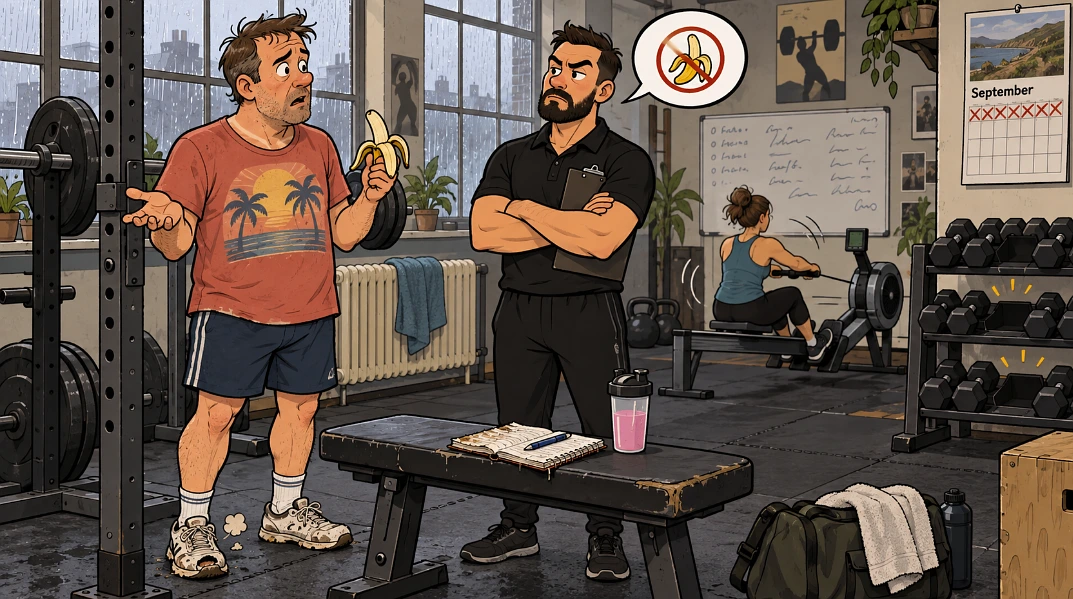
Every September it is the same crowd in my gym and the same conversation with them.
They get back from two weeks away, catch themselves in a hotel mirror somewhere over Alicante, and by Monday they are standing in front of me in trainers that have not left the cupboard since 2019. I book them in, we walk through the programme, and about 10 minutes in the same question comes up that comes up every year.
“So what should I be eating before I train?”
In 11 years of doing this I cannot remember one person opening with “how many sessions did I miss last month?”, and that would have been the more useful question by a mile, but it never comes.
But Dan, surely the food matters? It does, some, and a good deal less than you have been led to believe. My wife Priya has been hearing me say that since about 2018, so often that she now does a passable impression of me telling someone it is not the banana, mate.
What to Eat Before Training, and How Long Before
Carbs are the fuel going in, and the harder the session is going to be, the more they count. If you are lifting heavy, or doing intervals, or booked onto a class where you will be blowing by minute 5, they matter more than they would on an easy day.
That has never meant a plate of pasta before every gym trip though. A normal meal with some carbs and some protein in it has always been enough for most of the people I have trained.
If you are eating 2 to 3 hours out, any of these would do:
- Porridge with fruit
- Toast with eggs
- Yoghurt and berries
- Rice with chicken
If you are closer than that, go small and do not force a whole plate down, a banana, a few dates, toast with honey, whatever your stomach is used to.
Your own stomach knows more about this than any meal plan a stranger wrote, and I say that because I train a bloke called Mark who eats a full English 40 minutes before we lift and has never once flinched. I also train a woman who needs 2 clear hours or she spends the whole warm up feeling queasy and telling me it is my fault. They are the same age and roughly the same build, and their requirements could not be further apart.
So if you want a rule from me it is only that you should turn up fed and comfortable, and whatever gets you there is fine.
Whether You Need a Pre Workout, and How Much Caffeine Is Really In One
Probably not, if you have been eating properly through the day, and most of the people who ask me about it have been.
Where it does earn its keep is a narrower space than the tub would have you think. Early mornings mostly, when you have to be on the floor at 6 and the thought of eating before your eyes have opened is unbearable.
This is also where I watch people do themselves actual damage, because very few of them have turned the tub over before buying it. A typical pre workout supplement carries 150 to 300mg of caffeine a serving, and the shouty ones go north of that, so you would be swallowing 2 or 3 coffees in one go, on an empty stomach, at half six in the morning.
| Source | Caffeine |
|---|---|
| Filter coffee, one cup | 80 to 100mg |
| Espresso, single shot | 60 to 80mg |
| Typical pre workout scoop | 150 to 300mg |
| EFSA single dose guidance | Up to 200mg |
| EFSA daily guidance | Up to 400mg |
When you do the sum, a double scoop has spent your sensible single dose before your first proper coffee of the day has even been poured.
And it hangs about as well, because the half life is roughly 5 hours, so whatever went in at 6 in the evening is still half present at 11 while you are lying there working out why sleep will not come. I could not tell you how many clients have said to me that their sleep had fallen apart. When I have asked what time they train and what they take, the answer has come back the same every time, half six and a double scoop. One bloke had his dose halved and his sleep had come back inside a week, and his training had not moved an inch.
And remember more caffeine is not more workout, clear this in your mind.
Read the number on the back of the tub before you read anything on the front of it, and if the dose has been hidden inside a proprietary blend, put it down. Something gentler, a watermelon pre workout for instance, goes down easier at 6 in the morning when food repels you and all you want is something cold in your hand.
What to Eat After Training
Your post training meal should look like any other decent meal you would cook for yourself, and I know that disappoints people. It wants protein in it, and some carbs if the session actually spent something, and that is about the extent of the science.
- Chicken with sweet potato
- Eggs on toast
- Salmon and rice
- Greek yoghurt with fruit and honey
No food gets better because you have just finished squatting, and if someone is selling you a special post workout food category then what you are hearing is a sales pitch.
Whether the Thirty Minute Window Is Real
It has been taken far more seriously than it ever deserved, and I would put most of that down to a decade of supplement advertising. If you ate beforehand, your body is still working through those nutrients while you are racking the bar, so nothing has reset to zero, and a balanced meal in the next couple of hours will see you fine.
It does matter if you trained fasted, or if another hard session is coming later in the day, or if nothing is going to be eaten for the next 6 hours. If none of those apply to you then there is no reason to be jogging to the changing room with a shaker in your hand.
When Protein Powder Is Actually Worth Using
Powder covers the days when cooking is not going to happen, when you are going straight from the gym to work, or you have an hour on a train ahead of you, or the kitchen will not be seen until 9.
This is the job of the powder. I would argue that is the whole of its job.
Something like Naked Whey will get whey into you when a pan is out of the question, though it has never replaced a varied diet and I have not seen it beat eggs, dairy, meat or fish for anyone. What it is, is easier on certain days, and choosing something because it keeps your routine alive is a perfectly good reason to choose it.
Aim for 20 to 40g in that meal, scaled to your size. If you are getting that consistently across the week you have already done better than the person who hits an exact number after every session and then misses it completely on the days they do not train.
Which Foods Sit Badly an Hour Before You Train
Fat and fibre, mainly, because both of them digest slowly. Fried food, a mountain of salad, beans and whole grains are all fine at other hours of the day and all fairly miserable 60 minutes before you run.
Portion size will do the same thing to you, and I have yet to meet the person whose Tuesday gym session was improved by carb loading for it.
Do you fade halfway through? If you do, eat something beforehand next time and see what changes, because that experiment is going to teach you more about your own body than I can from the other side of the rack.
The Five Habits That Change People Faster Than Their Diet Does
If I could pick what people asked me in September it would be this list, because the difference gets made here and food barely features in it.
- Turning up beats intensity. Three honest sessions a week for a year will get you further than 6 savage weeks followed by nothing, and I have watched that play out so many times that it has stopped being interesting.
- Write down what you lifted. A notebook does it, no app needed. The ones who track add weight because they can see what they did last week, and the ones who guess end up repeating February’s session in August and wondering where the progress went.
- Do the boring lifts. Squat, hinge, push, pull, carry something heavy, and if you look around any gym the person progressing fastest is usually the one running the dullest programme in the building.
- Sleep is the one everyone would rather leave unmentioned. If you are getting 5 hours a night then there is no programme I could write that would out-train it.
- Two resistance sessions a week is the actual national recommendation, which was never written as a bodybuilding target, and most people I meet are nowhere near it.
How to Eat Around a Morning, Lunchtime or Evening Session
Nothing clever, and it should not need to be.
If you train at lunch you might eat breakfast at 7, something small at half twelve if hunger has arrived by then, and then lunch afterwards with protein and carbs on the plate. An evening session runs to the same shape shifted a few hours along.
Mornings are the awkward one and it depends entirely on you. If you wake up hungry, have a banana, and if you cannot face food at 6 without feeling ill, train empty and eat properly after, because that is where about half my early crowd have landed and stayed.
What Matters More Than Any of the Timing
Whether you are eating enough at all, and I know that is less exciting than people want it to be. Enough protein, enough carbs, enough water, and enough energy for what you are asking your body to do, and everything I have written above this heading is fine tuning on top of that.
September is as good a month to start as any. Book the sessions in, and put a notebook in the bag with your trainers.