


Irish residents took 3.1 million overnight trips abroad in the first quarter of 2026, up 5% year on year, according to the CSO’s Household Travel Survey published on 16 June. Holiday was the purpose of 56% of them, and the Canary Islands topped the destination list for the quarter.

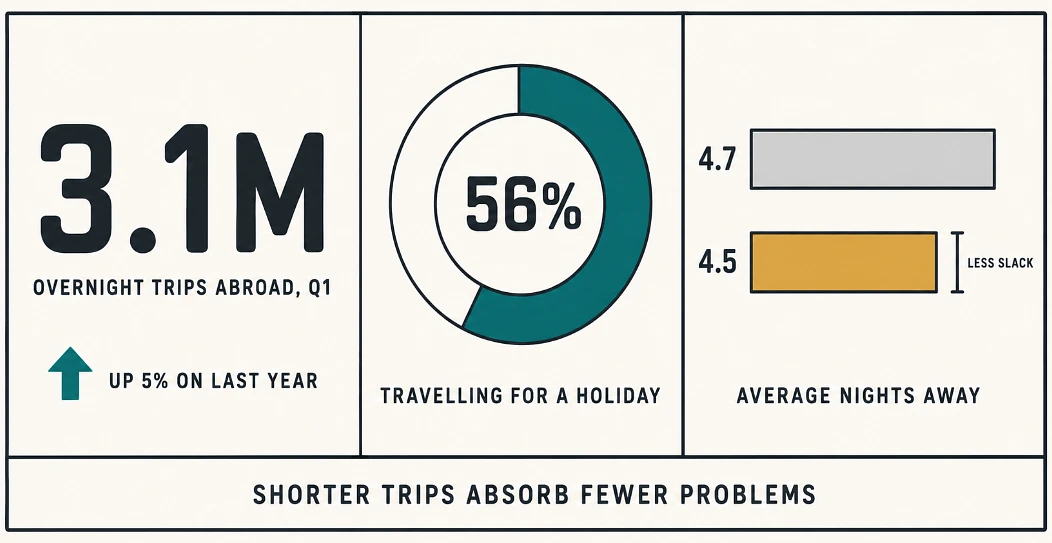
Trips are also getting shorter, with the average stay abroad falling from 4.7 nights to 4.5. Less slack in a trip means less room to absorb a problem.
What an Irish Passport Holder Actually Needs
Less than most checklists suggest.
The Schengen rule requiring three months’ validity beyond your departure date applies to non-EU nationals. As an EU citizen you are not subject to it. Your passport needs to be in date and undamaged.
There is a second document worth knowing about. The Irish passport card costs €35, or €25 if you apply alongside a passport book, and runs for five years or until your book expires, whichever comes first. It is valid across all EU member states, Iceland, Liechtenstein, Norway, Switzerland and the UK.
Two conditions on it. You can only get one if you already hold a valid passport book, and processing through Passport Online takes 8 to 10 weeks, which makes it the slowest application type they run. Not something to order the month before flying.
The New EU Border Systems and Whether They Apply to You

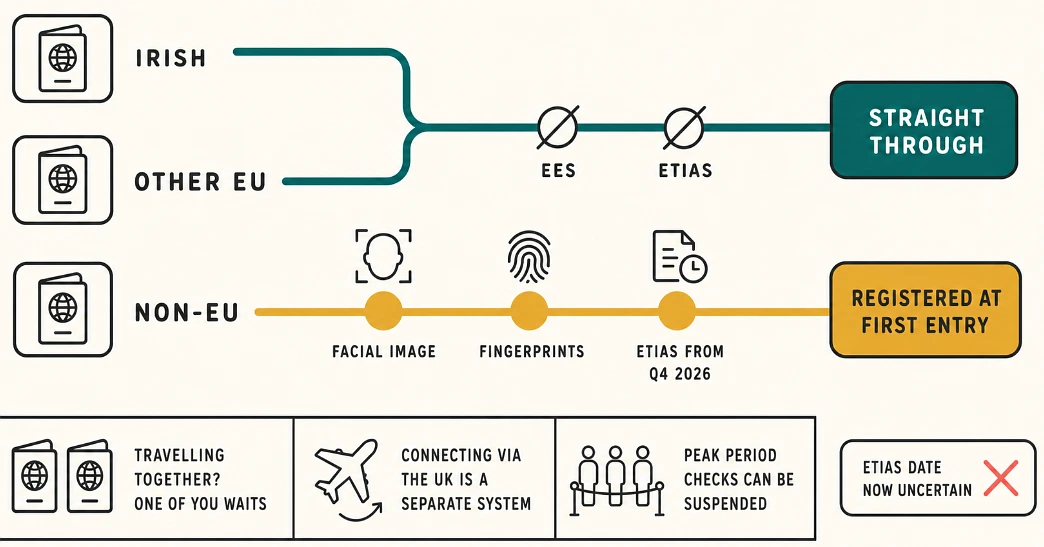
They do not, and that is the short answer.
The Entry/Exit System became fully operational across all 29 Schengen countries on 10 April 2026, following a phased rollout that began on 12 October 2025. It replaced passport stamping with a digital record, capturing a facial image and fingerprints at first registration.
ETIAS is expected in the final quarter of 2026, priced at €20, valid for three years or until the passport expires. Travellers under 18 and over 70 are exempt from the fee. Most applications are approved within minutes, though some take up to 30 days for further review.
Both systems target non-EU nationals. Irish passport holders sit outside both, and are also exempt from the UK’s ETA requirement.
Where it still reaches you
Three situations bring it back to your door.
Travelling with someone on a British, American or Australian passport means one of you registers biometrics and the other walks through, so allow for the wait rather than discovering it at midnight in Alicante. Connecting through a UK airport moves that leg into a different system. And anyone in your group arriving in Schengen for the first time since the transition ended will be doing the full registration.
There is a queue issue that ignores what passport you hold. The EU has kept the option for member states to partially suspend EES checks during exceptional peak periods, which tells you what the pressure has been like. For non-EU travellers in your party, the EU’s Travel to Europe app allows pre-registration of passport data and a facial image within the 72 hours before reaching the border. It is optional, and not yet live everywhere, but it moves people through faster where it is running.
EHIC and Travel Insurance Do Different Jobs

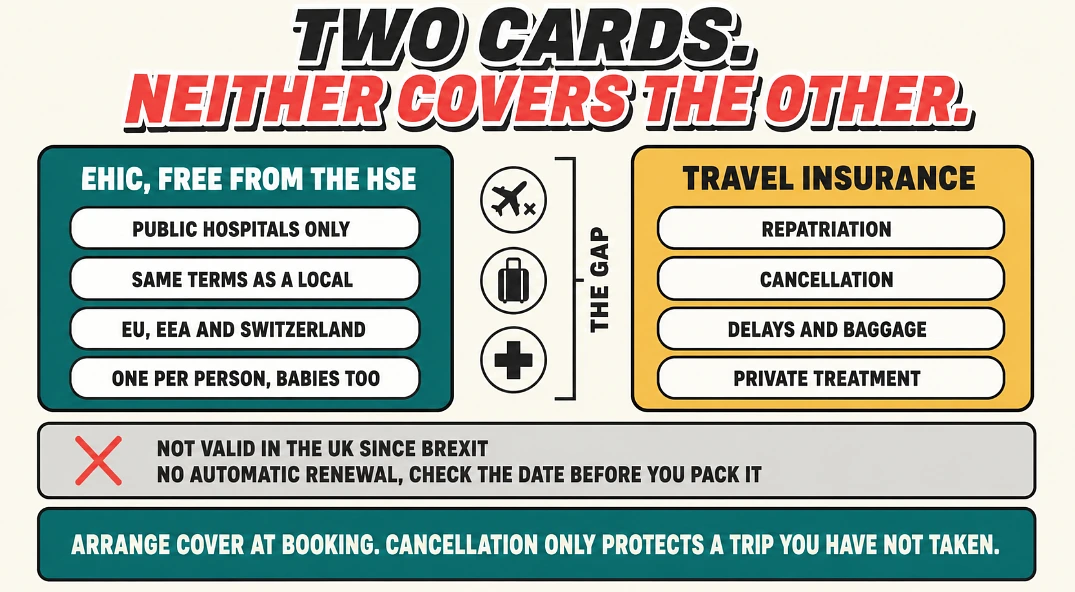
Irish residents use the European Health Insurance Card, applied for through the HSE. Not the GHIC, which is the British equivalent and appears in a lot of travel advice written for a UK audience.
The card is free, applied for online at HSE.ie, and there is no charge from any official channel. Apply and the digital version appears in the HSE Health App immediately, with the physical card arriving by post within about 10 working days. If you are travelling sooner, the HSE can issue a digital certificate valid for three months.
Each family member needs their own card, including babies. There is no automatic renewal either, so an expired card sitting in a wallet is worth checking before you pack it.
What it covers: medically necessary treatment from public healthcare providers in the EU, EEA and Switzerland, on the same terms as a local resident. What it does not cover: private healthcare, planned treatment abroad, and repatriation. It is also no longer valid in the UK since Brexit.
Organising your travel insurance covers the gap between those two lists, which in practice is repatriation, cancellation, delays and lost baggage. Arrange it at the point of booking rather than the week of departure, since cancellation cover only protects a trip you have not yet taken.
Two things to check on any policy. Whether the medical excess applies per person or per claim, and whether the activities you actually intend to do, hiring a scooter in Greece being the usual one, sit inside the cover or outside it.
Cards and Payments
- Check what your bank charges for card use in the eurozone. Revolut, N26 and a standard AIB or Bank of Ireland debit card all behave differently abroad.
- Carry a second payment method, stored somewhere separate from the first.
- When a card terminal offers to charge you in euro or in “your home currency”, always choose the local currency. Dynamic currency conversion costs a few percent every time you accept it.
- Keep copies of your passport, bookings and insurance policy in your email rather than only on your phone.