


The Short Answer (For Readers in a Hurry)
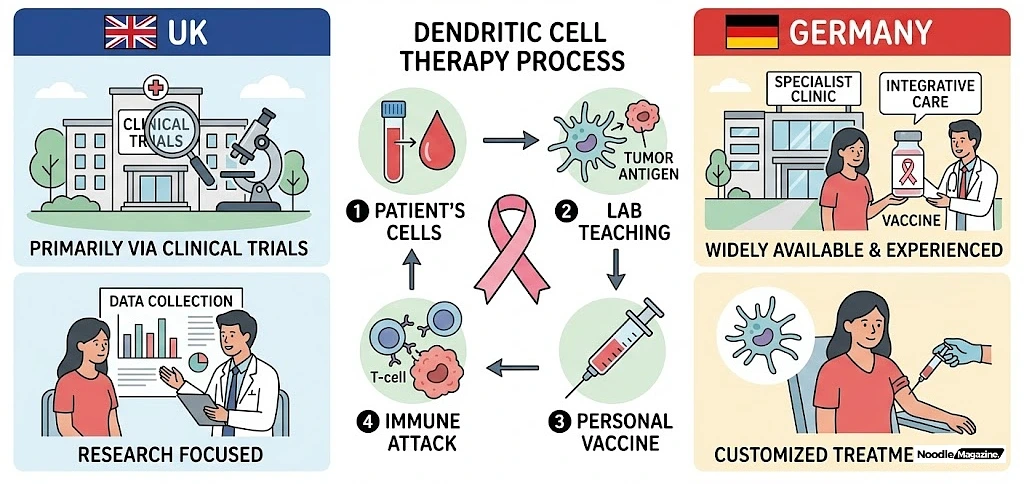
When you are looking to get dendritic cell therapy to treat breast cancer in Britain and just keep getting dead ends – you are not dreaming. The nurse team of Macmillan Cancer Support has made a simple declaration that dendritic cell treatment is not currently a standard treatment of cancer in the UK, and access to clinical trials is restricted. Legally, the same treatment is provided in Germany, at special clinics via a regulatory route known as the Hospital Exemption (4b AMG), which is managed by the Paul-Ehrlich-Institut.
So who’s actually further ahead? Honestly — it’s not that simple, and this article breaks down why.
First, What Even Is Dendritic Cell Therapy?
The intelligence officers of the immune system are the dendritic cells. They locate threats, research them, and train the attack squad (your T-cells) as to what to go after.
With dendritic cell therapy, the doctor will use a sample of your blood, extract your dendritic cells, and in a laboratory, they are trained to identify your unique tumour markers, and then they are injected back into you. The concept: your immune system now has the specifics on what breast cancer cells should look like – and attacks them.
Science fiction, but Ralph Steinman, who has just won the 2011 Nobel Prize in Physiology or Medicine, has found out how these cells actually work. It is a factual science. It is not so much whether it is reliable in curing breast cancer, but it becomes tricky.
UK vs Germany at a Glance
| What you want to know | 🇬🇧 United Kingdom | 🇩🇪 Germany |
|---|---|---|
| Available on NHS? | No | No (but private access is straightforward) |
| Regulatory status | Experimental / trial-only | Legal via Hospital Exemption (§4b AMG) |
| Regulator | MHRA + NICE (evidence-first) | Paul-Ehrlich-Institut + EMA |
| Access route | Mostly clinical trials | Private clinics + some trials |
| Typical cost (private) | Rarely offered; £20,000+ when it is | €24,000–€65,000 per programme |
| Specialist ecosystem | Small, research-led | Large, clinically active |
| Waiting time | Trial enrolment dependent | 1–2 weeks after consultation |
Why Britain Says “Not Yet”
UK is not trailing behind due to a lack of science. It is lagging behind due to the way the NHS and NICE determine what should be approved.
NICE just greenlights those treatments whose clinical trial phase 3 data is solid, demonstrating an improvement over the already standard. And the fair verity? Dendritic cell therapy of breast cancer is yet to pass that hurdle.
See evidence in “Immunotherapy in breast cancer: an overview of current strategies and perspectives, npj Breast Cancer, 2023. Phase 1 and 2 trials indicated immune activity, but a Phase 3 trial of the E75 breast cancer vaccine was prematurely term Ouch.
This is why Macmillan is taking a wary stand. British scientists do not necessarily believe in the technology; the NHS is already conducting DC research (the UK Health Research Authority has records of approvals to use iPSC-derived dendritic cells trials). They simply are not going to roll it out as a matter of course until the data has been made airtight.
The UK strategy = wait until it is proved. The slower, yet safer to the taxpayer.
Why Germany Can Just… Offer It
Germany has a legal route through which Britain does not follow: the Hospital Exemption in the German Medicines Act of 1993, the German law of which is found in section 4b AMG.
This is what that is in simple English. The EU regulations (Regulation 1394/2007) require cell therapies to typically have complete EU-wide marketing approval prior to being sold by anyone. However, the Hospital Exemption permits individual clinics to prepare a customised cell product on a case-by-case basis to a single identified patient under strict supervision – without awaiting complete approval.
This pathway is regulated by the Paul-Ehrlich-Institut (the federal organ of biological medicines in Germany). Clinics are required to be of GMP quality, licence fees range between €4,250 to 17,000 and each batch is monitored. Authorisation of ATMP, as per Section 4b AMG
The German method = prepare it legally now, continue gathering data. Quicker access, risk transference to the patient (and his wallet).
What the Actual Evidence Looks Like
Let’s be straight with you. Here’s what dendritic cell therapy for breast cancer can and can’t claim:
What research genuinely supports:
- Dendritic cell vaccines can trigger measurable immune responses in breast cancer patients (per the ScienceDirect review “Dendritic cell vaccines in breast cancer: Immune modulation and immunotherapy,” 2023
- DC therapy has been combined with checkpoint inhibitors and HER2/HER3 targeting in trials for triple-negative breast cancer with brain metastases
- Side effects are typically mild — flu-like symptoms, fatigue, compared to chemotherapy
What the evidence does not support:
- Claims that DC therapy “cures” stage 4 cancer
- Specific “success rates” like “50–65% effectiveness” you’ll see on clinic marketing pages (these numbers rarely come from peer-reviewed trials)
- That it replaces surgery, chemo, or radiotherapy
For most breast cancer patients, DC therapy is currently an add-on or last-line option when standard treatments have been exhausted — not a first choice.
If you’re weighing this option seriously, this deep dive on dendritic cell therapy for breast cancer walks through stage-specific scenarios, German clinic protocols, and what to realistically expect.
The Money Question
Nobody loves this part, but here we go. Costs vary wildly depending on what’s included, the clinic’s reputation, and whether you bundle in hyperthermia, viral therapy, or checkpoint inhibitors.
Real German clinic figures (2025–2026):
- Prof. Gansauge’s LDG clinic (Berg): approximately €24,000 for a standard DC therapy programme
- Combination programmes (DC + Newcastle virus + hyperthermia): €45,800 to €155,000 (source: Surgical Experts clinic listings)
- Full multi-cycle programmes for advanced cases: up to €270,000 for intensive protocols
- Single DC vaccination dose: around €18,000 (but rarely given as a standalone treatment)
UK private context: When DC therapy is available via UK private cell therapy groups, pricing is similar or higher, but choice and specialist depth are limited.
NHS cancer care, by contrast, costs the patient nothing out of pocket — but won’t include DC therapy.
Who Are the Specialists?
Germany has a depth of doctors actively practising DC immunotherapy that the UK simply doesn’t match. A few of the most-referenced names:
- Dr Thomas Neßelhut runs the Institute for Tumour Therapy in Duderstadt, widely recognised for personalised dendritic cell protocols including cases involving breast cancer. International patients frequently consult Dr. Thomas Neßelhut when evaluating whether this approach fits their diagnosis.
- Prof. Frank Gansauge — oncology surgeon turned immunotherapy specialist; his Berg clinic has run over 2,500 LANEX-DC® treatment courses
- Prof. Jaroslav Michálek (Czech Republic) — active in cell therapy research and clinical practice across Central Europe
The UK’s strongest credentials are in research institutions — the Francis Crick Institute, UCL Cancer Institute, and NHS-linked trial centres — rather than front-line clinical DC delivery. Different strengths, different priorities.
So Who’s Actually “Doing Better”?
Honest answer: they’re solving different problems.

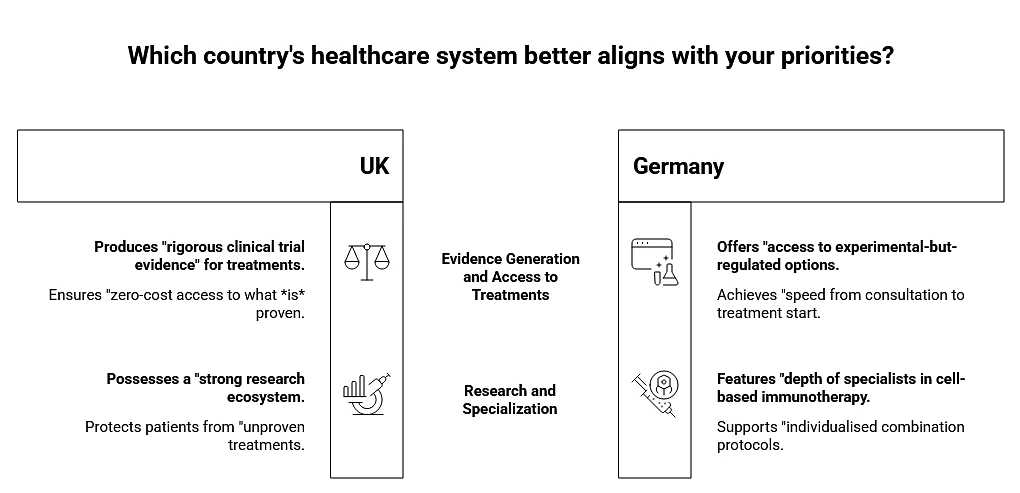
🇬🇧 Britain is better at:
- Protecting patients from unproven treatments
- Producing rigorous clinical trial evidence
- Zero-cost access to what is proven
- Strong research ecosystem
🇩🇪 Germany is better at:
- Giving patients access to experimental-but-regulated options
- Speed from consultation to treatment start
- Depth of specialists in cell-based immunotherapy
- Supporting individualised combination protocols
If you want certainty and aren’t willing to pay privately, the UK’s system serves you well. If you’ve exhausted standard options and want to try something promising-but-not-yet-proven, Germany has the legal infrastructure to make it happen quickly.
Neither country is wrong. They’re just answering different questions.
FAQ
Can I get dendritic cell therapy on the NHS?
No. Per Macmillan Cancer Support, it’s not a standard NHS treatment. You can ask your oncologist about active clinical trials via the Cancer Research UK or ClinicalTrials.gov databases.
Is Germany’s version FDA-approved or EU-approved?
No fully approved, off-the-shelf DC vaccine exists for breast cancer in Europe or the US. Germany’s Hospital Exemption lets clinics legally make it for individual patients — it’s regulated, but not the same as a fully licensed drug.
Is travelling to Germany safe and legal for UK patients?
Yes. Post-Brexit, Britons can travel to Germany privately for medical care. You pay out of pocket (not NHS-funded) and should confirm travel insurance covers overseas medical treatment.
How long does treatment take?
The actual lab preparation is about 7 days. The full programme — consultation, blood collection, vaccine prep, administration, follow-up — usually spans 9 days to a few weeks of in-person time, plus remote follow-up.
What’s the catch?
Honestly? Cost, and the fact that it isn’t a guaranteed cure. Anyone who promises otherwise is overselling. It’s a legitimate additional option — not a miracle.
Bottom Line
If you’re a UK reader trying to understand whether Germany is genuinely “ahead” on dendritic cell therapy for breast cancer, yes and no. Germany is ahead in access. The UK is ahead in evidence standards. Whether you prioritise one over the other depends on where you are in your treatment journey, what your oncologist recommends, and what you can realistically afford.
The best advice anyone can give: don’t rush this decision, don’t believe marketing pages claiming magic success rates, and always loop your NHS oncology team into any decision before paying for treatment abroad.