



Between 2020 and the start of 2026, borrowing in the UK got weird. That’s the simplest way to put it. Interest rates dropped to the lowest they’d been in over three hundred years of the Bank of England’s existence, then rocketed to a 16-year high inside about 18 months, and have been slowly coming back down ever since. If you took out a mortgage in early 2021, you got a deal your parents would’ve killed for. If you did the same thing in late 2023, you probably felt sick looking at the monthly repayments.
And what happened in the middle — lending to a pandemic, that shock of inflation, the hike rates violently — crammed into a tiny window what should be an entire cycle. It restructured both how much people owe, and how much they pay for it, and how they even think about borrowing in the first place.
The base rate — where everything starts
The Bank of England base rate is the number that drives basically all borrowing costs in the UK. Your mortgage rate, your personal loan APR, your credit card interest — they all trace back to it, directly or indirectly.
March 2020. COVID hits. The Bank panics — fairly, to be honest — and cuts the rate to 0.1%. That’s the lowest in the institution’s entire history, going back to 1694. Money is essentially free. And it stays that way for nearly two years, right through to December 2021.
Then inflation turns up. Not gently. CPI blows through 11% by end of 2022 — energy prices, supply chains, the war in Ukraine coming at once. The Bank’s reaction to that has been fourteen straight hikes. Its target for the federal funds rate was 0.1% in December 2021 and would be at the level of 5.25% by August 2023. If you’re keeping score at home, that’s a fiftyfold increase in less than two years.
5.25% kept for a complete 12 months. The first of them came in August 2024, and six others have followed. The latest count, as of February 2026, is 3.75%. Before Thursday, the message from the incoming administration was that house prices were way across their equilibrium value, and we’d wind up regretting all those increases in home equity. Inflation stood at 3.4% in December 2025 — higher than the Bank’s own 2% target but moving broadly in the right direction, and most analysts believe there will be more cuts in store through to 2026.
| Year | What happened to the base rate | Why |
|---|---|---|
| 2020 | Slashed from 0.75% to 0.1% | COVID emergency |
| 2021 | Sat at 0.1% until December, then bumped to 0.25% | Inflation brewing |
| 2022 | Rose from 0.25% to 3.5% | Inflation heading for 11% |
| 2023 | Hit 5.25% in August, stayed there | Peak — 16-year high |
| 2024 | Held until August, two cuts brought it to 4.75% | Inflation cooling, easing begins |
| 2025 | Multiple cuts through the year | Continued gradual reduction |
| 2026 | 3.75% as of February, held | More cuts expected |
Mortgages got cheap, then got brutal, then calmed down
Mortgage debt is the big one. Households’ outstanding residential mortgage debt in the UK reached £1,678 billion by the end of 2024 — a record high.
The pandemic turned out to be a boom time for mortgage borrowing, oddly enough. Near-zero rates and the stamp duty holiday, and all of a sudden, everyone was buying, or upgrading or remortgaging at once. Right now, new mortgage lending is booming: Gross new mortgage lending in Q2 2021 reached £89 billion — about double what it was in the same period a year earlier, when COVID had turned the housing market into a block of ice.
That all went sideways when rates started climbing. The average two-year fixed mortgage deal was sitting around 2% at the start of 2022. By the end of that year, it had more than doubled. By the time the base rate peaked in late 2023, some fixed deals were touching 6% and above. Affordability collapsed, transactions slowed, and net mortgage lending actually shrank slightly through 2023 — the first contraction in years.
2024 brought recovery. Gross advances hit £68.8 billion in Q4, the highest quarterly figure since late 2022 and nearly 30% above the same quarter in 2023. First-time buyers made up 29.6% of house purchase lending — the biggest share since records began in 2007, which suggests lower rates and various government schemes are pulling younger buyers back into the market.
Where are we now? As of January 2026, the average two-year fix was 3.91%, and the standard variable rate was 6.62%. Both are down meaningfully from their peaks. EY forecasts mortgage lending growth of 2.6% in 2025 and 3.3% in 2026. Steady. Not spectacular. But compared to the contraction of 2023, it’s a different world.
Nobody should expect 2% fixes again, though. Those were a product of emergency conditions that aren’t repeating any time soon.
Personal loans and credit cards
Consumer credit followed a different arc from mortgages, though the forces behind it were similar.
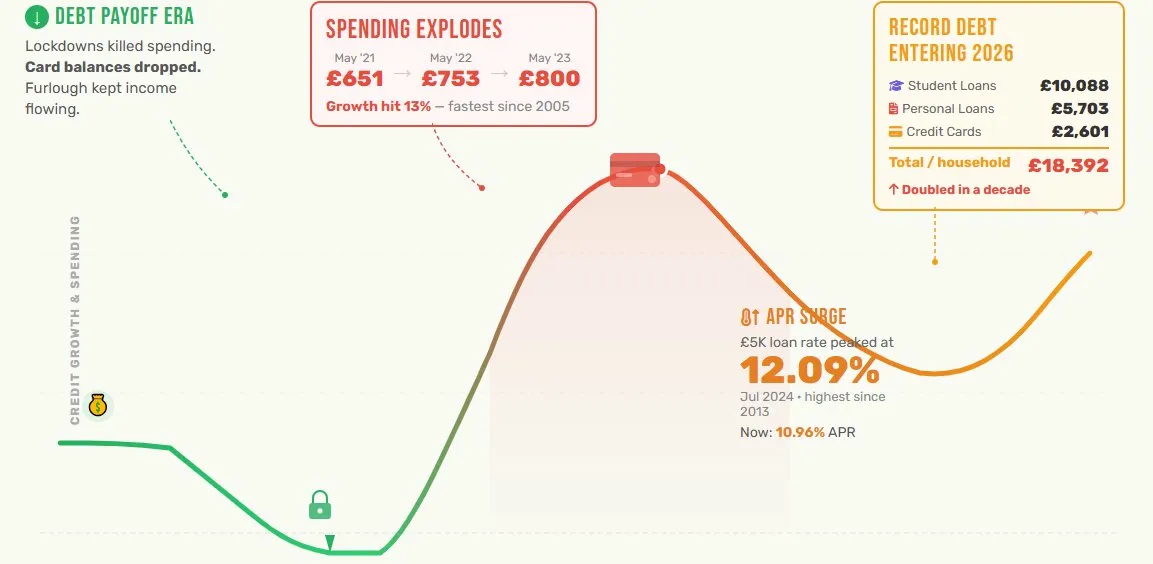
During 2020 and into early 2021, people were actually paying off debt. Lockdowns killed discretionary spending. Furlough kept income flowing for a lot of households. There was genuinely less to spend money on, so credit card balances dropped, and personal loan uptake slowed.
Once things reopened, borrowing surged. In May 2021, the average monthly card spending was £651; in May 2022, it was £753; and in May 2023, the figure stood at £800. By mid-2022, the annual growth rate for credit card borrowing had peaked at 13%, its fastest pace since 2005.
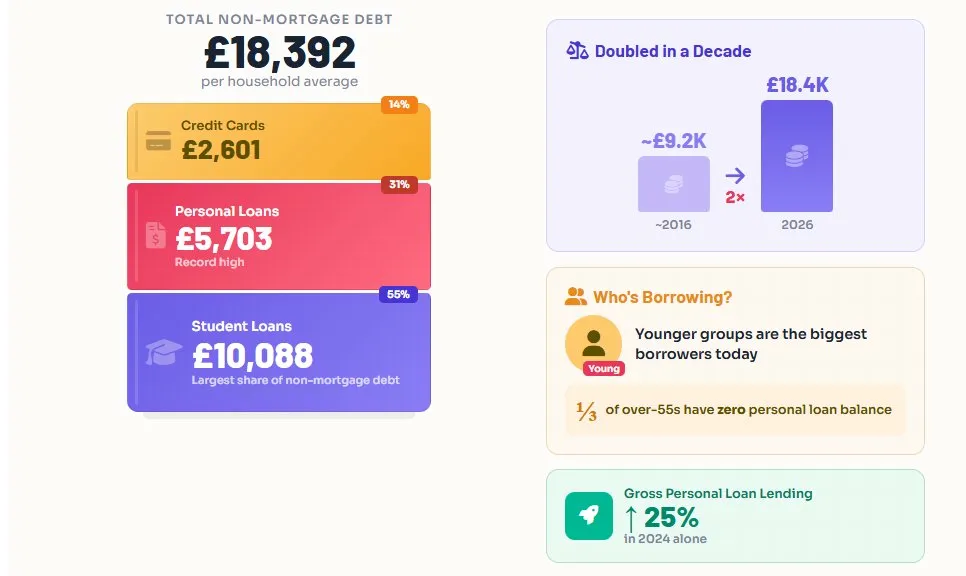
Personal loans followed the same trajectory. At the end of 2025, the average UK household personal loan balance was £5,703 — a record. Households had an average of £2,601 in credit card debt. Throw in the student loans (£10,088 per household on average), and you’re left with around £18,392 of non-mortgage debt per household entering 2026. And that number has doubled in the past decade.
The price of that borrowing surged as well. By May 2025, a £5,000 personal loan averaged 10.96% APR — topping out at 12.09% in July 2024, the highest since at least 2013. Borrow a total of £10,000, and you’d be offered a rate that was more competitive — 6.95% on average — because lenders offer better rates the higher the amount borrowed.
Gross personal loan lending was up nearly a quarter in 2024 alone. It’s younger age groups that are most likely to borrow today, with nearly a third of over-55s having no personal loan balance at all right now.
Consumer credit overall, excluding mortgages, netted a rise of 8.6% in 2024, and EY expects that to stabilize at about 6.5 percent through 2025 and 2026.

Alternative lending has grown alongside all of this
Mainstream lending got tighter and more expensive through 2022 and 2023. That pushed a lot of people and businesses toward alternatives.
For business owners, however, a merchant cash advance offers a distinct advantage by aligning repayments with daily sales, providing a flexible lifeline that grows alongside their success.. Repayments flex with your actual takings rather than hitting you with the same fixed amount every month regardless of whether you had a good week or a terrible one. During the kind of trading conditions that defined 2022 and 2023, that flexibility was the difference between surviving and folding for a lot of small operators.
On the personal borrowing side, the cost-of-living squeeze left millions of people with damaged credit scores. Missed payments, maxed-out cards, defaults — these things snowball, and they lock you out of mainstream lending precisely when you need it most. Demand for no credit check loans climbed as a result, driven by people who need emergency funds and can’t afford to be turned away by lenders running hard credit searches that further damage their already fragile score. These products fill a gap that the high street banks have largely abandoned.
Who’s struggling, and how bad is it
The overall household debt-to-income ratio has been dropping since mid-2022, reaching 116.9% by Q3 2025. On paper, that looks like an improvement. In practice, it masks some grim stuff underneath.
Around 84% of UK adults carried some form of credit or loan in the year to May 2024. Eighty-four percent. That’s almost everyone.
Buy now, pay later added another dimension. Usage jumped from 8.8 million adults in the year to May 2022 to 10.9 million by May 2024. Lone parents are the heaviest users at 40%, followed by women aged 25 to 34 at 35%.
Individual insolvencies in England and Wales hit 33,559 in Q3 2025 — that’s up 14.7% on the same quarter a year earlier. Citizens Advice dealt with over 50,000 people seeking debt help in January 2025 alone, a record. StepChange reported the same pattern.
An ONS survey from April 2025 found that 72% of adults reported increased living costs. Of that group, 14% said they were relying on credit more than usual to pay for basics. Not holidays. Not cars. Basics — food, energy, rent. That’s a different kind of borrowing entirely, and it carries higher rates, worse terms, and uglier consequences when it goes wrong.
Business borrowing spiked and then dropped off a cliff
COVID brought a wall of government-backed lending. Bounce Back Loans, CBILS, CLBILS — billions flowing to businesses that needed cash to survive lockdowns. Bank-to-business lending grew at rates never seen before.
When the schemes wound down, borrowing collapsed. SME lending was shrinking by about 4.7% year-on-year by April 2024. Large business lending turned negative, too. The cost of borrowing for businesses — nearly 7% for larger firms and over 7.5% for SMEs — didn’t help.
The forecast from here is optimistic. EY sees business lending growing 5.6% in 2025 and 6.2% in 2026 — the strongest annual growth since the emergency lending boom of 2020. Lower rates, more political certainty after the July 2024 election, and a recovering deal pipeline are all doing their bit.

Where things stand now
Total bank lending across the UK — households and businesses combined — shrank 2.2% in 2023. It bounced back to 2.6% growth in 2024. Forecasts say 3.7% in 2025 and 4.3% in 2026.
Borrowing is recovering. Rates are heading down. Confidence is returning. But the scars from the past few years are real.
Millions of people are locked into fixed-rate mortgage deals signed when rates were high — those won’t roll off for years. Personal loan rates are still well above anything we saw before 2022. And a significant chunk of the population has shifted from borrowing for wants (cars, holidays, home improvements) to borrowing for needs (food, energy, rent), which is a fundamentally different and more fragile kind of debt.
The difference between taking out a mortgage in early 2021 and taking one out in late 2023 could easily be 2% versus 6%. On a £250,000 loan over 25 years, that’s roughly £600 a month in extra repayments. Same house, same buyer, same bank — just different timing. For most families, that gap defines their financial reality for the next decade.