Zoe Ball has been back on daily radio since 7 September, weekdays from 1pm on Greatest Hits Radio, sitting between Ken Bruce and Simon Mayo in the schedule. It’s her first weekday show since she left the Radio 2 breakfast slot at the end of 2024, and it has brought her back into the conversation. For a lot of people the conversation goes straight to the photograph from April 2025, the one of her stomach before and after, and the assumption that follows it, which is that something surgical must have happened.
Nothing surgical happened. The two photographs were taken either side of an hour on a massage table in London.
What The Photograph Actually Showed
On 9 April 2025 Sophie Yerby of Soph London posted two pictures of Ball’s midriff to Instagram, taken either side of a single session. Ball was 54. The treatment was Brazilian sculpting combined with lymphatic drainage massage, and Yerby’s caption listed what it was for, blood flow, fluid retention, metabolism, immune support, and, in her words, to sculpt and slim the body. The core method cost £120. Ball framed it as help with fluid retention from the menopause, which she had already talked about at length in Davina McCall’s 2021 documentary and, before that, in a story about a hot flush arriving mid interview with Al Pacino.
Lymphatic drainage moves fluid. It does not remove fat. That distinction explains the photograph. The lymphatic system carries fluid around the body and out of it, and when it runs slowly, through hormonal change, long sitting, salt, heat, flying, the fluid pools and the stomach reads as bigger than it is. A therapist working the tissue by hand pushes that fluid back into circulation, and the difference on the day can be real and visible. Whether it stays depends on why the fluid was there, and on whether the person goes back.
The Mirror Sent A Reporter To Try It, And The Clinic Sold Out For Six Months
The photograph travelled far enough that the Daily Mirror ran a piece under the question “Can the Zoe Ball treatment trim my tum?“, with a reporter, Niamh Kirk, booked in for the same session. By then the clinic was full for the following six months on the back of one post.
- £120 for the two step method, lymphatic drainage and Brazilian sculpting.
- £200 for what the clinic called the full Zoe, adding ultrasound cavitation and radiofrequency.
- One hour, one session, back to work the same afternoon.
The compression version of the same idea has its own celebrity file. Dame Kelly Holmes, Jennifer Aniston, Chrissy Teigen and Paris Hilton have all been photographed in the Body Ballancer, the inflatable trousers that squeeze the legs in sequence to move fluid upward. Aniston put hers in a summer photo dump on Instagram and The Independent picked it up.
What Any Of This Means For A Person Looking At It Themselves
A before and after on a famous stomach tells you what one method did on one day. It doesn’t tell you which method suits a particular concern, and that is the question when you’re the one booking.
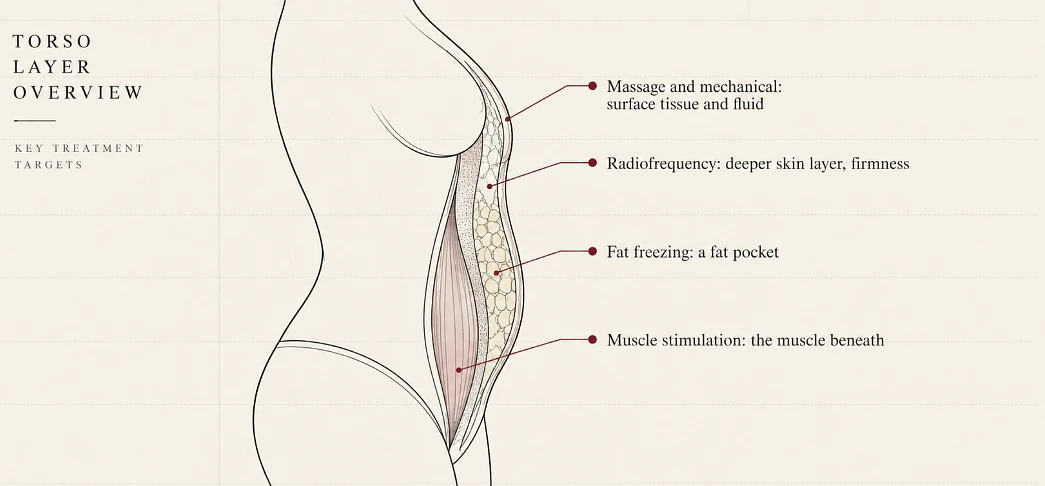
The treatments sold under body contouring fall into four groups, and they do different jobs. Massage and mechanical stimulation, which is the Zoe Ball category, move fluid and work the surface of the tissue, so they suit puffiness, cellulite and uneven texture. Radiofrequency warms the deeper layer and is used where skin firmness is the complaint. Electromagnetic muscle stimulation, the Emsculpt family, contracts the muscle underneath and suits people who want tone rather than volume change. Fat freezing targets a pocket of fat and is the one with a lawsuit attached to it, Linda Evangelista’s, which settled in 2022.
So the useful question at any consultation is which of those four the salon is proposing and what makes it the right one for the area. For anyone looking at body sculpting in London, the way P-DE-P splits its own service is a workable example of that logic. The salon uses Icoone, a mechanical stimulation treatment, for cellulite, puffiness and uneven texture, and Stratosphere Therapy where firmness across a larger area is the concern, so the method follows the complaint rather than one machine being applied to everyone. The salon states that clients generally return to normal activities straight after a session and that visible change tends to start after several sessions, with a course planned over multiple appointments.
Ask which technology, for which concern, and how many sessions before anyone touches you. A reputable place answers all three without being pushed.
Non invasive is not the same as suitable for everyone. The standard reasons a salon should turn a client away, or send them to a GP first, are pregnancy, active skin inflammation in the area, and certain vascular conditions, and a consultation should ask about all three before anything is booked.