


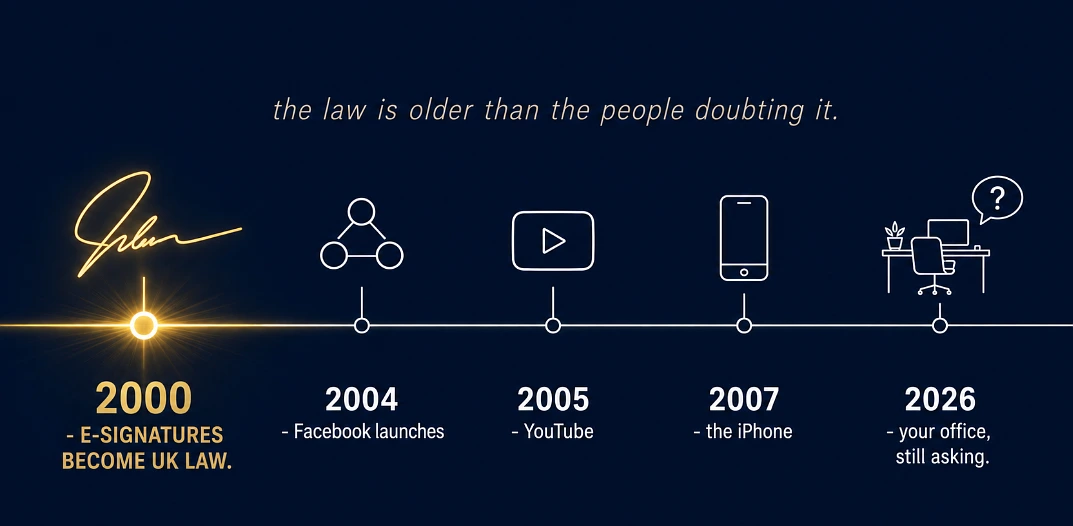
Ask around your office whether a contract signed on a phone screen would hold up in court, and watch the doubt arrive. Someone is saying you need wet ink for anything serious. Someone else is sure it is legal for small things but not big ones. Now here is the fact that settles it: electronic signatures have been legally valid in the UK since the Electronic Communications Act 2000. The year 2000. The law is older than Facebook, older than the iPhone, older than most of the people doubting it in that office.

And if the 2000 Act left any lawyers hedging, the Law Commission ended the argument in September 2019 with its report on the electronic execution of documents, Law Com No 386, confirming that an electronic signature can validly execute documents, including where statute requires a signature. That is the full stop on the question. The Consumer Rights Act 2015 recognises them too, and the UK kept its version of the eIDAS framework after Brexit, so the tiers of signature security carried straight over into UK law.
Even property gave in, and property is the stubborn one
Land was always the last holdout, so watch what happened there. HM Land Registry has been accepting electronically signed transfers and certain other deeds since 2020, with the process set out in its own guidance, and Practice Guide 82, updated as recently as July 2025, now details exactly which forms of electronic signature it takes. From August 2025 a pilot went further, accepting Qualified Electronic Signatures for charges, transfers and assents. People are completing property deals from their kitchens, and the registry is registering them.
One detail worth knowing from that guidance, because it tells you how the system thinks. HM Land Registry does not prescribe which platform must be used and keeps no approved list. What it prescribes is the process: identity checks, proper audit trails, the conveyancer certifying the steps. The regulator cares about evidence, not brands, and that logic runs through the whole of UK signature law. A signature is valid when the intention to sign is clear and the signature is properly tied to the document. The technology is just the how.
Where wet ink still rules, and it genuinely still does
Now the honest part, because a piece telling you everything can be signed on a screen would be lying to you. A short list of documents still refuses the digital route, and the exceptions are strict:
- Wills. The Wills Act 1837 requires the testator’s signature with two witnesses physically present, and electronic execution is not accepted in England and Wales. An 1837 statute is still running the show here.
- Lasting powers of attorney. The Office of the Public Guardian requires wet ink on its forms, no exceptions.
- Statutory declarations. These must still be made in the physical presence of a solicitor or commissioner for oaths.
- Witnessed deeds carry a catch. A witness must physically observe the signing. Remote witnessing over video is not permitted, the Law Commission has recommended reform on this, and Parliament has not yet moved.
Some HMRC filings also sit case by case, so the specific guidance is always worth checking for the odd form. Everything else, employment contracts, NDAs, supplier agreements, tenancy agreements, freelance contracts, signs electronically and binds completely.
How businesses actually do it, and the habit that matters more than the platform

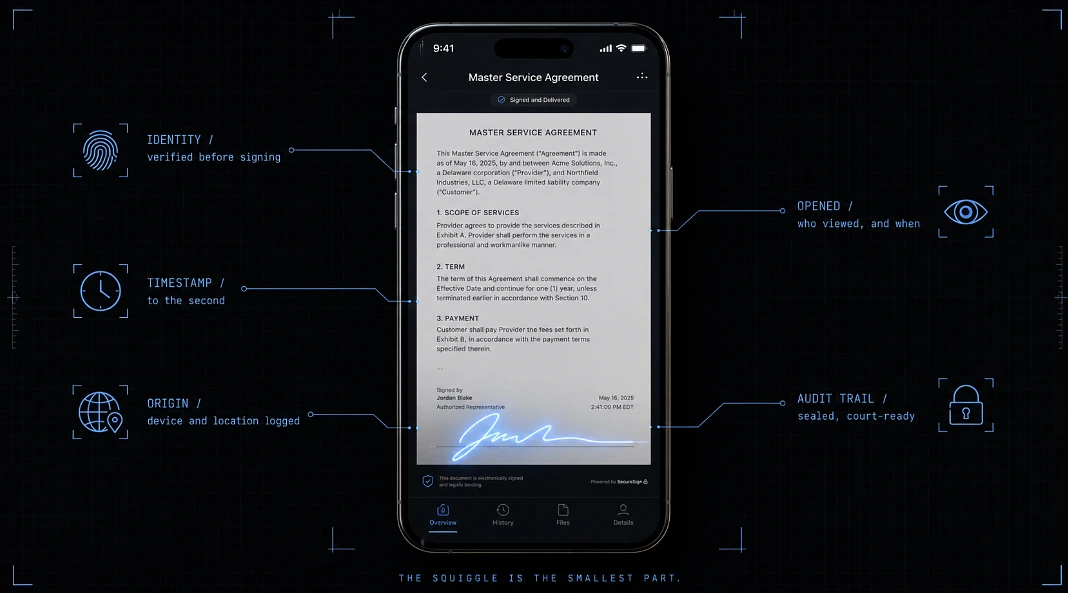
For everyday business signing, companies use e-signature services to run the process, and what those platforms genuinely earn their keep on is not the signature squiggle itself, it is the evidence around it. Identity verification, timestamps, a sealed audit trail showing who opened the document, when, from where, and what they agreed to. Remember what HM Land Registry cares about, because courts think the same way. When a signature gets challenged, the side holding the audit trail is holding the argument.
So the habit worth adopting is simple. Include a consent step before signing, keep the signed copy with its audit trail, and know the short exceptions list above. Do that, and the paperwork that used to take a week of printing, posting and chasing is done before the kettle boils, with better evidence behind it than a biro ever left.
The doubt in your office was twenty six years out of date. The law moved in 2000. It is everyone else who is catching up.