


Elongated cushion cuts are having a serious moment. Queensmith’s 2026 data shows cushion cut popularity jumped to 9%, up from 6.3% in 2024, with the elongated versions doing most of the heavy lifting in that rise. Taylor Swift’s champagne old-mine cushion from Lorraine Schwartz didn’t hurt either — searches for 1920s-style cushion rings spiked 300% after that.
But it’s not just some turbo-wellness trend driven by star power. The elongated cushion cut really does fix a problem so many couples find themselves in: we all want a ring to look expensive even if our pockets aren’t. The shape pulls the stone longer, creating an appearance that looks significantly larger than a square cushion or round brilliant of the same carat weight. Pair that with the fact that lab-grown options can cut costs by 40–70%, and you’ve got a combination that makes a lot of financial sense without looking like you cut corners.
What Actually Makes This Cut Different
A typical cushion cut is approximately square but with rounded corners — envision a pillow shape, to which the name refers. The elongated version stretches to a rectangle, usually between 1.15:1 and 1.30:1. It still has those soft, rounded edges, but it’s longer and that does two things: It covers more finger area (so the stone looks bigger) and it gives the hand a nice slimming effect.
The facet structure runs between 58 and 64 facets in a brilliant pattern, giving it plenty of fire and sparkle. Depth percentage sits around 60–68%, which is deeper than a round brilliant — and that depth is partly what gives the elongated cushion its distinctive warmth and vintage glow rather than the sharp, icy flash you get from some other cuts.
| Spec | Detail |
|---|---|
| Shape ratio | 1.15:1 to 1.30:1 |
| Facets | 58–64 (brilliant cut) |
| Ideal depth | 60–68% |
| Ideal table | 60–68% |
| Size appearance | Looks roughly 20% larger than a square cushion of same carat |
For most buyers, the sweet spot sits between 1.0 and 3.0 carats. Below 1.0ct the elongation doesn’t show as dramatically, and above 3.0ct you’re into territory where the price jumps steeply regardless of the shape.
Why It Keeps Showing Up Everywhere in 2026
Brilliant Earth listed elongated cushions alongside ovals as a top shape for 2026, and they’re not the only ones. Ryan Thomas Jewellers put it bluntly: “Elongated cushion dominates 2026 — romantic yet fresh.”
Part of this is the celebrity effect. Zendaya’s 4-carat east-west elongated cushion from Jessica McCormack — reportedly valued between £100,000 and £150,000 — put the east-west setting on the map almost overnight. Queensmith saw rubover (bezel) settings jump 100% after that. Miley Cyrus went with a cushion halo from Jacquie Aiche, keeping the vintage angle but with a chunkier, bolder band that’s become its own trend.
But celebrities aside, the shape just works well for what most couples actually want. It flatters the hand better than a round, carries more visual weight per carat than most cuts, and bridges the gap between vintage charm and modern clean lines. That’s a hard combination to find.
How Much You’ll Actually Spend
This is where things start to get exciting for anyone on a budget. The cushion elongated is also one of the more affordable cuts on a per carat basis, given that it sculps less waste from the rough diamond compared to round brilliant shapes.
Throw some lab-grown diamonds into the mix and the savings are pretty dramatic. A 1.5-carat lab-grown elongated cushion with excellent specs will set you back around 70 percent less than the natural version.
| Stone Type | Setting | Typical Cost (UK 2026) |
|---|---|---|
| 1.5ct lab-grown diamond | Solitaire | £2,800–£4,500 |
| 2ct natural diamond (G/VS) | Halo | £8,500–£15,000 |
| 1.8ct moissanite | Bezel / east-west | £1,200–£2,500 |
| 3ct fancy yellow natural | Vintage | £18,000+ |
The average UK engagement ring spend in 2026 ranges from £2,500 up to 15k. An elongated cushion in lab-grown diamond or moissanite will effectively place you at the nice end of that range while pretending to have spent a whole lot more. Fogal & Barnes summed it up nicely: “Elongated cushions maximise visual impact affordably.”
Lab-Grown vs Natural — The Actual Differences
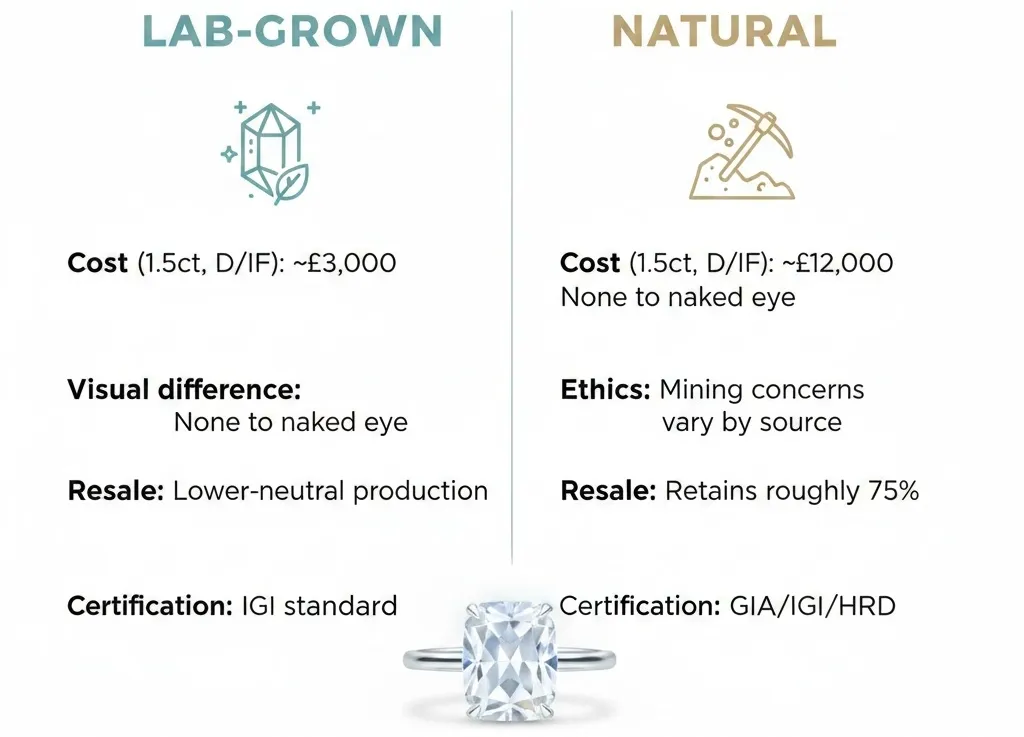
This comes up in every engagement ring conversation now, and the elongated cushion is right at the centre of it because it’s one of the cuts where lab-grown stones are virtually impossible to tell apart from natural ones without specialist equipment.
| Lab-Grown | Natural | |
|---|---|---|
| Cost (1.5ct, D/IF) | ~£3,000 | ~£12,000 |
| Visual difference | None to naked eye | None to naked eye |
| Ethics | Carbon-neutral production | Mining concerns vary by source |
| Resale | Lower resale value | Retains roughly 75% |
| Certification | IGI standard | GIA/IGI/HRD |
If resale value matters to you, natural diamonds still hold their worth better. But if you’re buying a ring to wear — not to flip — lab-grown gives you a significantly bigger, better-graded stone for the same money. A growing number of British couples are making that call, and the 2026 trend data shows no sign of the lab-grown surge slowing down.
Brands like Cullen Jewellery have built their whole offering around this shift. Their elongated cushion cut rings use lab-grown diamonds and moissanite, delivering the same fire and brilliance you’d get from a mined stone at a price that leaves room in the budget for, well, the rest of life. Moissanite in particular scores a 9.25 on the Mohs hardness scale (diamond is 10), so durability isn’t a concern for everyday wear.

Which Settings Work Best
The elongated cushion is one of those shapes that genuinely looks good in almost anything, which is part of why jewellers love working with it. That said, some pairings are stronger than others right now.
- Solitaire — The minimalist route. A single elongated cushion on a thin band lets the shape speak for itself. Bezel solitaires (where the metal wraps around the stone’s edge) are on the rise because they protect the stone and give a sleek, modern look.
- East-west setting — Instead of the stone sitting vertically on the finger, it’s turned sideways. This is the Zendaya effect in full force, and Queensmith’s data backs it up with a 100% rise in rubover east-west designs. It looks unusual without being weird, which is a difficult balance to strike.
- Halo — Micro-pavé diamonds surrounding the centre stone. Very Hatton Garden, very vintage. It adds perceived size and sparkle, which makes it popular with buyers who want maximum visual impact from a modest centre stone.
- Three-stone — Trilliant or pear-shaped accent stones flanking the elongated cushion. More dramatic, more expensive, but undeniably striking for anyone who wants something with a bit of presence.
- Chunky bands — The Miley Cyrus influence. A wider gold band paired with an elongated cushion creates a bolder, more fashion-forward look that breaks away from the delicate-band-with-big-stone formula that’s dominated for years.
Harmony Jewels flagged chunky bands with elongated cushions as a 2026 signature combination.
Wearing It Every Day
Their incorporators aren’t fine jewelry — they are in for the wear and tear of commuting, cooking, gym sessions and everything else. The centralized cushion has a practical advantage here that doesn’t always pop up in the aesthetics conversation: its rounded edges.
Unlike princess cuts or emerald cuts, which have sharp edges that catch on knitwear and pockets and gloves, the soft corners of the cushion will not catch so easily. If you choose a bezel setting further still, the stone is flush with the band and there’s basically nothing to get caught on at all. For anyone who works with their hands and/or just doesn’t want to have to think about their ring every time they pull on a sweater, this is worth more than most people realize.
Moissanite and lab-grown diamond rank high enough on the hardness scale (9.25 and 10, respectively) that scratching from daily use is not really an issue. The biggest thing to watch is the setting — prongs may get a little bit looser over time with any ring, so having that checked once a year is ten minutes well spent.
What to Look For When You’re Buying
A few things worth knowing before you start shopping, especially if you’re buying online or from a jeweller you haven’t used before:
- Certification matters. GIA, IGI, or HRD — these are the grading bodies you want to see on the certificate. An ungraded stone is a gamble, and there’s no good reason to take that gamble when certified options are widely available at every price point.
- Check the ratio. Not all elongated cushions are equal. Anything below 1.10:1 will look basically square. The 1.15:1 to 1.25:1 range tends to be the most flattering for most hand sizes. Above 1.30:1 and you’re getting close to oval territory, which may or may not be what you want.
- Depth and table percentage. Aim for 60–68% on both. Too shallow and the stone looks glassy and flat. Too deep and light gets lost through the bottom, killing the sparkle.
- Try before you decide on a setting. East-west looks incredible in photos but some people find it odd on their own hand. Halos can overwhelm smaller fingers. A solitaire might feel too plain in person even if you loved it online. If you can’t try in store, at least check the retailer’s return policy.