


The wedding car is one of those things guests are not really supposed to notice, and then they do, and then the photograph of the couple stepping out of it is the one that runs on the front page of every paper the next morning. So the pick matters more than most couples treat it.
The strange thing is nobody talks about this any more. Have a proper look at any celebrity wedding from the past ten years and the getaway is almost always a black Range Rover with tinted windows. Nothing you would remember an hour later. Whereas the five weddings below all worked out the wedding car logic properly, and every one of them produced a photograph that people are still looking at decades later. Which raises the obvious question about what we lost along the way, but that is for the end of the piece.
Grace Kelly and Prince Rainier III of Monaco, 19 April 1956
The wedding that is still the reference wedding, seventy years on. And genuinely, seventy years is a long time for a wedding photograph to still be doing the rounds.
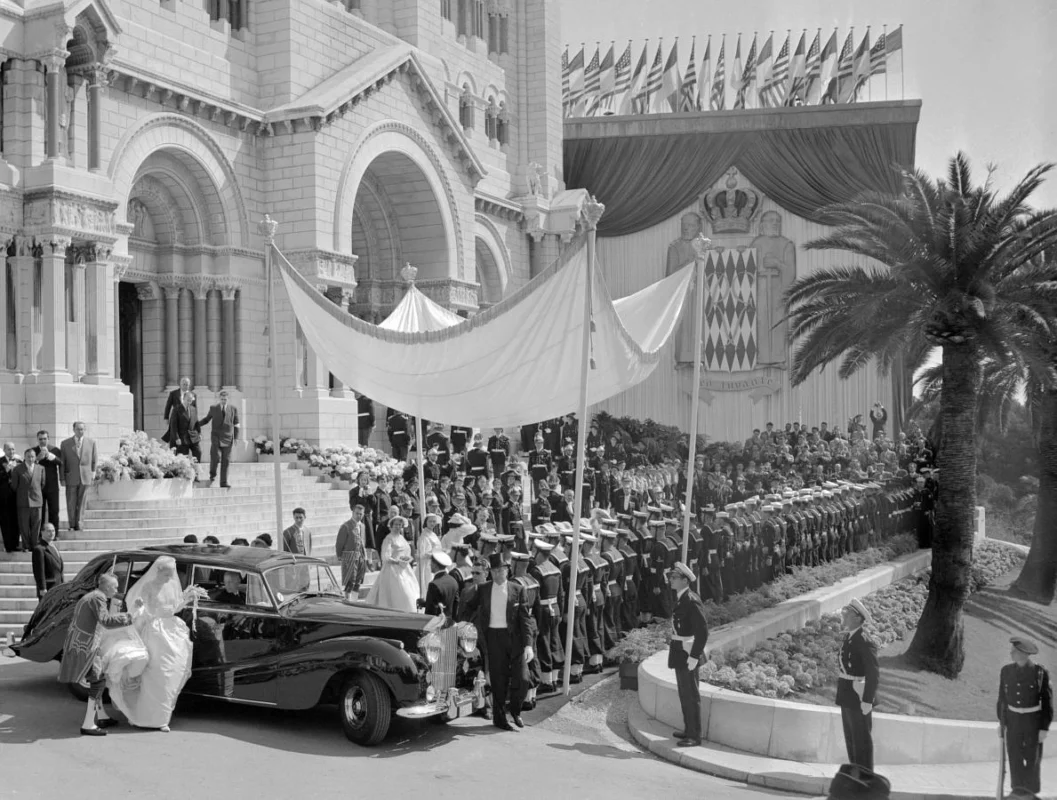
Grace Kelly is arriving at Saint Nicholas Cathedral in an ivory silk taffeta and lace gown that is going to be studied by every royal bridal designer since. Around thirty million people are watching on television, which is a mad number for 1956, and the ceremony is being broadcast through Eurovision and MGM. Bishop Gilles Barthe is officiating in French. Cary Grant is in the guest pews. Ava Gardner too. Aristotle Onassis, who at this point is not yet the second husband of any Jackie Kennedy but is a Monaco regular, is there.
But the car is the moment nobody quite forgets.
After the religious ceremony, Grace and Rainier are being driven through the streets of Monte Carlo in a cream and black Rolls-Royce convertible, a gift from the people of Monaco to the couple. Open-top. Waving to three thousand Monegasques who have been invited to the palace gardens for the wedding celebrations. The image of Grace, tiara catching the April light, Rainier in his dress uniform beside her, is the image that gets sent around the world. Genuinely one of the most beautiful wedding photographs of the twentieth century, that one. You know the one, everyone has seen it.

Why did the Rolls work.
Because it did not compete with the bride. That is the trick almost every wedding car gets wrong. A car that is louder than the couple standing next to it is the wrong car. The cream and black Rolls is dignified enough to belong at a royal wedding and quiet enough to let Grace be the photograph. The people of Monaco understood the assignment when they picked it.
And the Rolls survives beyond the wedding day, which is worth noticing. It sits in the Grimaldi collection. It is still displayed periodically. A car that becomes part of the family history rather than a rental that returns to the depot on Monday morning is a different kind of pick entirely. Try telling that to a wedding-car hire company in 2026.
Marilyn Monroe and Joe DiMaggio, 14 January 1954, San Francisco
The wedding that lasted 274 days but produced a wedding car photograph nobody has ever forgotten.
Marilyn Monroe is marrying Joe DiMaggio at San Francisco City Hall on 14 January 1954. She is wearing a chocolate-brown suit with an ermine collar, holding a small bouquet of white orchids. He is in a dark blue suit. The whole thing takes twelve minutes. There are around five hundred people jammed into the corridor outside Judge Charles S. Peery’s chambers trying to catch a glimpse of what has already been called the wedding of the year, and this is January, and Monroe is not yet the Monroe she is going to become when Some Like It Hot lands five years later.

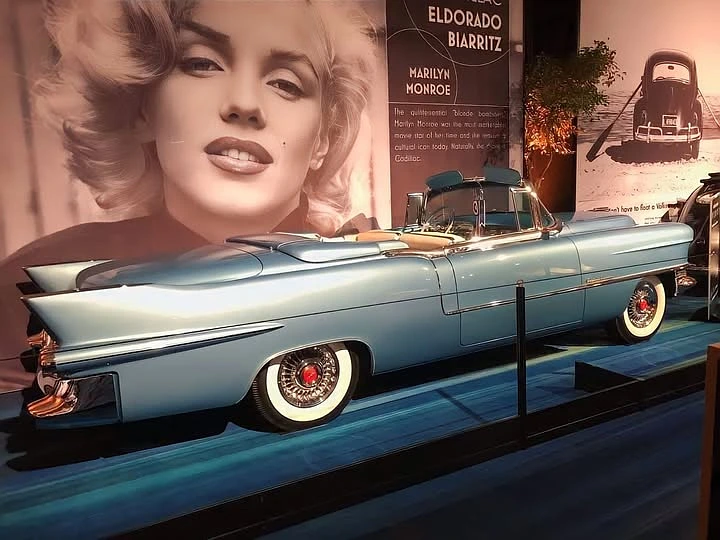
They marry. They leave. And they leave in Joe DiMaggio’s own black Cadillac, licence plate “Joe D”.
That is the detail. That is what makes the photograph work.
It is not a rented wedding car. It is not a hired Rolls-Royce sent from a chapel service. It is Joe’s own car, the car he drives around town, with his personalised plate on the back. He and Marilyn get in, and Joe drives them out of San Francisco toward Paso Robles for the honeymoon.
And you know what actually makes that sadder in retrospect. The marriage lasted 274 days. Two hundred and seventy-four. Whole thing was over by October. But Joe kept that Cadillac for years afterwards, and he never remarried, and the story goes that he sent flowers to her grave every week for the rest of his life until he died in 1999. The Cadillac outlasted the marriage by four decades, put it that way.
The classic Cadillac has never really lost that association though. When a couple hires a Cadillac wedding car for their own day, part of what they are buying is that DiMaggio and Monroe pull-away moment. The chrome. The tail fins on the fifties Coupe de Villes. The wide bench seat that fits a wedding dress properly. American cars of that era are built with the kind of proportions that photograph well from every angle, which is one of the reasons Cadillacs from the 1950s and early 1960s remain the most-hired vintage American wedding car in Britain.
Which raises the obvious question of why we do not see them at more weddings anymore. Fashion moved on, the Range Rover happened, the world got busy. But the Cadillac wedding car is still one of the most photographable choices a couple can make, whatever the salesman at the local Rolls-Royce hire company is telling you.
Prince Harry and Meghan Markle, 19 May 2018, Windsor
The wedding where the car is doing something newer than any other royal wedding car has ever done. And I mean it, no royal getaway car before this one had done what this one is about to do.
Harry and Meghan are arriving at St George’s Chapel on 19 May 2018 through the standard royal transport of the day. Nothing unusual there. The car story starts after the ceremony, when the couple are leaving Windsor Castle for the evening reception at Frogmore House hosted by the then Prince of Wales.
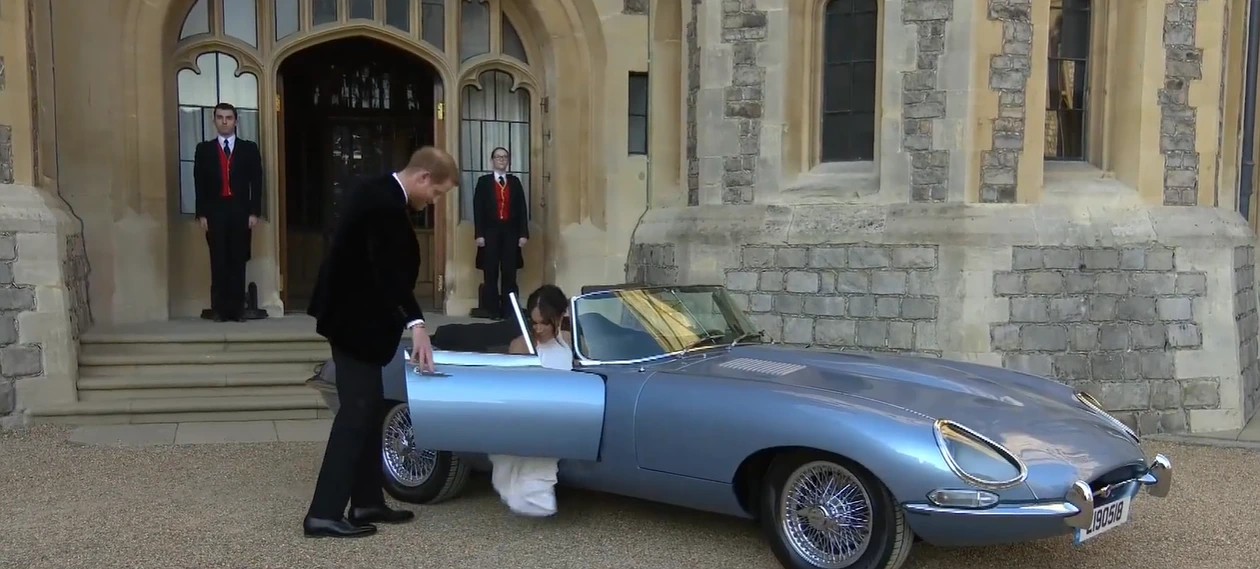
They emerge, both changed. Meghan is in a Stella McCartney silk crepe gown, high neck, bare shoulders. Harry is in black tie. They walk out to a silver-blue 1968 Jaguar E-Type convertible with the top down, and the whole world watches Harry open the passenger door for his bride.

But this Jaguar is not a normal 1968 Jaguar.
It is called the E-Type Concept Zero, and it is one of the first fully electric conversions of a classic E-Type ever built by Jaguar Land Rover Classic Works in Warwickshire. The original petrol engine is gone. In its place is a 220kW electric drivetrain that does zero to sixty in five and a half seconds. Silent. Zero emissions.
Then look at the licence plate.
E190518.
Established, 19 May 2018. Their wedding date, spelled out on the number plate. Nobody but the closest photographers spots this on the day, but the tabloids catch it within hours and the plate becomes one of the most-discussed wedding car details in modern British royal memory. Which, honestly, is quite a lovely detail when you think about it, and the kind of thing that suggests someone put actual care into the pick rather than ringing the palace car pool the week before.
The E-Type has been called the most beautiful car ever made. Enzo Ferrari is on record with that quote. Harry picking one for his getaway matters because his older brother William had chosen an Aston Martin DB6 seven years earlier for his own wedding to Kate, and there is a clear conversation happening between the two brothers through the cars they pick. William’s was his father’s car. Harry’s is a classic reworked as electric, which reads as a Harry-and-Meghan statement in a way nothing else on the day quite manages.
The car is not just transport. It is signalling. And on this day it is signalling successfully. Whatever has happened between those two brothers in the years since, that Jaguar photograph still stands.
Priyanka Chopra and Nick Jonas, 1-2 December 2018, Umaid Bhawan Palace, Jodhpur
The wedding where the wedding car is a horse. And honestly this might be the most beautiful piece of wedding transport of the five, no argument.
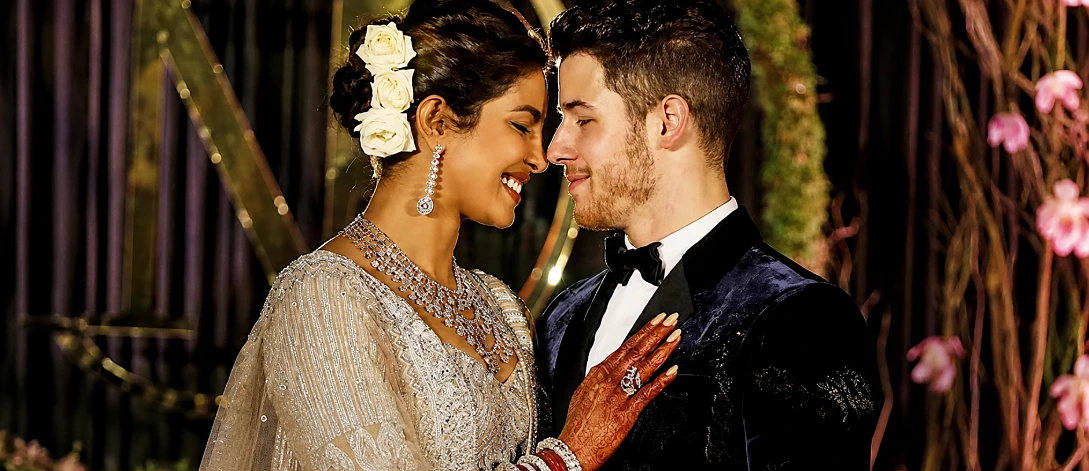
Priyanka Chopra and Nick Jonas are getting married at Umaid Bhawan Palace in Jodhpur across two ceremonies. The Christian ceremony is on 1 December, presided over by Nick’s father. Priyanka wears a custom Ralph Lauren dress covered in Swarovski crystals that reportedly takes 1,826 hours to construct, plus a 75-foot veil. Which is a lot of hours and a very long veil, in case anyone was in any doubt about the scale of the operation.
For the Hindu ceremony on 2 December, the traditional baraat is happening.
The baraat is the groom’s wedding procession. In Indian weddings, particularly Rajasthani and North Indian ones, the groom is arriving at the ceremony not by car but by horse or occasionally elephant. Nick Jonas is riding a white horse to the ceremony, dressed as a prince in a turban and a sherwani, sword at his side, with the extended family and wedding party dancing around him in a proper baraat procession the entire way.
Which is a beautiful point about wedding transport in general, and one that most Western wedding-car articles miss entirely.
A serious percentage of weddings around the world are not using cars at all. They are using horses, elephants, palanquins, gondolas, camels in some Gulf traditions, motorbikes in modern Vietnamese weddings, pickup trucks in some rural American ceremonies where the pickup is part of the couple’s actual life. The Western wedding car is a Western convention that we sometimes forget is a convention.
Priyanka and Nick’s wedding is a useful reminder that if a couple is having a fusion wedding or an Indian wedding, the horse and the baraat are the transport, and hiring a vintage Rolls-Royce alongside would look completely absurd. Match the transport to the tradition, not to the wedding-car catalogue.
George Clooney and Amal Alamuddin, 27 September 2014, Venice
The wedding where the wedding car is a boat, and again, cinema.
George Clooney is marrying Amal Alamuddin, the London-based Lebanese-British human rights barrister, at the Aman Canal Grande Venice, a hotel housed inside the sixteenth-century Palazzo Papadopoli on the Grand Canal. The venue is one of the most photographed hotels in Italy. Andrea Bocelli and John Legend are performing at the reception. Matt Damon, Cindy Crawford, Bill Murray, Anna Wintour are in attendance.
There are no cars in Venice.
So Clooney is arriving up the Grand Canal in a water taxi called Amore, standing at the back, waving to the crowds along the Rialto Bridge and the Accademia bridge and every canal bank between the Cipriani and the Aman where the paparazzi are shouting “George, auguri!” as he passes. The pink Venetian sunset is catching the water. He is in a tuxedo. It is one of the most cinematic wedding transport photographs of the modern celebrity era, and Clooney knew exactly what he was doing when he approved the boat as the wedding car. This is a man who understands lighting.

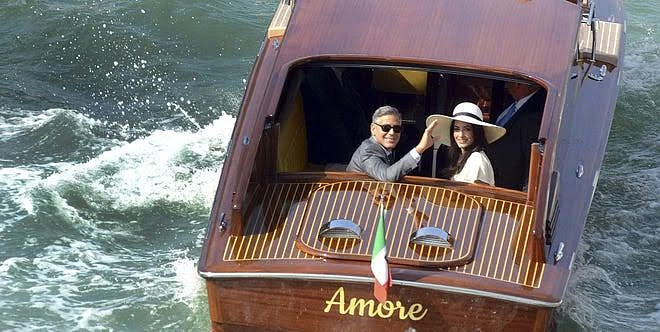
The point being: the wedding car problem in Venice is different. You cannot drive to a Venice wedding, so the water taxi is the wedding car. Clooney’s Venetian water-taxi driver, the one he always uses when in the city, is the one at the wheel of Amore that afternoon. Which is another lovely detail actually, that he did not hire some fancy boat firm for the day. He used the driver he already knew, and Amore is the boat he had always used going up and down the canal for years before the wedding.
The lesson from Clooney’s pick is location-specific. If a couple is having a destination wedding on the Amalfi Coast, or in Positano, or on the Greek islands, or anywhere the local transport is not a car, hiring a wedding car is the wrong pick entirely. Use the boat. Use the horse. Use the tuk-tuk if the wedding is in Sri Lanka and the couple actually met in a tuk-tuk. Use whatever fits the actual geography of the day.
What The Five Pull-Aways Share
Look at the picks together and a pattern emerges. And it is the pattern that answers the question this article opened with.
Every one of these transports is telling a story about the couple that would be missing if the wedding used a generic hire car. The Rolls-Royce is a gift from a country. The Cadillac is a personal car with the groom’s own plate. The Jaguar is an electric conversion with a coded number plate. The horse is a tradition. The boat is a city.
None of them are showing up because a wedding-car website has a nice photograph on the front page.
Which is exactly why we do not really get wedding car photographs like these any more, and it is worth naming why. Celebrity weddings now are managed by publicists, secured with black Range Rovers with tinted windows, and photographed under NDA. The wedding car is a security decision, not a storytelling decision. Grace Kelly’s Rolls is unimaginable at a 2026 A-list wedding because the couple would not be allowed to ride in an open convertible waving to crowds. The Range Rover with tinted windows has won because it hides the couple, and hiding the couple has become the point. That is not the couple’s fault. That is what fame is now.
But for anyone getting married soon who is not a celebrity, and who wants a photograph they will still be looking at in forty years, the five weddings above are the lesson. The transport works when it means something to the couple. It fails when it is just a car with ribbons on the bonnet showing up because the venue is expecting one.
The useful question is not which vintage Rolls-Royce is available in your county. The useful question is what the car is saying. And once that question is answered properly, the pick becomes obvious.
Grace Kelly’s Rolls was a gift. Joe DiMaggio’s Cadillac was Joe’s own car. Harry’s Jaguar carried the wedding date on the plate. Nick’s horse was the tradition. George’s boat was the city.
Match the transport to the story. Everything else sorts itself out.