



One K-beauty product sells every eleven seconds at Boots. Proper stat, not a marketing line, and it says a lot about how deep the glass skin thing has gone into British bathroom cabinets. UK sales of Korean skincare in the first nine months of 2025 were already twenty percent up on the whole of 2024, per Euromonitor. Space NK shelves are rammed with essences and toner pads promising the same result, skin so smooth and hydrated it catches light like actual glass.
Here’s what most of the coverage skips though, and it’s the bit that actually matters.
A ten-step routine only gets you so far
The double cleanse, the layering, the niacinamide, all of it works on the surface. Calms the barrier, hydrates properly, genuinely changes how light bounces off healthy skin. None of that’s rubbish. But some people chase that look for years off product alone and never quite land there, while others seem to arrive overnight after what they vaguely call “a reset” online.
That reset is very often a clinical procedure. Not a serum. Specifically, for a fair chunk of the more dramatic before-and-afters doing the rounds, it’s fractional CO2 laser, and it works nothing like a bottle of essence.
Euromonitor’s own people flagged this directly in their latest K-beauty report, calling the next wave “clinically backed treatments” arriving alongside the products. Marie Claire’s already written up Korean bodycare built on the same logic. Grazia’s covered PDRN drifting from clinic treatments into product bottles. The direction is obvious enough. Skincare’s the entry point. Underneath the trend, for a growing number of people, is a laser, not a serum.
What the laser actually does?
Older CO2 lasers, the 1990s kind, treated the whole face in one go. Fractional splits the beam into thousands of tiny columns instead, each one going deep into the dermis and creating a small controlled patch of damage, while the untouched skin around each column speeds the whole healing thing up. That’s the difference between weeks off and days off.
Two things follow. The damaged surface sheds over about a week. Underneath, the body starts laying down new collagen in response to the injury, and that keeps building for another three to six months, which is what actually tightens pores and smooths scarring from below rather than papering over it. Genuinely effective. Also a real medical procedure with real risk attached, and that’s exactly where the glossy trend pieces tend to stop talking.
Do you know:
Yuri pibu is the original Korean phrase. Translates literally as glass skin. It crossed into English-language beauty writing around 2017, 2018, when Alicia Yoon at Peach & Lily brought the term over and built a whole product line off it. The Guardian did a proper business piece on it back in 2024, more or less the same story, glass skin driving a genuine surge in K-beauty sales across the country. Ahh, and this bit is where my own nan would roll her eyes at me, because she’s been doing half this routine since before anyone gave it a name, layering on rice water and calling it a day. Funny how the internet catches up to what your grandmother already knew.
The bit almost nobody mentions


Skin tone changes everything about how this laser behaves.
Darker skin carries more active melanocytes, the cells making pigment. Hit those cells with an inflammatory event, which a controlled laser injury absolutely is, and they can overreact, producing extra melanin in patches. Anyone who’s had a spot leave a dark mark for months has already met a small version of this. Post-inflammatory hyperpigmentation, PIH for short, and it’s a genuine risk with fractional CO2 for plenty of skin tones the standard treatment literature barely accounts for, because most of that literature was built on lighter-skinned patients in the first place.
- Skin tone changes everything about how this laser behaves. Darker skin carries more active melanocytes — the cells responsible for making pigment. Hit those cells with an inflammatory event (and a controlled laser injury absolutely counts as one) and they can overreact, pumping out extra melanin in patches that linger for months.
- Think of it like this: anyone who’s had a nasty spot or mosquito bite leave a dark mark long after the original problem healed has already seen a baby version of this. Now imagine that happening across your whole face. That’s post-inflammatory hyperpigmentation, or PIH, and it’s a genuine risk with fractional CO2 for plenty of skin tones.
- The standard treatment literature barely accounts for it because most of the early studies and protocols were built on lighter-skinned patients. So what works as a “safe default” on fair skin can go sideways on medium, olive, or deeper tones.
Doesn’t mean the treatment’s off the table. It absolutely isn’t. Means the settings, prep and aftercare need adjusting properly rather than running the same default on everyone who books in.
Prep takes weeks, not a same-day slot
A clinic that actually knows what it’s doing builds in four to six weeks of prep before touching the laser at all. Topicals during that window calm the pigment-producing cells down in advance, hydroquinone, tranexamic acid, azelaic acid or kojic acid depending on what suits the person. Point is lowering baseline melanin and settling everything before the treatment provokes it.
Skip that step and you’ve skipped the main safeguard against the exact complication that gives this laser its bad reputation online. Booked in within a fortnight with no mention of prep at all? Worth a conversation before anything gets scheduled.
What if you skip proper prep? You book in within a couple of weeks, no hydroquinone, tranexamic acid, or azelaic acid beforehand. The laser triggers inflammation, your melanocytes go into overdrive, and instead of glass skin you end up with uneven dark patches that can take six months or more to fade — sometimes longer.
Recovery isn’t the airbrushed after-photo

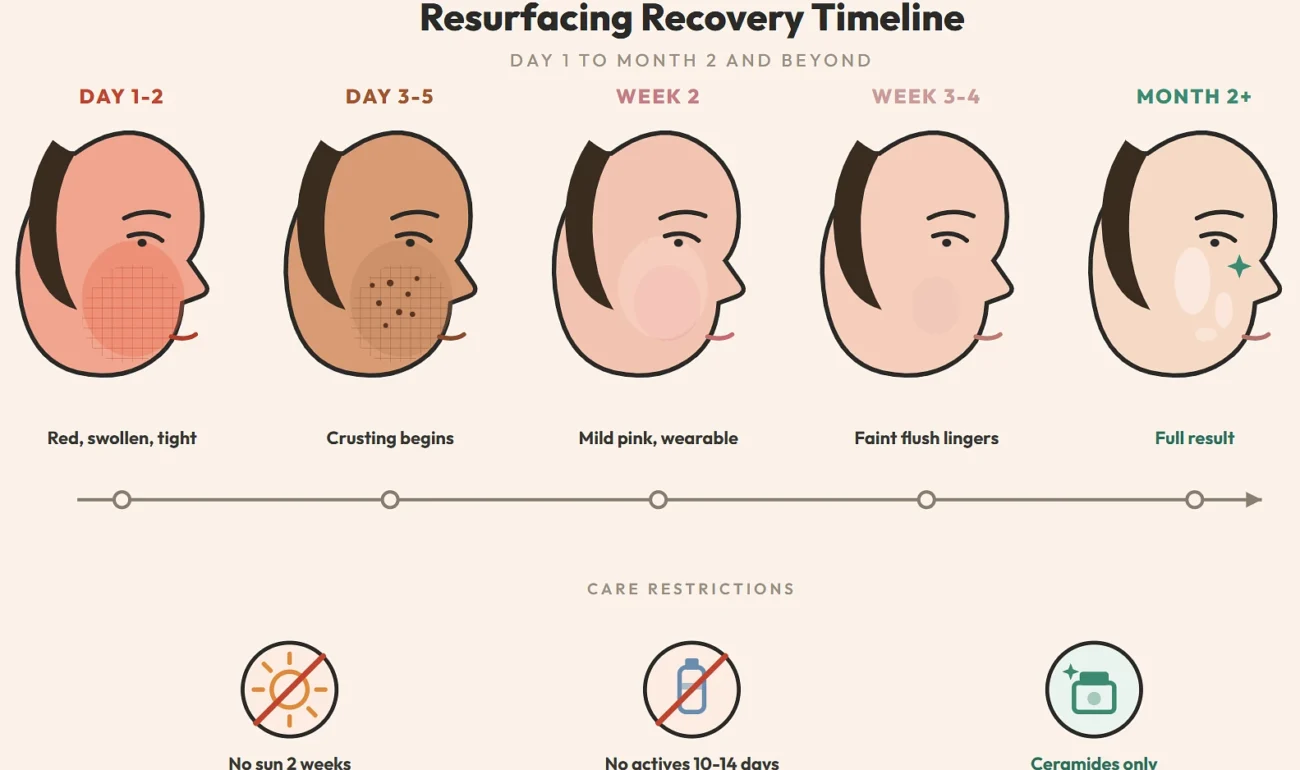
First two days are rough. Red, swollen, tight round the eyes and jaw, the grid pattern visible up close. Most people take a day off, plenty take three or four. Days three to five bring the crusting, small dark scabs across the treated columns giving the face a rough, bronzed look, and picking at that stage is exactly how scarring happens instead of the result anyone wanted. Second week, the pinkness is usually mild enough for sunscreen and light makeup, though some carry a faint flush a fortnight beyond that.
- No sun for two weeks minimum, physical sunscreen only
- No retinoids, no vitamin C, no acids for ten to fourteen days
- Bland moisturiser with ceramides, nothing more adventurous
None of it optional. A clinic glossing over any of this is telling you something about the rest of their protocol too.
Why Singapore and Korea keep coming up in this conversation
Both places have large populations sitting at exactly the skin tones where getting this wrong carries the highest risk, which means practitioners there have had far more repetition treating those tones safely than most Western clinics have managed. Same logic already familiar from the skincare side, nobody blinks at Korean formulators understanding barrier repair better than most Western labs, decades of refining it will do that. Clinical work follows the same pattern.
A specialist aesthetic clinic working within that Fitzpatrick-aware approach, adjusting settings and prep to the actual skin in front of them rather than running one programme on everyone, is the standard worth measuring against. Doesn’t matter whether Singapore’s realistically where you’d book. What a proper consultation for fractional CO2 laser actually covers there is a useful benchmark for any UK consultation too.
Questions worth having ready
What Fitzpatrick type will they treat you as, and what changes in the settings because of it. How long’s their prep phase and what’s actually in it. Honest guess at your pigmentation risk, and why. What happens if PIH turns up afterwards anyway. Realistic number of sessions for your specific concern. And straight out, whether they think this treatment’s actually right for you or whether something else would do the job as well.
Vague answers tell you one thing. Specific, numbered, reasoned answers tell you something else entirely. That gap is most of what decides whether you end up with the glass skin you went in chasing, or a pigmentation problem you didn’t have before you started.