


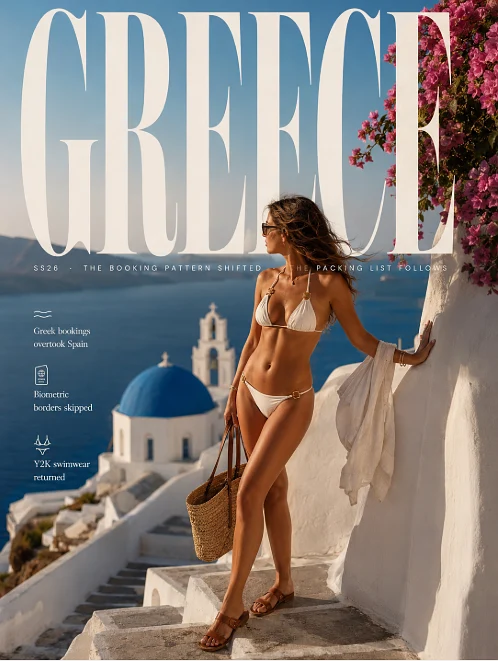
The short version: British holidaymakers are booking Greece in record numbers this summer, the biometric border checks at Greek arrivals have made it the path of least resistance, and the swimwear actually working for a Greek island holiday in 2026 looks very little like what people were packing for Marbella three years ago. If a flight to Crete or Mykonos is in the calendar this July or August, the packing list needs a rethink.
It is the last week of June. Wimbledon starts this morning. Half of London is checking the weather forecast for Hyde Park and the other half has already left for the airport. And for the first time in roughly twenty years, the airport they’re leaving from is not pointing them at the Costa del Sol.
What SS26 Swimwear Actually Looks Like

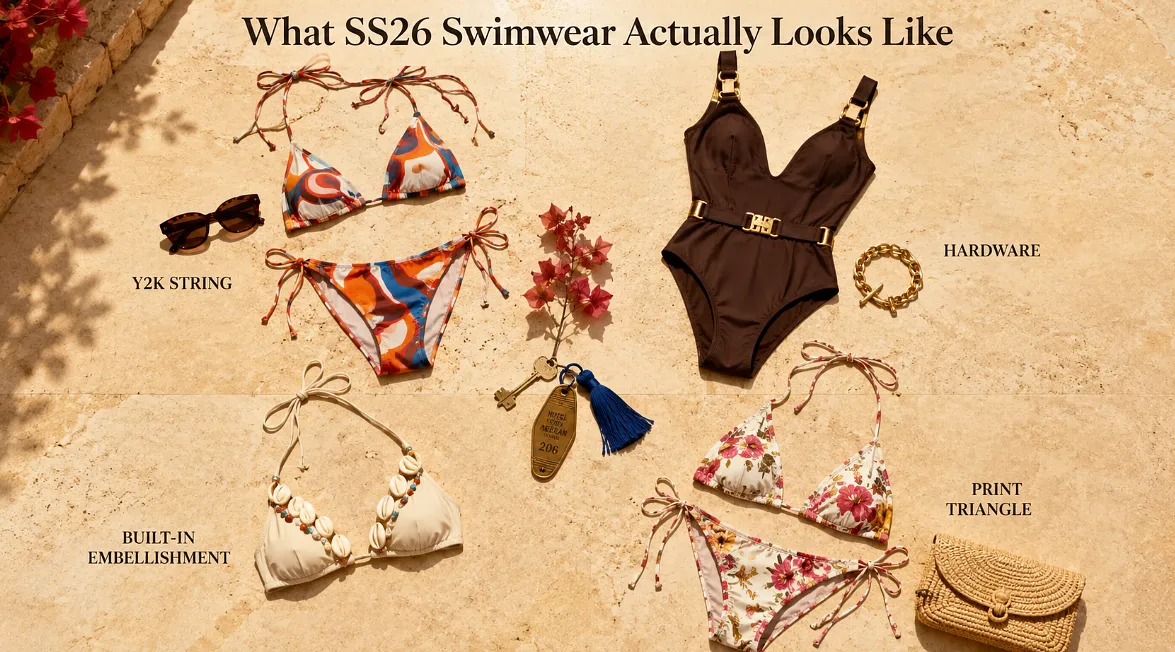
The Spring/Summer 2026 swimwear story has been building in trade press since February, and a few clear directions have crystallised. Marie Claire UK, Harrods, Vogue and the major retailers have all covered it from slightly different angles, but the underlying movement is the same.
The 2000s Have Genuinely Come Back
The biggest single story is the return of Y2K swimwear. Designer bikini sets, embellished triangles, low-rise bottoms, Burberry check on swim fabric. Dua Lipa spent the summer of 2025 wearing a different triangle bikini in a different Mediterranean cove every other week, and that did most of the work of pulling the rest of the market with her.
Burberry x Hunza G is the collaboration everyone in the buying offices was talking about going into this season. ASOS, Bershka and the high street followed within weeks. What’s different about the 2026 version is the materials. The fabrics are better. The construction is better. The £19 string bikini still exists for anyone who wants to commit to one cove, but the proper version of the look sits at the designer end.
Hardware Has Become The Statement
Belts, buckles, eyelets, chunky metal clasps on bikini tops and one-pieces. This is the Bond girl trend the swimwear press kept flagging in spring previews. Away That Day, Zimmermann, Simkhai and Hunza G have all done versions of it. Low-slung belts on bikini bottoms. Utility-style hardware on triangle tops.
The reason this trend works on a Greek island specifically is the colour palette around it. The metal details land cleaner against the white walls and the bougainvillea than they did against the more saturated colour fields of Spanish resort architecture.
Embellishment Has Replaced Jewellery
Built-in detailing has become a genuine category move. Shell motifs, fringe, beading, statement-earring-style detailing on the strap line. The thinking is straightforward: women who are nervous about losing jewellery in the sea simply wear the jewellery on the swimsuit itself.
It works better than it sounds. The poolside-to-beach-bar transition that swimwear is now expected to handle becomes much easier when the suit is doing the accessorising on its own.
The Itsy-Bitsy Triangle Is Still Here, Just With Print
The barely-there triangle bikini never actually went away, but the 2026 version has more colour, more print, and more embellishment than the early 2010s minimalist version. Loewe x Paula’s Ibiza did abstract Anagram prints. SIR did tonal stripes. Maygel Coronel did floral corsages.
These are the bikinis built for a Santorini cliff bar, not for a hotel pool lounger. The shape demands a specific kind of confidence and a specific kind of setting, and the Greek islands provide both.
The News That Changed The Booking Pattern
Advantage Travel Partnership, which represents more than 700 UK travel agencies, reported earlier this year that Greece had quietly overtaken mainland Spain as the most-booked summer destination for British holidaymakers. Greek share of new bookings rose from just under 8% in mid-April to nearly 10% by the end of the month. Spain’s share fell. Not catastrophically, but enough that the agencies started briefing the trade press.
The driver was border policy.
Greece chose not to enforce the full EU Entry/Exit System biometric checks for UK passport holders at its airports, which meant the arrival process stayed roughly the same as it had been for the last decade. Other Mediterranean destinations rolled out the fingerprinting and facial scanning. Greek airports stayed quick.
For families with two children, a flight delay anxiety, and a week of holiday they refuse to spend in a queue, that was the deciding factor. Crete, Rhodes, Corfu and Kos took the bookings that Malaga and Alicante would have had three years ago.
There is a separate story bubbling underneath about jet fuel supply and Mediterranean route stability, but for end-of-June bookings already locked in, that is somebody else’s problem. The flights are flying. The hotels are booked. The packing question is what’s left.
And the packing question this year is genuinely different.