


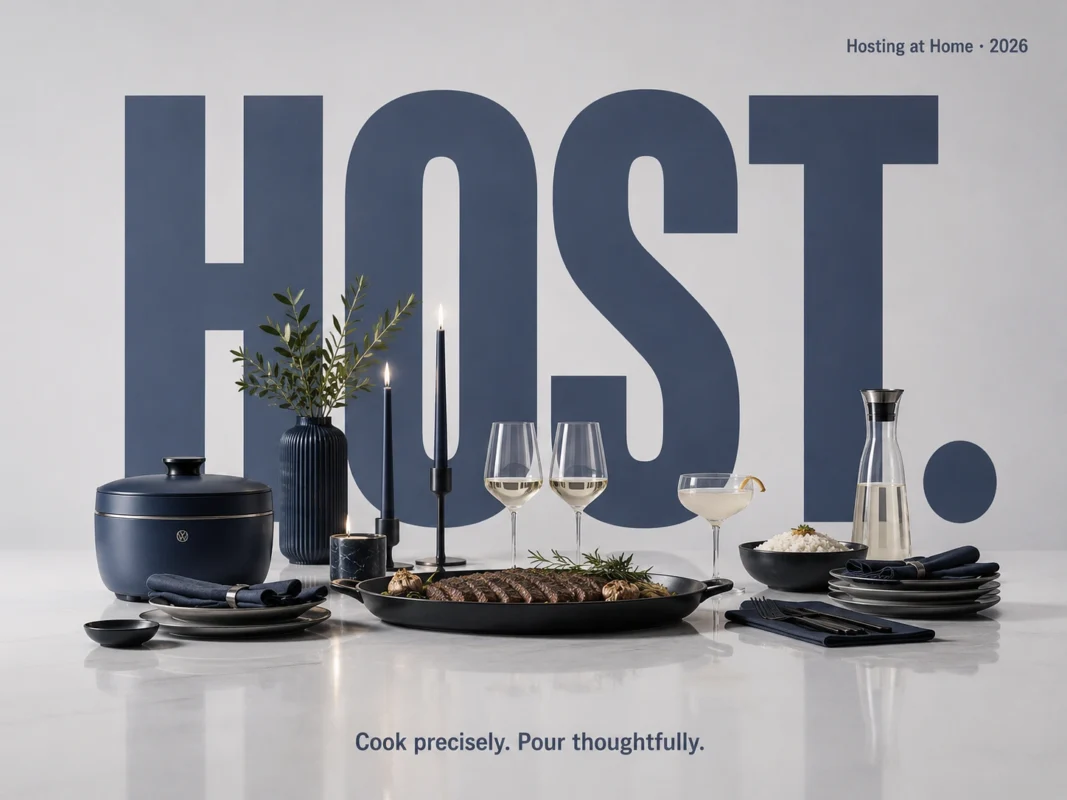
Hosting a dinner at home used to feel like a faff. You’d spend the whole afternoon stressed about timings, then arrive at the table sweating and unable to enjoy your own company. The version that actually works is quieter and more confident. A few dishes you genuinely know how to cook, a couple of drinks that complement them properly, lighting that isn’t the overhead bulb, and enough preparation done in advance that you can actually sit down when your guests do.
That’s not a complicated formula. It just requires thinking through a handful of things before they arrive — the kind of small decisions that mean the difference between a memorable evening and one where you spend most of it standing by the hob.
Setting the tone before anyone walks in
What kind of evening are you actually trying to host?
This is the question worth answering before you write a shopping list. A sit-down dinner for six where you’re trying to impress someone’s new spouse is entirely different from a laid-back Friday with two close friends sharing a large bowl of pasta. This one choice affects the menu, the drinks, the table, and the music.
The bit that costs nothing but changes everything
Lighting is the underrated trick. Most kitchens and dining rooms have one overhead light that turns the room into a hospital ward. Switch it off completely an hour before guests arrive. Use lamps, candles, the under-cabinet kitchen lights if you have them, and a couple of low table candles that actually flicker rather than the LED imitation ones. The room transforms.
Music matters more than people credit it for. Something on low volume in the background — not a curated playlist that announces itself, just something atmospheric — covers the dead air while people are arriving and settling in. The point is to give the room a pulse without making conversation work harder.
Keep the table itself simple. Cluttered surfaces make people feel like they’re encroaching on something. Plates, glasses, napkins, salt, water — that’s the working set. Save the centrepiece flowers for the photograph; clear them off when people sit down.
Precision in the kitchen without the stress
Although it seems daunting, culinary precision does not equate to expert expertise. It entails being confident that your food will always turn out the same way. You may start being present with your guests instead of worrying about the cuisine, thanks to that dependability.
So what does that actually look like in practice?
Cook things you’ve cooked before. Resist the urge to debut a new recipe for the first time at a dinner party — that’s how Sunday afternoons end in tears. Pick dishes where the elements can be prepared in advance and finished quickly when people arrive. Anything braised, anything roasted, anything that benefits from sitting for half an hour before serving — these are your friends.
Why the right kitchen tool earns its place
The other half of consistency is having a few pieces of kit you can genuinely rely on. A good knife. A heavy-bottomed pan that conducts heat properly. A timer you actually use. Additionally, a professional rice cooker completely eliminates one variable if rice is a part of your hosting menu, whether you’re preparing a Thai green curry, a Japanese dinner, or simply want fluffy basmati to go with a slow-cooked lamb.
Something like a Zojirushi Rice Cooker UK, Zojirushi UK handles the grain perfectly every time. It seems insignificant until you’ve attempted to finish three other recipes and timed flawless rice. Without requiring you to stand over them or make educated guesses about water ratios, the Japanese-built models excel at the textures that matter, such as perfect sushi rice, fluffy jasmine, and separated long-grain basmati. The remainder of your focus can be directed where it is needed after the essential component of your meal is assured.
When prepared properly, even basic dishes feel more sophisticated. The foundation for a dinner that feels elegant without being overly complex is well-cooked rice, seasoned proteins, and veggies that haven’t been overdone.
Thoughtful pairing of food and drinks
Drinks shouldn’t be the afterthought you panic-buy on the way home. The right drink alongside the right course is what lifts a dinner from “fed everyone” to “everyone’s still talking about it on Monday.”
Where should you actually start with pairings if you’re not a sommelier?
Start with something light and refreshing when people arrive. Sparkling drinks work for almost anything — a decent prosecco, an English sparkling wine if you want to flex, or a citrus-based aperitif like a Japanese yuzu spritz if you’re leaning Asian with the food. The point of the arrival drink is to mark a transition. People walk in from outside, they get a glass, and they exhale.
Matching drinks to courses without overthinking it
The core idea of food-and-wine pairing is to gradually increase the intensity of beverage flavors as the meal sequence progresses. Under the universal food pairing logic, appetizers are paired with light white wines, main dishes with full-bodied wines or sake, and post-meal courses are matched with digestion-aiding beverages. For Japanese creative cuisine, chilled Junmai Ginjo sake complements all umami-rich ingredients, while Japanese highballs serve as a refreshing option that can pair
with the entire meal. Western menus adhere to the traditional principle of pairing light beverages with light dishes and full-bodied beverages with heavy, rich dishes; sparkling wine can cleanse the palate. Diners only need to select beverages that match their meal, and need not worry about lacking professional knowledge of alcoholic beverages.
What about people who aren’t drinking?
When preparing home banquets or hosting various types of gatherings, one must devote the same level of consideration to non-alcoholic beverages as to alcoholic options. Flavor-infused drinks made by steeping citrus, mint, and cucumber are both visually appealing and tasty. In recent years, high-quality non-alcoholic spirits such as Seedlip, Three Spirit, and Lyre’s have been widely available. Served with tonic water and ice, these drinks are far superior to the disappointing concentrated lime syrup that served as the only underwhelming non-alcoholic option in the past; they can accommodate the needs of all guests, and this thoughtful gesture will be remembered by everyone.
Creating a seamless flow
Why do some dinner parties drag and others fly by?
Pacing. It is the aspect of hosting that is most neglected. A dinner that drags is typically one in which the host is clearly under stress in the kitchen and the intervals between courses are excessively protracted. A dinner that flies is one in which the host has prepared enough that they are there at the table for the majority of the meal, and each course is served when the guests are ready.
How to actually pace a meal without a stopwatch
Make every effort to prepare the day before, or at the very least, the morning of. Anything that can be prepared in advance and reheated ought to be. Any last-minute tasks should be as simple as possible, such as a fast toss, a last sear, or a three-minute sauce reduction.
Serve food in a style that promotes conversation. For nearly any supper that isn’t attempting to be a restaurant, sharing plates in the center of the table is preferable over separately plated servings. No one is observing you for cues; people help themselves, and the discussion naturally revolves around the meal. You desire that beat.
Give students a break in between classes if you’re teaching several. Before moving on to the next topic, clear the plates, replenish the beverages, and give the conversation ten minutes. The evening feels like a tasting menu that no one requested because the food is being rushed out of the kitchen.
Making it look effortless
The finest hosts always appear effortless, which is typically the outcome of more planning than most people acknowledge. Simplicity combined with planning is the key. Prepare meals that you are comfortable with. Steer clear of convoluted menus that need you to switch between four pans. A good rice cooker, a sharp knife, and a meat thermometer, if you’re cooking large proteins, are examples of instruments that relieve you of variables.
Many people who host home banquets stay busy by the stove nonstop throughout the event, treating it as a performance to show off their cooking skills. In fact, the core memory guests’ form of a home banquet is never the host’s cooking ability, but rather their sincerity. The essence of a home banquet is simply an invitation to gather extended to family and friends. Prepare meals within your budget, pour drinks thoughtfully for your guests, and treat the occasion as a genuine gathering rather than a show. Only a dinner where everyone feels relaxed will be remembered by guests for a long time.