


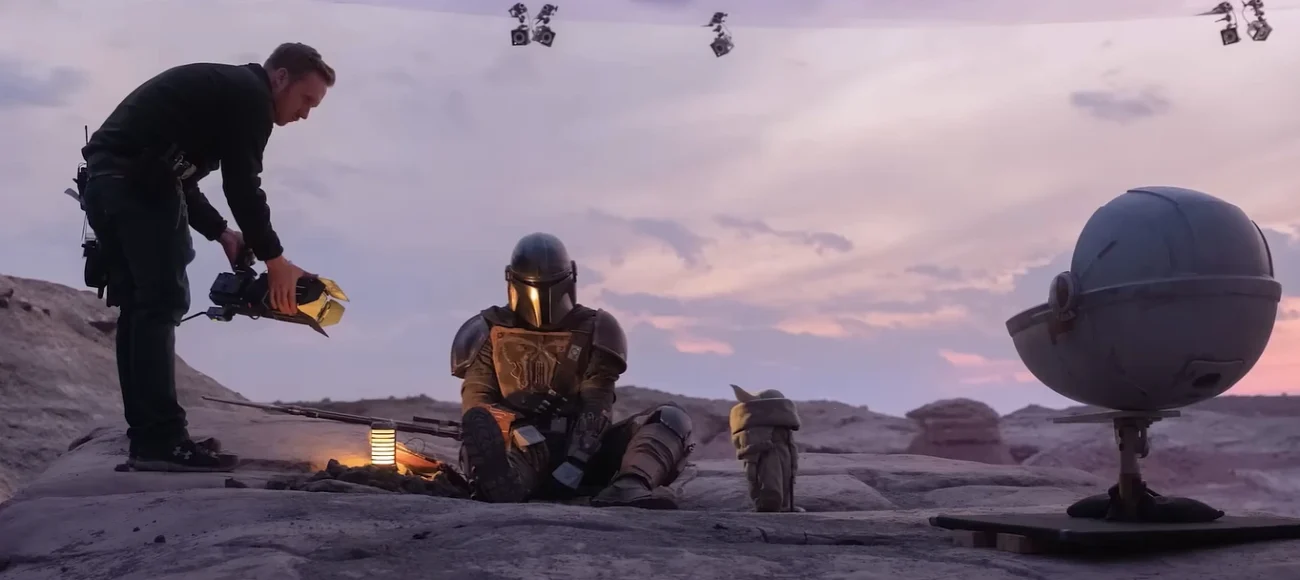
Something quiet happened between 2019 and 2026. Films stopped looking like films.
If you have watched the last few years of prestige television without particularly noticing it, you have been staring at a completely new way of making things. The Mandalorian did it first. Then House of the Dragon. Then Andor, Obi-Wan Kenobi, The Batman, 1899, Ahsoka. No green screens on set. Actors performing inside actual glowing walls of computer-generated worlds. Reflections that behave properly. Sunsets that hit an actor’s face as if the sun were really there.
The technology behind that shift has a very unglamorous origin. It came from factories. Specifically, it came from the kind of high-precision 3D vision cameras that were originally built to check whether the panel gaps on a car door were correct to within a few microns. Nobody in a Nissan plant in Sunderland was thinking about Star Wars when they were speccing out their inspection systems in 2016. But the technology they needed was, more or less, the technology Jon Favreau would use three years later to make The Mandalorian.
That is the whole story here. The most quietly interesting technology shift in modern film comes directly from industrial machine vision. And the trickle-down has now reached your phone.
The Mandalorian Moment

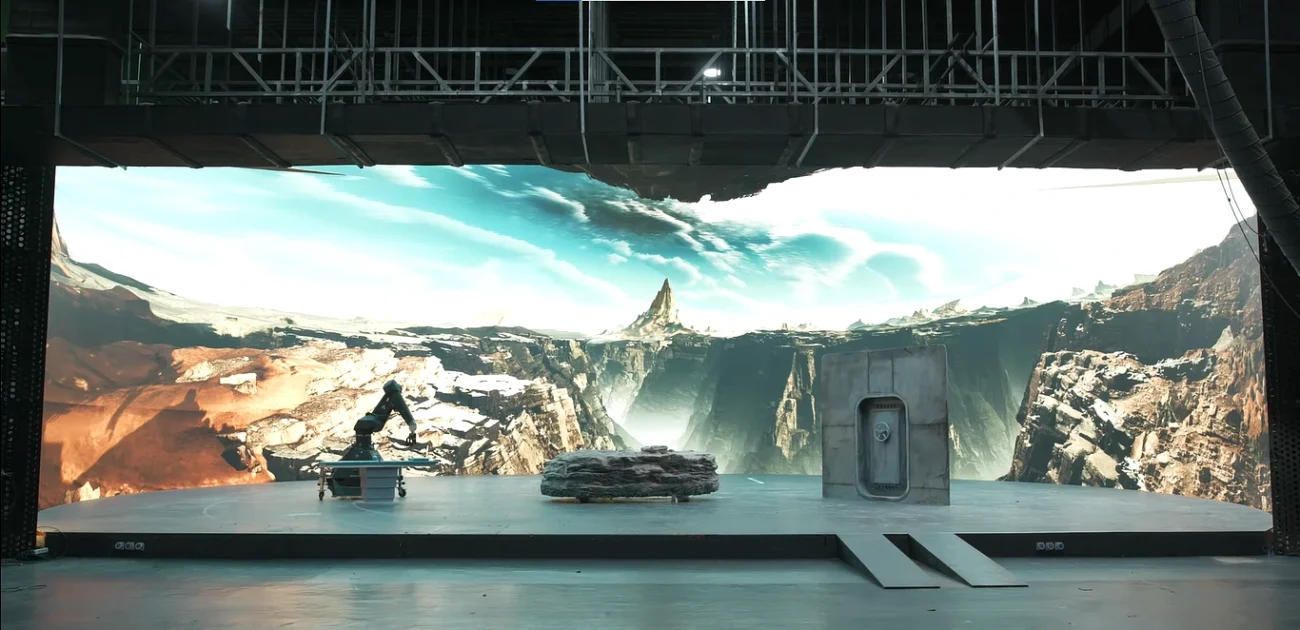
Here is what changed. In November 2019, Disney Plus launched with a Star Wars series that was not filmed the way anything had been filmed before.
Jon Favreau, working with Industrial Light and Magic, had built something called an LED Volume. A 20-foot-high semicircular wall of high-resolution LED panels, 270 degrees around a 75-foot-diameter performance space, with a matching ceiling. Every panel was showing a real-time computer-generated environment, rendered through Epic Games’ Unreal Engine. Actors performed inside it. The camera moved through it. The background changed perspective in real time to match the camera’s movement, using motion-capture tracking that knew exactly where the camera was to the millimetre.
Over 50% of season one of The Mandalorian was shot this way. No location shoots. No green screens. The reflections on Din Djarin’s Beskar armour were reflecting the actual light from the actual desert on the LED wall behind him.
The system was called ILM StageCraft. It won the 2022 Engineering Emmy Award. And it changed the film industry more or less overnight.

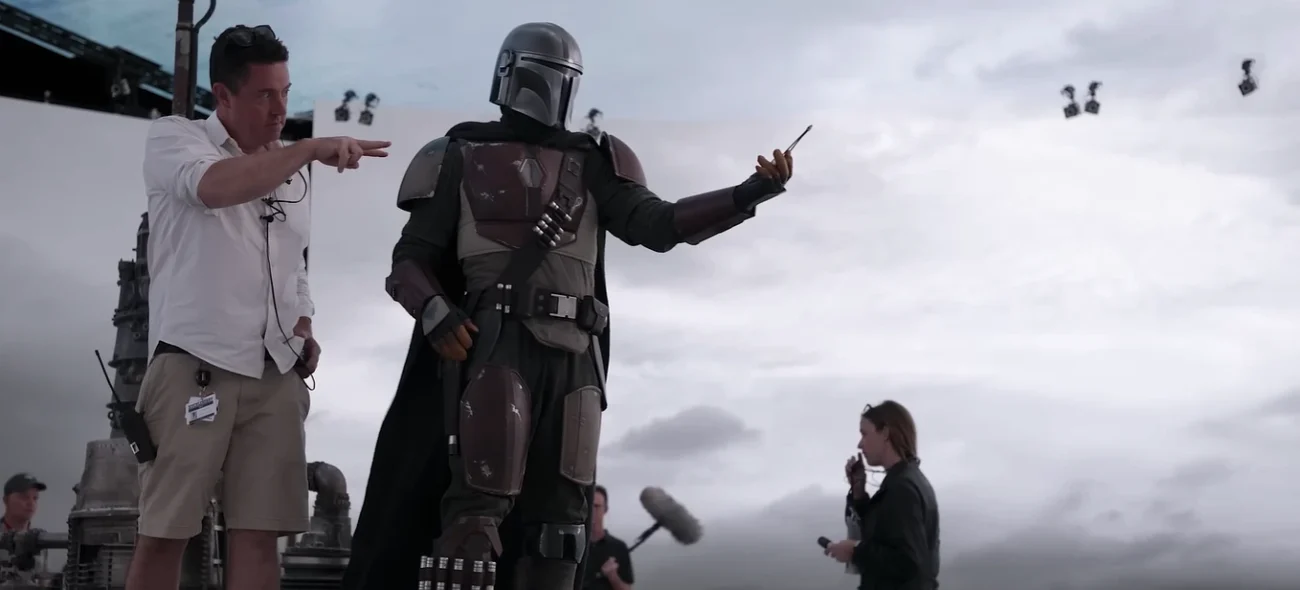
In 2019 there were three virtual production LED stages in the world. By 2022 there were roughly 300 according to Epic Games’ Miles Perkins. Pinewood Studios opened one in London in early 2021. Warner Bros Studios Leavesden built their own for House of the Dragon. Fox Studios Australia built a bigger one. Vancouver got one. The whole industry pivoted, hard, in the space of about eighteen months.
Why It Actually Works
There is a genuinely magical bit of technology at the centre of virtual production, and it is worth understanding because it is the same technology now in your phone and probably in the surveillance camera at your local Tesco.
A camera on a virtual production stage needs to know exactly where it is in 3D space, in real time, to the millimetre. If the camera moves left, the wall behind the actor has to update the perspective correctly, or the whole illusion collapses. The wall does not “know” the camera is there. It is being told, forty times a second, by a 3D tracking system that watches the camera itself in space and calculates its position.
That tracking system is essentially a high-performance industrial 3D camera pointed at the film camera. Same technology as would be used on a factory floor to check whether every widget coming off a production line is dimensionally correct. Same class of hardware, same class of software, same class of speed and precision requirements.
And it turns out this is genuinely hard. You need to capture the position at high frame rate. You need it accurate to sub-millimetre. You need it stable across a full shooting day of hot lights and vibration and people walking about. You need it to keep working when someone drops a coffee cup near the sensor and the light shifts.
These are the exact same problems industrial 3D vision engineers had been solving for the previous decade, for factories running 24/7 that could not afford to stop for a badly calibrated sensor.
Where You Have Seen It Since The Mandalorian
If you have watched any of these in the past four years, you have watched virtual production:

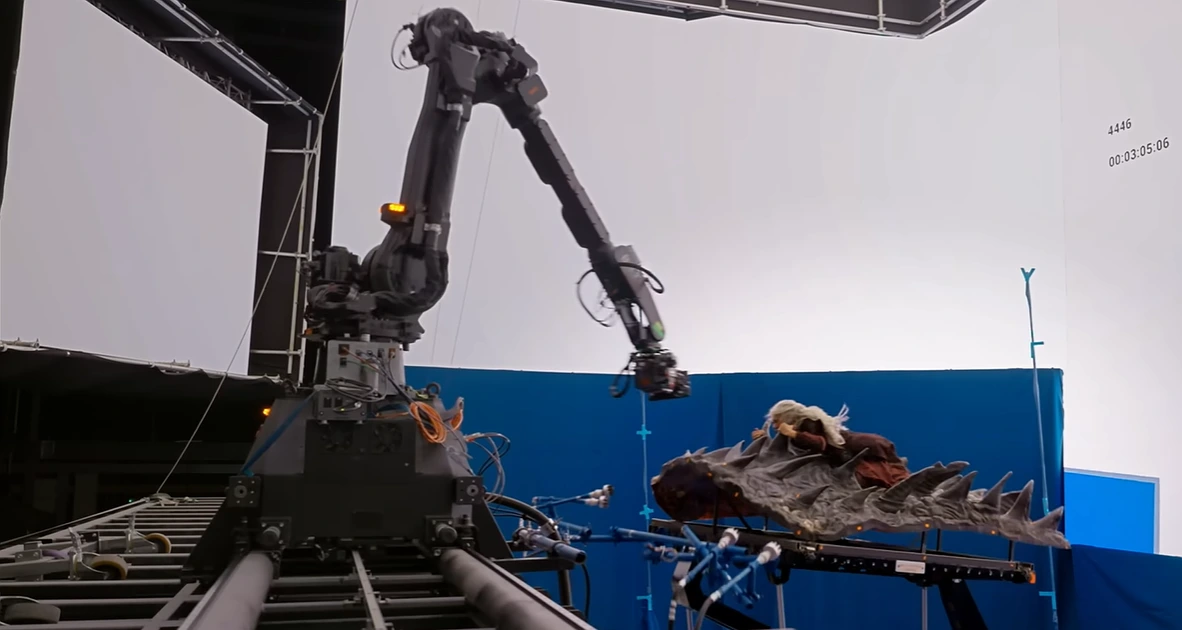
- House of the Dragon. Warner Bros Studios Leavesden built a purpose-made LED volume for the show. The Dragonstone bridge scenes were shot inside it. Rhys Ifans has talked about how virtual production let them shoot dawn or dusk scenes repeatedly without waiting on real weather.
- The Batman (2022). Cinematographer Greig Fraser (who won the Oscar for Dune the same year) used LED stages for parts of the film, particularly dawn and dusk sequences.
- Obi-Wan Kenobi. The city street on the planet Daiyu was rendered live inside a StageCraft Volume.
- Ahsoka. Full StageCraft workflow.
- 1899. Netflix’s German multi-language series shot almost entirely inside a purpose-built virtual production stage in Berlin.
- Andor, The Book of Boba Fett, The Acolyte, Skeleton Crew. All Star Wars, all Volume.
And this is only the visible tip of it. Virtually every major prestige TV production in the UK and US now uses virtual production for at least some of its shooting.
There is one thing worth knowing though. Even Greig Fraser, one of the technique’s most enthusiastic users, has said openly that virtual stages “do not do midday or daytime sunlight very well.” Dawn and dusk, yes. Night, absolutely. Direct midday sun, still difficult. The technology has limits, and cinematographers who understand those limits are the ones getting the good results.
The De-Aging Story, Which Is A Slightly Different Version Of The Same Thing
Sitting alongside virtual production is another technology that also depends on 3D vision. De-aging.
The most famous example is Indiana Jones and the Dial of Destiny (2023), where Harrison Ford, who was 80 at the time of filming, plays a 37-year-old version of Indy in a 25-minute prologue set in 1944. ILM used a system they called FaceSwap. Over 100 artists worked on the de-aging over three years.
Here is how it actually worked. During production, additional cameras were attached to the main camera capturing extra angles on Ford’s face. Full 3D lighting reference photography was done after every setup. Every set was 3D-scanned. All of this data was fed into ILM’s system alongside the entirety of the first three Indiana Jones films, which Lucasfilm scanned at high resolution, and eight-by-ten still portraits from Raiders of the Lost Ark that had pore-level detail nobody had ever captured from the cinematography itself.
The 3D vision element is not obvious but it is central. You cannot de-age a face without 3D data. A flat photograph or video does not give you enough information about the geometry of the face for the system to convincingly rebuild it thirty-five years younger. You need the depth. You need the pore-level topography. You need every setup on set captured in 3D so the digital face can be relit correctly to match the plate.
Ford said at the 2023 Cannes press conference that the results were “very realistic” and that “I know that that is my face. It’s not Photoshop magic. That’s what I looked like 35 years ago.”
The film lost Disney around $140 million and Ford has admitted “s— happens” about the box office. But the de-aging technology itself was one of the technical triumphs of 2023 cinema, and it depended on 3D vision capture at every step.
What This Has To Do With Your Phone
Right, here is where it gets fun.
Apple launched the iPhone 15 Pro and iPhone 15 Pro Max in September 2023 with a feature they called Spatial Video. Enabled via the iOS 17.2 update in December 2023. Uses the phone’s main and ultrawide rear cameras together to record video at 1080p at 30 frames per second, but crucially records it as stereoscopic 3D, capturing depth alongside the image. One minute of spatial video takes roughly 130MB of storage.
The feature was designed to feed into Apple Vision Pro, which launched in the United States on 2 February 2024 at $3,499, and in the United Kingdom on 12 July 2024 at £3,499. Watching a spatial video on Vision Pro genuinely does feel like looking through a window at a memory. Your child’s birthday party from three months ago is suddenly a diorama you can lean into.
But look at what is actually happening in that phone.
Your iPhone 15 Pro is capturing 3D depth data using two cameras that were designed for still photography, computationally combining the two feeds into a stereoscopic 3D video file, and doing it all in real time on a device the size of a bar of soap. The same class of problem as an industrial 3D camera on a car body panel inspection line. Different application, similar underlying technology.
Every iPhone Pro since the 12 Pro (September 2020) has had a LiDAR scanner on the back that projects invisible dots and measures how long they take to bounce back, giving the phone a depth map of everything in front of it. It is what makes portrait mode work as well as it does. It is what makes AR filters actually stick to your face. And it is essentially the same technology, at consumer price point, that industrial 3D vision was doing on production lines a decade ago.
What This Means For Photographers Now
For anyone with a professional or semi-professional interest in photography, this is a genuinely interesting moment.
Volumetric portraiture is a real growing niche. Some wedding photographers in the UK now offer 3D-scanned couple portraits as an add-on. Some fashion photographers use 3D body scans as part of their pre-shoot workflow so they can rework poses in post-production. Music video directors have been using volumetric capture for years for concert visuals and stage productions. Beyoncé’s Renaissance World Tour visuals, Taylor Swift’s Eras Tour projections, Kendrick Lamar’s Grand National tour, all built partly on volumetric capture technology.
The gear that used to cost £250,000 in 2019 now costs closer to £15,000 for equivalent capability. The consumer version (iPhone Pro) is essentially free once you have bought the phone. The gap between industrial-grade 3D vision and consumer-grade has narrowed dramatically in five years, and the applications for photographers have expanded in the same window.
This is roughly where things are heading:
- Product photography. 3D-scanned products can be relit and re-shot digitally, saving reshoots.
- Portrait work. Volumetric portrait sessions where the client is captured in 3D and images are generated in post from any angle.
- Wedding videography. Spatial video capture as an add-on service, with Vision Pro or Meta Quest playback for the couple.
- Fashion. 3D body scanning for pre-visualisation and styling.
- Architectural photography. 3D scans of interiors that can be re-photographed digitally from any position.
None of this replaces traditional photography. It sits alongside it, and the photographers who understand both are the ones with the interesting careers ahead of them.
The Small Genuinely Beautiful Bit
Here is what I keep coming back to.
The technology that lets Din Djarin’s Beskar armour glow correctly in the light of a computer-generated desert is fundamentally the same technology that catches a fractionally out-of-spec car door on a production line in Sunderland. And it is fundamentally the same technology your iPhone uses to capture a spatial video of your niece’s birthday.
One industry solved the hard problems slowly, over about fifteen years, on factory floors that nobody was watching. Then Hollywood found it. Then Apple productised it. And now most of the visual culture you consume, from House of the Dragon to a birthday video on your phone, is running on the same underlying 3D vision technology.
The Volume changed cinema. Spatial video will probably change home photography. And the industrial 3D cameras that started all of this are still doing their unglamorous day job, checking car panels and pharmaceutical packages and food quality, mostly unnoticed. Which is the way most quietly important technology works, honestly.
Worth knowing next time you watch someone’s face light up on a fake sunset in a prestige drama. The sunset is not real, but the camera that made it possible was, and it started life in a factory.