


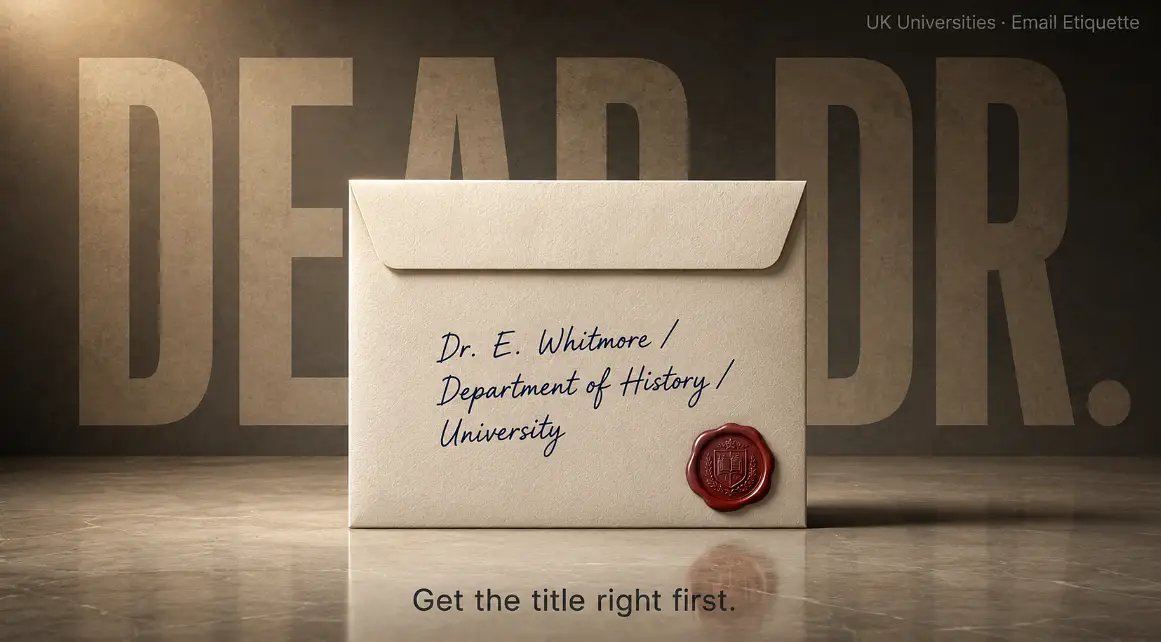
Britain’s students also misaddress the first email to a lecturer, addressing it with “Dear Professor Surname” to someone who may not be a professor at all, forgetting that most are not by the UK system.
According to the official Higher Education Statistics Agency (HESA) figures, 11% of all UK academic staff are employed at the contract level of professor.
Just one in ten higher education academics is a professor. There are 19,975 actual professors, out of a total population of approximately 200,000 higher education staff. Nine times out of ten, when you call a lecturer “Professor”, you are wrong.
That one mistake sets the tone for everything that follows, and the recipient knows from the outset either that you didn’t check, didn’t understand the British academic system, or thought Professor was a generic respectful title the way it functions in America. None of those impressions help you.
So before we even get to subject lines, sign-offs or the right tone, let’s start with the thing that almost nobody explains properly to first-years.
The British Academic Title System, Properly Explained

In the UK (unlike the US), to get this right is the single biggest signal that you have actually thought about the email you are sending.
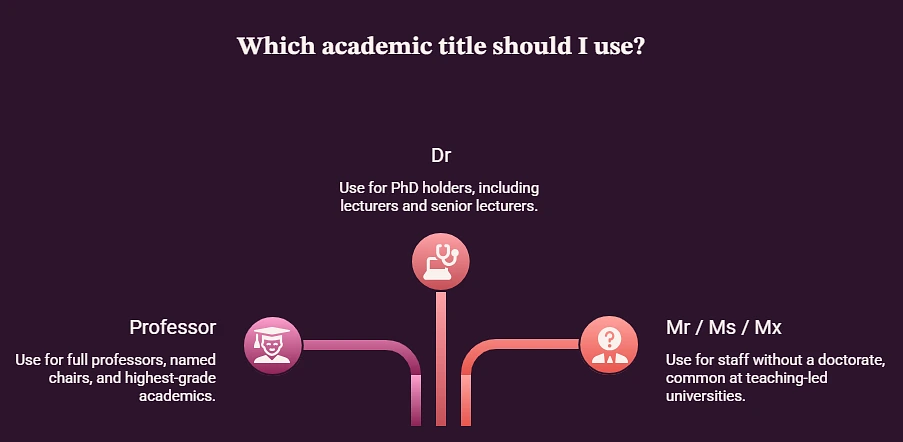
Most UK universities follow a relatively simple hierarchy:
- Professor. Reserved for full professors. The top decile of academic staff. Promotions to the highest grade also give the title, as do appointments to named chairs and similar positions.
- Dr. Anyone with a PhD not in full professorship, such as lecturer, senior lecturer, reader, research fellow. This is the title most of your lecturers actually hold.
- Mr / Ms / Mrs / Miss / Mx. Academic staff who do not have a doctorate. While less common at research-led universities, this approach occurs widely at teaching-led universities.
The complications worth knowing:
- Associate Professor is a newer title. LSE and UCL now have Associate Professors as a formal grade, which means an Associate Professor at LSE goes by Professor. Oxford lets the holder choose, so an Associate Professor there may still be a Dr. Check your staff page before you send.
- Music conservatoires are an exception, the Royal College of Music (RCM), Royal Academy of Music and Trinity College of Music calling all instrumental and singing tutors Professor irrespective of academic rank. A violin teacher at the RCM would be called Professor Surname even if she did not have a doctorate.
- On the American “Dr is always safest” rule, calling a full Professor “Dr” in the UK can be a put-down, especially from other senior academics who themselves earned their chairs. The best safeguard is to check before you write.
If you spend longer than thirty seconds looking for someone’s staff page on your university’s website, it’s the best professional habit you can develop at university. Type the person’s name into the website’s search function, find their matching name in the results, and read the title below the name. That is what they go by.
What Goes In The Subject Line

Most student emails are already doomed to failure from the subject line, before the body text.
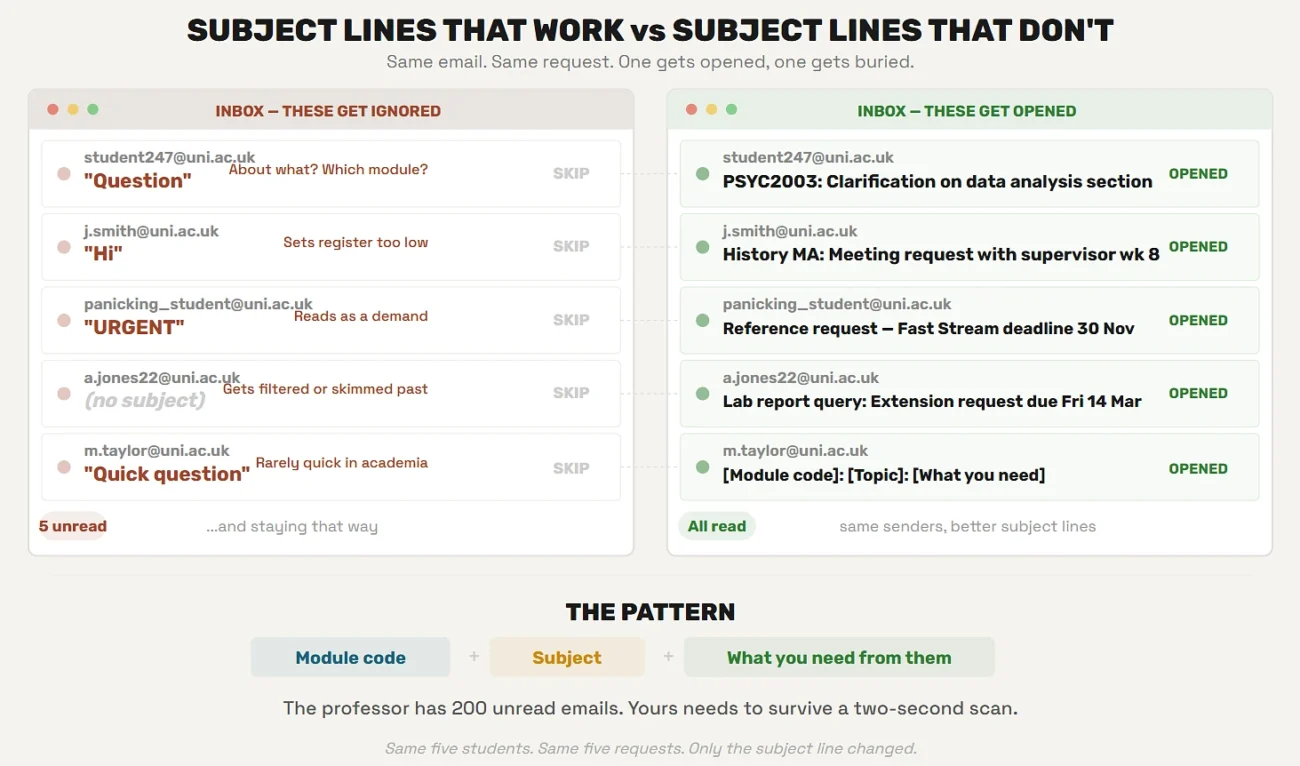
A good subject line identifies who you are and what you are emailing about. You’ll know it’s working. It tells the recipient what they need to do. It doesn’t waste their time.
Academics dislike these subject lines:
- “Question” — about what? Which module? Which assignment?
- “Hi” — sets the register low before they have even opened the message.
- “URGENT” almost never means it’s urgent and reads as a demand.
- No subject line at all — the email gets filtered or skimmed straight past.
- In academia, a “quick question” is rarely quick.
Subject lines that work tend to be: module code if appropriate, subject, what I need from them.
Some examples of this are:
- PSYC2003: Extension request for essay due Friday 14 March.
- History MA dissertation: Request meeting with supervisor week 8 of term.
- Reference request for Civil Service Fast Stream application, deadline 30 November.
- Lab report query: Clarification on data analysis section.
The pattern is the same throughout: the recipient knows what the email is about before they have read the first word of the body. That alone puts you ahead of most students.
The Three Emails That Actually Matter
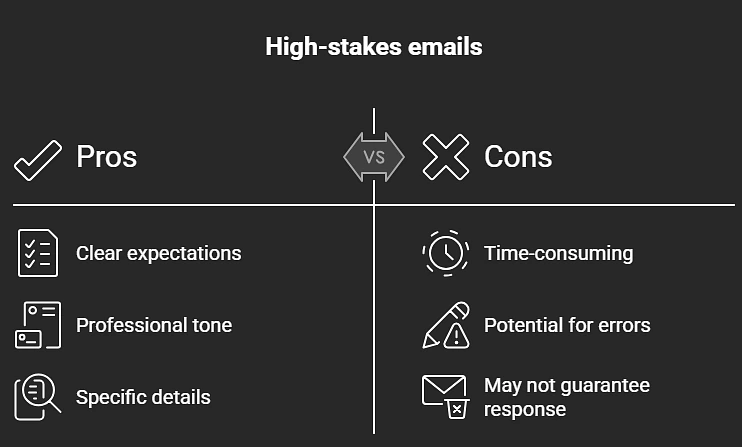
Most emails to academics follow a predictable pattern. But a few call for a more planned approach. These are the ones where getting the right has a real consequence.

The Extension Request
The extension request is the email that students tend to dread most, and it is the one that is most prone to error. If students begin with their reason for needing an extension, they’ll put the reader on the back foot.
The structure that works best:
- Start with: “I am writing to request an extension on the [module code] essay due [date].”
- Then the reason why, without unnecessary detail, in one or two sentences.
- Then the proposed new deadline, not an open request for sympathy. Specifying dates ensures that you have thought it through.
- Include any supporting evidence, such as medical or bereavement, and if your university requires an Extenuating Circumstances form to be filled out, tell them you have submitted one.
- Make sure to sign off correctly. Don’t say “thanks in advance”, because it sounds presumptuous.
In general, it works better to sound like a polite request than a desperate plea. Academics grant extensions all the time. They’re not fans of reading dramatic ones.
The Reference Request
This is the email that determines whether you get a strong reference or a perfunctory one, and most students treat it like a box they need to check.
Including the following in a good reference request:
- Include the job title, organisation, employer name and the application deadline in the body of the email.
- Why you are asking this particular academic rather than another. Did they supervise a project? How well did you do in their module? Be specific.
- What you would like them to emphasise. Without guidance, a reference can become generic. A reference in which three specific things are flagged for emphasis is the one that reads as informed.
- Please include a CV and job specification, so that the academic does not need to ask.
- A reasonable lead time, two weeks. One week is rude. A few days is unworkable.
- An invitation for a follow-up phone call or in-person meeting. Some academics prefer to talk before they write.
The students who get the best references are the students who treat the request as a real ask rather than a tick-box exercise.
The Dissertation Supervisor First Contact
The first email from final year and postgraduate students to a potential dissertation supervisor sets the tone of the working relationship, and you have only one opportunity.
What it must contain:
- A short paragraph on who you are, what year you are in, and what programme you are studying.
- You should be specific about your intended area of research. For instance, “Cold War nuclear strategy” is too broad. Something an academic can actually respond to is: the role of dual-key arrangements in NATO nuclear posture between 1962 and 1968.
- Why this particular academic. Read one of their publications or a module they teach or their research profile on their staff page. Generic emails get generic replies.
- What you are asking for. A meeting? Whether they would supervise you? A reading recommendation?
- If they are already at the maximum number of supervisors they will take on, you may wish to ask whether there is someone else they would recommend.
The email that gets answered is the one where you’ve done the reading, not the one where you’ve asked for the relationship.
The Response Time Reality
Within the UK, the normal expectation among academics during term time is within 24 to 48 hours. There are a number of things that stretch this:
- It is common for Friday afternoon emails to not receive replies until Monday or Tuesday.
- University vacations can last for a week or longer.
- Conference travel and research leave are two to three weeks of total radio silence.
- Marking periods and exam block weeks are slow because all the academics are reading 80 essays.
On top of that, students worry too much about chasing. If you email on Tuesday at 3pm then chase on Wednesday morning that looks panicked. The follow-up window is five to seven working days, or sooner if you have indicated within your original request that there is a genuine time-pressured deadline.
Another one for you, when you’re thinking about your own behaviour. Emails sent at 1am or 2am? Academics see the timestamp. They do not think you are dedicated. They think it is too late and question your time management. If you’ve written it late the night before, use Outlook delayed-send to send it at 8 or 9am the next morning.
The Things Faculty Surveys Consistently Flag

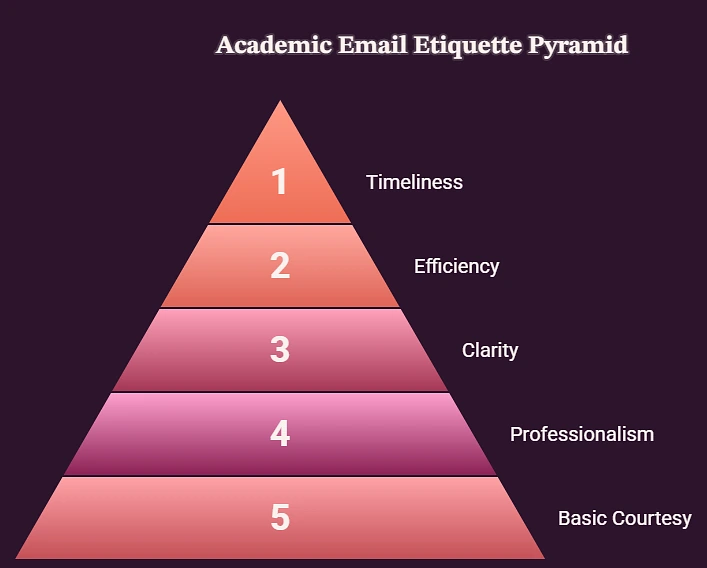
Surveying faculty over several years, and posting the complaints to email discussion forums, has produced a similar list of complaints in the UK and abroad. The most common irritations:
- No introductory greeting: simply asking the request beginning with “hey can you” or just the request.
- Lowercase i’s throughout the email. It’s the single biggest giveaway.
- Emoji of any kind. Even one. Even at the end.
- Personal Gmail addresses containing numbers or jokes used instead of university accounts. One professor who published the survey used the example goody2shoes@gmail.com.
- No subject line or a useless one.
- Command tone emails that sound like: “I need this by tomorrow”, or “please reply ASAP.”
- If your question is covered by the syllabus, consult the module handbook before asking.
- Don’t reply-all to large emails unless it is necessary for all recipients.
- Ending your email without a sign-off, or failing to use “Best wishes”, “Kind regards” or “Many thanks”, depending on register.
- Follow-up messages sent within hours.
None of these are deal-breakers, but three or four of them piled on top of each other in a single email is the kind of thing that will get an eye-roll.
Which Email Address To Send From
Your university account appears to be the default choice for university communication, it identifies you as a registered student of that institution, it has your name attached properly and it routes through the right channels for module emails and reading lists.
The .ac.uk address is ephemeral. Most universities close student email addresses between three and 12 months after graduation; anything you have associated with that address, graduate scheme applications, LinkedIn recovery, professional body memberships, references from people at the university or from whom you want references next year, are gone the moment the .ac.uk dies.
The fix to this is to have a personal long term email account before graduation. The professional email account (firstname.lastname or so; never birthday years or nicknames) is the email that should be used for communications: graduate applications, networking, and anything that will have to be done in five years time.
For students concerned about privacy and relying on encrypted services, Proton mail provides one email option outside the Google platform, particularly useful when dealing with sensitive items such as a passport scan, references and application documents that need additional protection. The principle is the same, whatever you use. You want your long-term inbox to be created before the .ac.uk domain is shut down.
The Email That Lands You An Academic Mentor For Life
In my experience, these student emails stay etched in faculty members’ memories for years.
The one who shows up after lecture, who is referencing a single point from the reading, who is engaging you with a question beyond what you’ve said in lecture, who has actually read the material is quite rare. The academics who receive them remember the name. Students who send them benefit from better references, better relationships with their supervisors and professional networks that can prove priceless years after graduation.
You do not need to do this often. One or two great intellectual emails to each academic a year is enough. But the people who do this are the students who leave university with mentors, not lecturers.
What it looks like in practice:
- Specific reference to something from a lecture or reading.
- A genuine question that you have thought about, not just looked up.
- No demand attached. You are not asking for anything. You are continuing the conversation.
- Short. Three or four short paragraphs maximum.
This is the email almost no first-year ever sends. The students who do it by second or third year are the ones whose academic relationships become genuinely useful.
What This Adds Up To
Email habits at university are not really about email. They are about whether you have learned to operate inside a professional system before you are dropped into one.
The undergraduate who can write a clean extension request, a thoughtful reference request, and a properly addressed first contact to a potential supervisor is also the graduate who can write the first email to a client, the chasing email to a procurement team, and the careful one to a senior partner. The habits are the same. The professional context just changes.
Most students figure this out late. The ones who figure it out early get the better references, the better supervisor relationships, and a noticeable head start in the first weeks of their first job. The cost of learning it now is a couple of weeks of paying attention. The cost of learning it later is being the graduate in the team who gets quietly briefed on how to write a proper email at twenty-three.
Worth getting right earlier than that.