


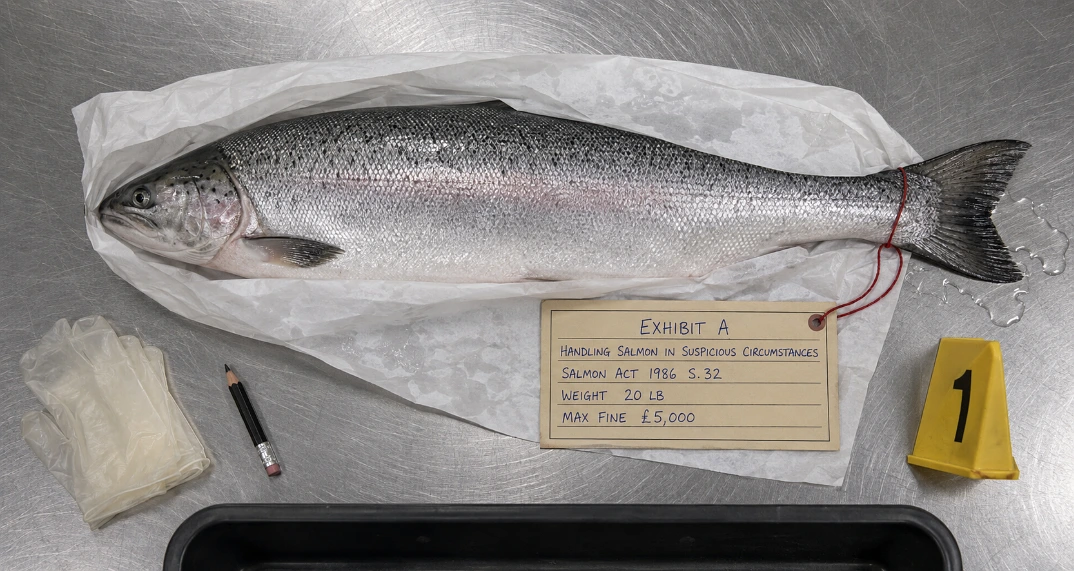
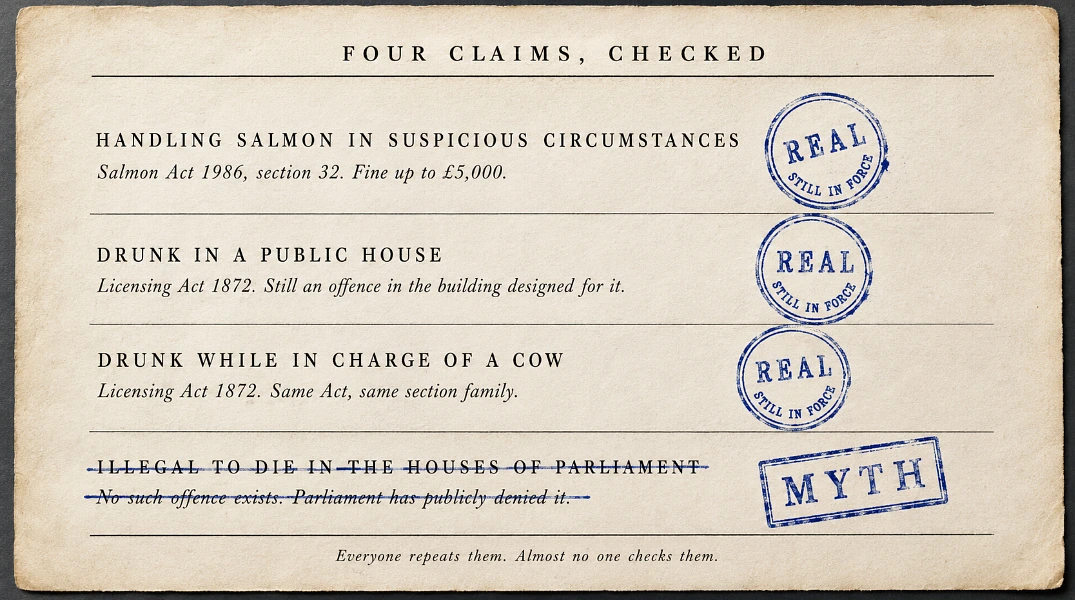
Somewhere in the British statute book, still in force, sits section 32 of the Salmon Act 1986, and its official heading, written by actual parliamentary draftsmen in actual suits, is “Handling salmon in suspicious circumstances“. I did not make that up and I could not have. It is on legislation.gov.uk right now, word for word, and I have read it about four times purely for the joy of it.
A dead letter no court would ever touch, you would assume. Except in 1997 two men were actually prosecuted for moving roughly twenty pounds of salmon across a car park in circumstances the authorities found, well, suspicious. The fine runs to £5,000, with six months inside available for the truly committed fish handler. So if your London trip involves a market, a large fish and a shifty walk, consider yourself warned by this magazine.

Drunk in Charge of a Cow Is Also Still on the Books
The salmon has company. Under the Licensing Act 1872 it is technically an offence to be drunk in a pub, yes, in the one building designed for it, which makes every British Friday night a small festival of lawbreaking. The very same Act makes it an offence to be drunk while in charge of a cow, and I would pay decent money for the court transcript of whichever Victorian evening made that clause feel necessary.
Everyone’s favourite is the claim that it is illegal to die in the Houses of Parliament. Chancers have repeated that one for decades, it even won a television poll as Britain’s most absurd law, and I have to be straight with you because I checked. It is a myth. No such offence exists, and the claim got so big that Parliament’s own people have had to publicly deny it. Which tells you something useful about legal claims generally, everyone repeats them, almost no one checks them, and I spent a whole evening checking the rest of what follows for exactly that reason.

The Occupiers’ Liability Act Was Basically Written for Tourists
Because while chasing the daft ones, this turned up, and it stopped being funny in the best way. Britain has an Act whose entire job is making sure places are safe for people the law itself calls visitors. The Occupiers’ Liability Act 1957 puts a duty of care on whoever controls a premises, a hotel, a shop, a venue, a stairwell, to keep it reasonably safe for the people who come in. A tourist tripping on a broken hotel step in London counts, in the eyes of that Act, as exactly the visitor the law was built for, and the word could not fit better if the tourism board had drafted it.
Shopping carries its own protection through the Consumer Rights Act 2015, which covers you in a London shop the same as anyone born here, and it is one good reason the ticket chancers outside popular venues are best ignored, since a tout’s paper ticket comes with no rights at all while an official purchase comes wrapped in them. Emergency help does not care about your passport either, 999 for the urgent stuff, 101 for the rest, and every embassy in the city will tell you to save both before you save the restaurant bookings.
Injured Visitors Hold the Same Claim Rights as Locals
If someone’s negligence injures you in Britain, a careless driver while you are crossing the road, that unrepaired hotel staircase, a venue that ignored an obvious hazard, you have the same right to claim compensation as any British citizen, and your nationality is irrelevant to it. Honestly this is the fact that made me want to write the piece at all, because visitors assume the opposite so consistently. Being foreign, the thinking goes, must put you outside the system, so injured tourists fly home hurt and out of pocket and let it go, and the assumption is simply wrong.
But how would a tourist even afford an English lawyer?
Another real law answers that, which I found properly satisfying. The phrase no win no fee describes something called a conditional fee agreement, made lawful by the Courts and Legal Services Act 1990, under which the solicitor only gets paid if the case succeeds, and it sits on the same statute book as the suspicious salmon, which I find weirdly reassuring. It exists precisely so a person with a genuine case and no spare money, which describes most injured tourists rather exactly, can still ask the question. And the arrangement has become so completely standard in the decades since that the phrase itself crossed over from legal jargon into London shop signage, there are practices in the city trading under the name outright, No Win No Fee Solicitors being exactly what it says on the door, which is roughly a bakery calling itself Fresh Bread, and honestly I respect the directness. The practical upshot for a visitor is the same whoever handles it, since the model only pays the lawyer on success, asking whether an injury is worth pursuing costs nothing but the phone call, and a case can carry on after you have flown home.
- Worth saving from all of this: 999 and 101 in the phone, receipts kept for anything official you buy, and the knowledge that the claim right exists whatever your passport says.
The salmon offence turns forty soon and Parliament has shown no urge to tidy it away. Fine by me. The statute book that keeps it also keeps the 1957 Act, the 2015 Act and the 1990 Act working for every visitor who walks through arrivals, and unlike the Parliament death rule, every one of those checked out.