


Millions of pounds are spent on supplements every year in Britain alone. And a huge chunk of that money does precisely nothing — not because the supplements don’t work, but because the people taking them have no idea what dose they’re actually supposed to be on.
This isn’t a small problem. The data on supplement dosage habits — from the UK and globally — is genuinely alarming, and collagen is one of the clearest examples of where getting it wrong costs people real results.
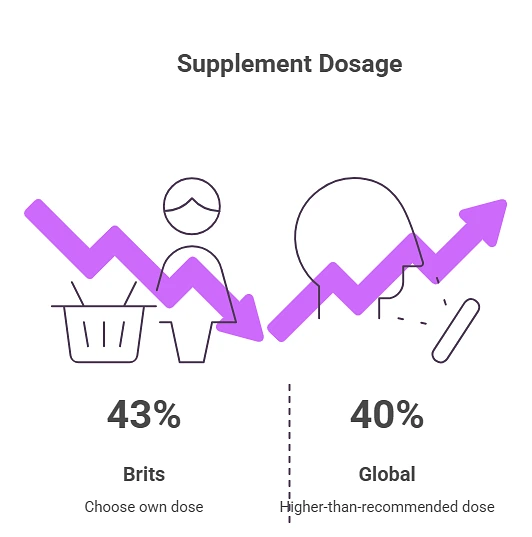
43% of Brits Choose Their Own Supplement Dose Without Professional Input
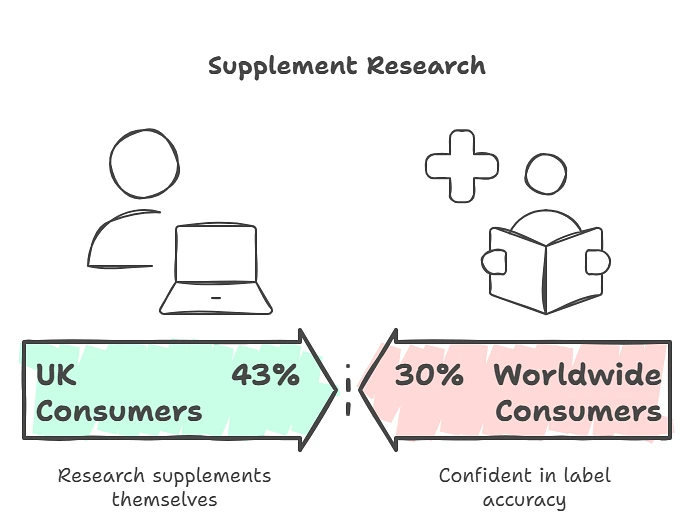
A survey of over 1,000 UK consumers found that nearly half — 43% — prefer to research supplements themselves rather than consult a healthcare professional. Fewer than 20% considered a doctor or pharmacist their main source of guidance.
That figure looks similar everywhere you check. A global survey on dietary supplement habits found that only around 30% of consumers worldwide feel confident in the accuracy of information on supplement labels — meaning the majority are making dosage decisions without a reliable foundation to work from. Globally, the same survey found that 40% of participants admitted to taking higher-than-recommended doses, believing more would produce faster results.

Back in the UK, almost 1 in 4 Brits (23%) admitted to trying a supplement purely because of a trend or influencer recommendation — no dosage research, no context. Just a product in a cart.
What Happens When People Pick Doses Themselves
Two things, mostly. Either they take too little and wonder why nothing’s happening. Or they assume more is better and overdo it.
Which? investigated supplements being sold across the UK online marketplaces and major retailers, including Amazon and Superdrug. What they found was troubling — some products were on sale at doses up to 12.5 times more than the recommended safe daily limit. Not niche products. Mainstream retailers.
The problem isn’t limited to Britain. Research published in Frontiers in Pharmacology found that adverse events related to dietary supplement misuse — driven primarily by improper dosage and duration — ranged from mild gastrointestinal discomfort all the way to life-threatening complications. Global adverse event reports related to supplements have increased by 50% over the past decade, a figure flagged by market health researchers tracking the supplement industry worldwide.
The US National Institutes of Health (NIH) has specifically warned that the risks of supplement side effects increase sharply when people take products at high doses, combine multiple supplements, or use them instead of prescribed medicines. None of those behaviours is rare. They’re common.
On the underdosing side, a UK nutrition study found that even among people actively taking supplements, a significant proportion were still falling short of amounts needed to make a measurable difference. Taking something daily doesn’t automatically mean you’re taking the right amount of it.
Why Collagen Dosage Is Particularly Easy to Get Wrong
Collagen is a useful case study here because the dosage range in clinical research is wide, and different goals require genuinely different amounts.
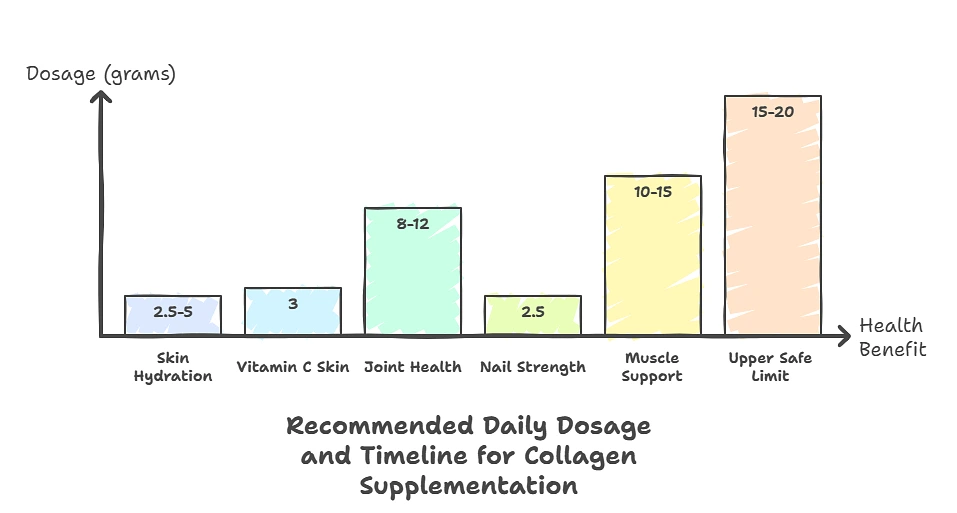
Doses of collagen peptides have been applied in clinical trials of between 2.5 grams and 15 grams per day. The identical supplement, a six-fold variation in dose, based on what a person is seeking.
To achieve skin hydration and skin elasticity, research has found that 2.5 to 5 grams a day can be used, and results can be seen in 8 to 12 weeks of regular use. The research indicates 8 to 12 grams as more effective in relation to joint health. Some research indicates that 10 to 15 grams is best to support the muscles and give them metabolic advantages.

Someone picking up a marine collagen complex without understanding this ends up in one of two camps. They buy a product dosed at 1 or 2 grams per serving, take it faithfully every day, see nothing, then conclude collagen doesn’t work. Or they buy a high-dose product aimed at joint recovery and take it, hoping for better skin, when the evidence for that specific goal sits at a lower dose taken consistently over a longer period.
Neither outcome is the supplement failing. It’s the dosage being wrong for the goal.
The Timing Problem People Consistently Underestimate
Dose is one part of it. Duration is another thing people get badly wrong.
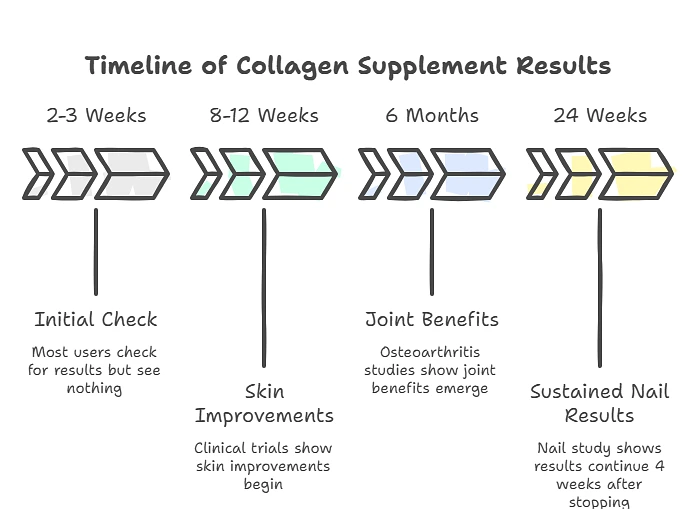
Most people expect supplements to work like medication — take it, feel something fairly quickly. Collagen doesn’t work that way. Clinical trials consistently show meaningful skin improvements start appearing around the 8 to 12 week mark. Joint benefits in osteoarthritis studies took up to six months to show up properly.
A 24-week nail study found that participants taking 2.5 grams of collagen peptides daily saw a 42% reduction in broken nails — and those results kept improving even four weeks after supplementation had stopped. The body had built something lasting.
Most people who start a collagen supplement check for results at two or three weeks, see nothing obvious, and either stop or double their dose. Both responses undermine the process entirely. This pattern isn’t unique to the UK — a European study across the UK, Germany, and Poland found that the majority of supplement users had not sought professional guidance and were making dosage decisions based on product packaging or personal preference rather than clinical evidence.

The Self-Dosing Habit Is a Global Pattern, Not a Personal Quirk
A study in Frontiers in Pharmacology discovered that the prevalence of global self-medication, or individuals adjusting, skipping, or disregarding the prescribed doses, is between 11 and 93 percent, depending on the country and population investigated. The difference between those figures is it all: this is not a niche behaviour of a specific kind of individual. It’s near-universal.
The unifying factor among the nations is that individuals are taking supplements with the same level of carelessness as they would with prescription medication. To feel good that day, no one cuts their blood pressure pills in half. However, using supplements, it seems perfectly natural and even responsible to make any changes or guesses about the dose.
One of the issues is the gap in regulations. In the UK, the Food Supplements Regulations specify that labels must contain a recommended daily dosage, but the safe upper limits are not binding but only advisory. In the US, supplements do not need pre-market approval at all; the companies are left to provide their own evidence, and the regulator only intervenes when issues are reported. NIH has reported instances of prescription medications, such as anticoagulants and anticonvulsants, being sold as dietary supplements. Buyers had no idea.
What the Research Actually Recommends for Marine Collagen
Cutting through the noise, here’s where the clinical evidence sits:
- Skin hydration and elasticity: 2.5 to 5 grams daily, minimum 8 weeks before expecting visible results.
- Skin with added vitamin C: 3 grams combined with vitamin C shows measurable results in multiple trials.
- Joint health and osteoarthritis support: 8 to 12 grams daily, realistic timeline of 3 to 6 months.
- Nail strength: 2.5 grams daily showed a 42% reduction in breakage over 24 weeks.
- Muscle support: 10 to 15 grams daily, combined with resistance exercise.
The upper safe limit for daily marine collagen in healthy adults sits at around 15 to 20 grams. Beyond that, digestive discomfort becomes likely, and no clinical evidence suggests going higher adds further benefit.
One consistently overlooked detail: marine collagen has a lower molecular weight than bovine collagen, giving it a slight absorption advantage. Gram for gram, you may need a little less of it to achieve equivalent results — worth knowing when comparing products on dosage alone.
What to Actually Do Before Starting Any Supplement
Check the dose on your product against what the research says for your specific goal. Not the general recommended daily intake on the label — that’s often a minimum, not an optimum.
Set a realistic timeline. Eight weeks at minimum before drawing any conclusions. Twelve is better.
If you’re taking any prescription medication, ask a pharmacist before adding anything. Marine collagen can affect platelet function, which matters if you’re on blood thinners. It’s not a common interaction, but it’s a real one flagged in clinical literature.
And if you’re buying from online marketplaces — Amazon, eBay, Superdrug Marketplace — check the actual dose on the product. Which?’s investigation made clear that risky doses are being sold at mainstream UK retailers without any obvious warning to buyers.
Supplements are not magic, and they’re not harmless. Getting the dose right, for your goal, your weight, your timeline, is the part that determines whether you’re spending money on something useful or on very expensive nothing.
This article is for general information purposes only. Consult a healthcare professional before starting any new supplement regimen.