


Let me guess what your Search Console looks like. Impressions crawling along the bottom, clicks basically flat, and a folder full of articles you were genuinely proud of when you hit publish. If you run a small magazine site, or you write one entirely on your own, this is probably exactly where you are sitting right now. You did the content. The visibility never came.
Now hold your horses before we get into any list, because this is where most guides go wrong from the very first line. I am not here to hand you 7 clickable links. That is not what this is about, at least not to me. The way I look at it now, if something is evidencing you anywhere outside your own website, I count it as Off-Page SEO. A quote in someone else’s article. A group post. A founder bio sitting on a site you do not control. A Flipboard share. All of it. The link is one signal out of many now, and honestly it is not even the loudest one anymore.
Right. Seven things that actually move a magazine.
HARO Is Dead and Half the Guides Have Not Noticed
This one catches people out constantly. HARO shut down in December 2024. The Connectively rebrand flopped, the plug got pulled, and yet you will still find articles published last month telling you to sign up for HARO like nothing happened. That tells you exactly how those articles got written, and it is not flattering.
The replacements that actually work are SOS, which is Source of Sources, Qwoted, and the #journorequest hashtag over on X. Same trade as before. Journalists need people worth quoting, you run a publication and know your category, so you answer their requests with something specific and your name lands in real publications. For a magazine that is a double win, the mention builds the brand and the author at the same time.
But there is a harder version of this that almost no one bothers with. Go direct. Skip the platforms sometimes, find the writers themselves on X, the ones holding actual contributor bylines, and pitch them a genuinely useful angle from your niche. I mean writers at places like:
- Forbes and Entrepreneur, both running big contributor networks full of people permanently hunting for fresh angles.
- Business Insider and HuffPost, whose freelancers basically live on X and do respond to good pitches.
- The trade titles inside your own category, which honestly convert better than the famous names because the relevance is exact.
Does it take work? Obviously. That is rather the point. The things that take work are the things the other ten thousand small magazines are not doing.
The Platforms Publishers Live On, and the Shortcut People Feel Weird About
Flipboard. Google Discover. Apple News. Newsletter swaps with the magazines sitting next to yours. You will not find these in generic SEO guides because a plumbing company cannot do anything with them. A magazine can, and they feed exactly the branded searches and referral visits every ranking system is watching for.
The mistake I keep seeing is people create a brand new Flipboard account, a brand new Pinterest page, zero followers on both, and start posting their own links into the void every morning. Technically correct. Practically pointless for about a year.
So let me say the quiet part. You may reach out to the pages that are already big on these platforms. The Flipboard curator with a hundred thousand followers. The Pinterest account that basically owns your category. Ask them to feature your work.
Some will do it because the content is good. Some will charge a small amount. Pay it.
People spend thousands of dollars on a press release that disappears inside a week, then get squeamish about paying a page with a real audience a fraction of that. Make that make sense. You are renting reach, that is all this is, and right now it is the cheapest reach on sale anywhere.
Press Releases Still Work, Just Not for the Reason You Think
I can feel the eye roll from here. Press releases earned their reputation, all those announcements about revolutionary platforms that no journalist has ever read willingly.
That is not what this is though.
Watch what happens to a wire release in 2026. It gets crawled almost instantly, syndicated across dozens of news domains, and swallowed by AI bots within hours. The AI Overviews and the answer engines are permanently hungry for recent, structured, factual statements about brands and people, and a press release is exactly that shape. So the real job of a release now is not impressing an editor. It is feeding the machines a clean, dated record of who your magazine is and what it just did, written in your own words. When someone later asks Gemini or ChatGPT about your niche, part of what it knows about the names in that niche came from you. You trained it yourself.
Save them for real events though. A data report. A notable interview. A milestone worth recording. The machines are getting better at smelling filler too.
The Founder Bio Is Where E-E-A-T Actually Lives

Everyone chants E-E-A-T like the acronym settles something. Fine. But what does it look like in practice for a two person magazine?
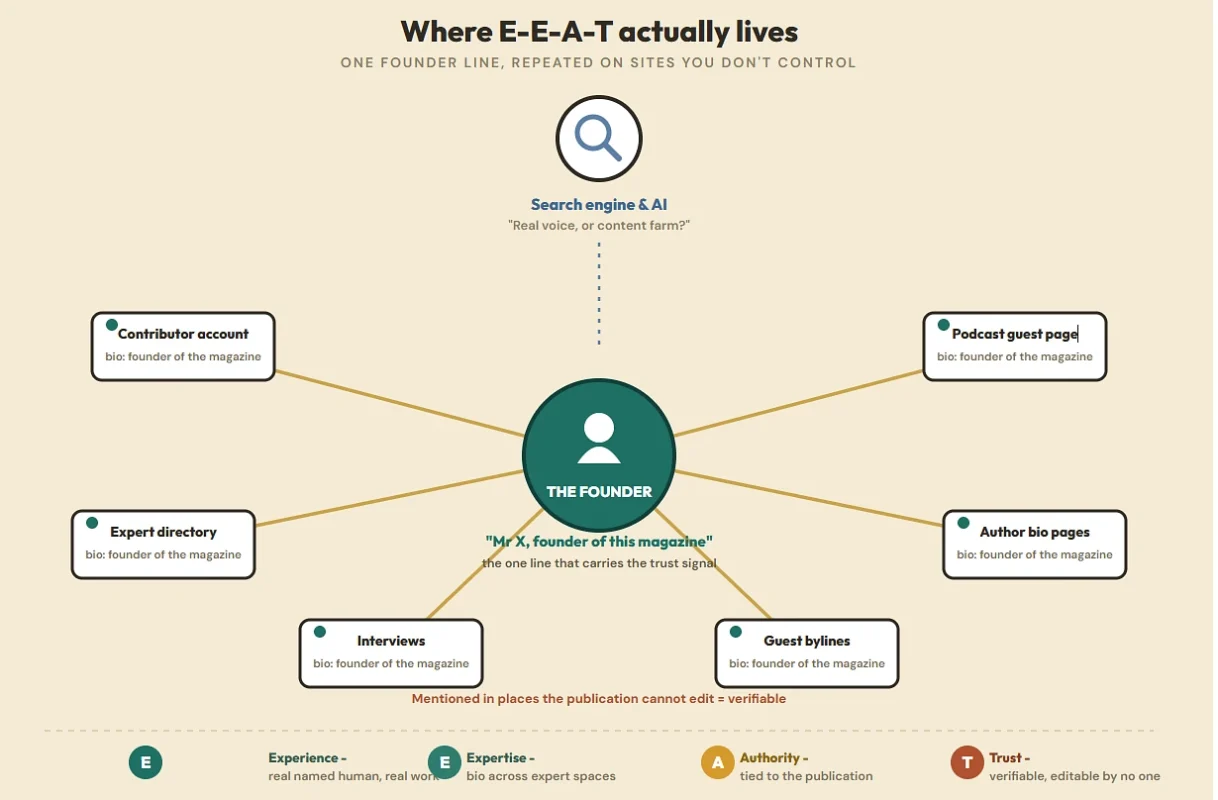
Smaller than you would think. Wherever a website gives you the option of signing up as an author, take it. Contributor accounts, expert directories, podcast guest pages, anywhere that carries a real author bio. And in that bio you write it plainly: Mr X is the founder of this magazine. That single line, repeated across different websites you do not control, is where the whole trust signal actually comes from. A named human, verifiable, tied to the publication, mentioned in places the publication cannot edit.
Boring work. Genuinely boring. But when a search engine or an AI model is deciding whether your magazine is a real voice or another content farm, the founder with bios and interviews scattered around the web has answered that question before your articles even get read.
You Are Already Sitting on Citable Data
The standard advice here is publish original research, which sounds lovely and helps absolutely no one, because a small magazine is not commissioning a study.
But look at what you already have. You know what your readers clicked most this winter. You know which category on your site grew fastest this year. Run one question in your newsletter or on your socials, a hundred answers is plenty for an interesting line. 68% of our readers plan to cut a streaming subscription this year. That is a citable sentence. Put two or three findings like that into a short report with a number in the title and you have built the one thing every writer on a deadline is desperate for, a specific stat with a source they can point at.
Fair warning, this compounds slowly. The first report gets two mentions if you are lucky. The third one starts getting found by writers searching for numbers. Keep the format the same each time and date everything.
Reddit Is Google’s New Affair, and Facebook Is Not Far Behind
You have seen it yourself, surely. Search almost anything and Reddit threads are sitting on page one like they pay rent there. Reddit is Google’s new affair and neither of them is being remotely subtle about it. So why fight it. Take the advantage.

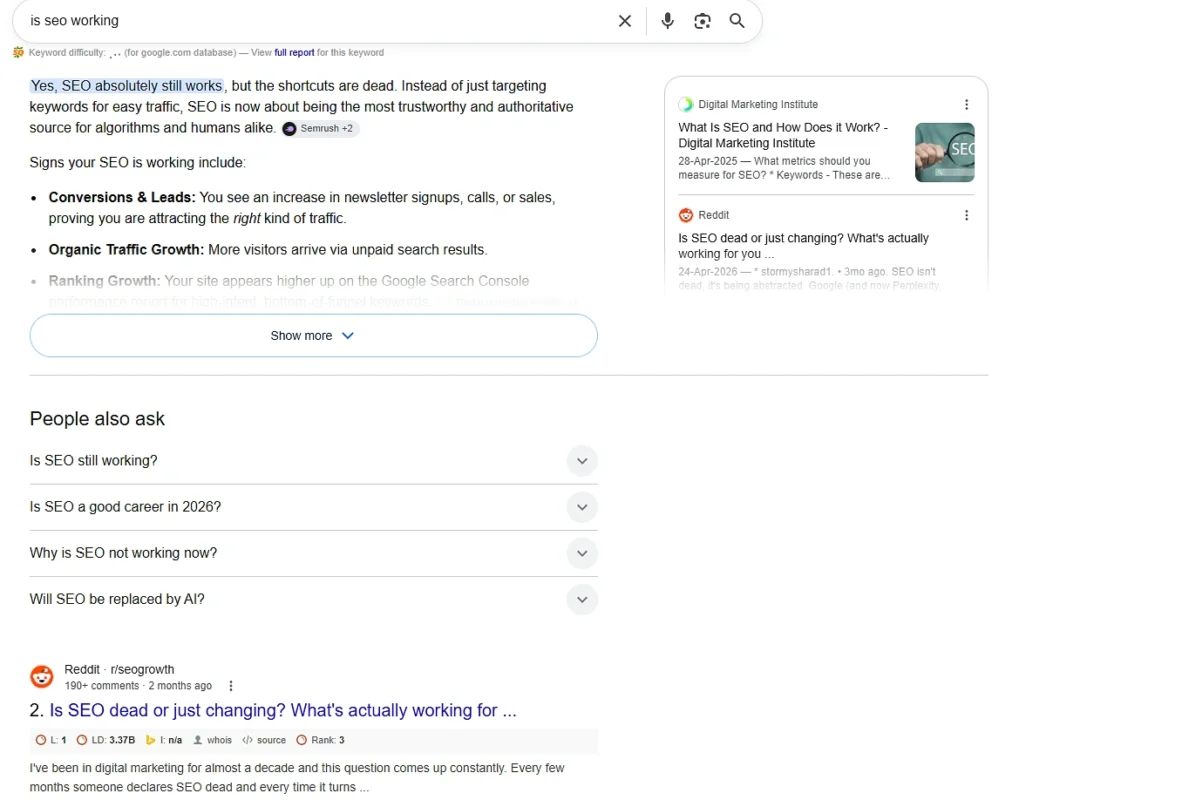
Oh SIRE, SEE THIS REDDIT AGAIN. When I searched “IS SEO WORKING“
And Facebook is not exactly playing hard to get either. Google has been pulling Facebook group posts into the results heavily lately, public group discussions ranking for real queries, which makes Facebook look a lot like Google’s new girlfriend. Two years ago that sentence would have sounded mad. Today you can test it in thirty seconds.
The way in matters though. Join as yourself. Founder, author, actual name, not a brand account. Find the groups and the subreddits where people ask the exact questions your magazine covers, and answer them properly, in your own words. Where it genuinely fits, quote your own coverage the way you would quote anyone else’s. We looked at this last month and found such and such. That reads like a person. A bare link dropped with no context reads like spam, and Reddit especially will burn you for it, that crowd can smell promotion from three subreddits away.
Social Posts Are Off-Page SEO Now, Argue With the Data Not With Me
People still file social media under brand awareness and keep it in a separate box from SEO. Go and test that belief yourself. Search a handful of everyday queries and count how often the AI answers cite social platforms. Or open Semrush, look up facebook.com and instagram.com, and see how many AI Overviews and answer engines are leaning on them.
Here you go:

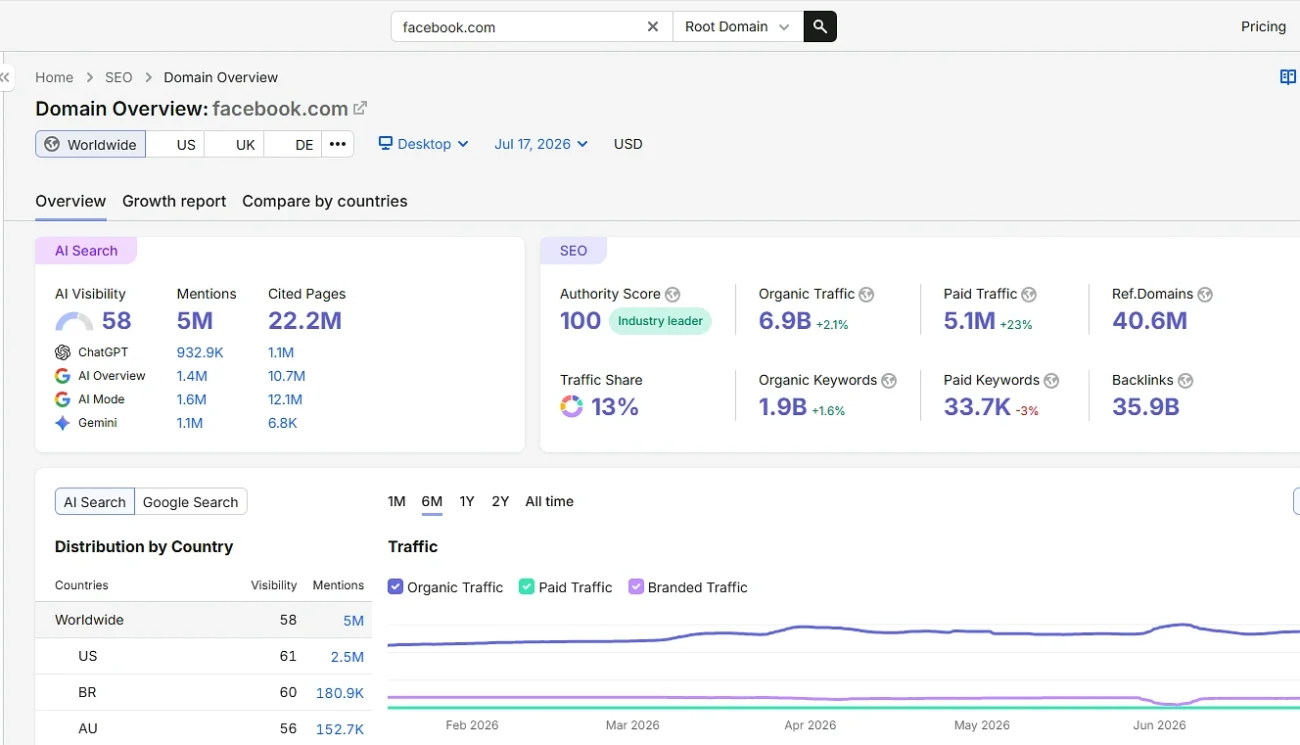
I checked it again on July 17, and it keeps increasing.
Google’s AI Mode, ChatGPT, Gemini, the lot. Social content is shaping what the machines say, and it is quietly shaping what search itself shows.
Now, what I am not saying. I am not telling you to post one homepage link every day from your page with its 10 followers. You can. It will not hurt anything. It also was never the mechanism.
The mechanism is borrowed reach. Contact the established X accounts in your industry, the ones people actually follow, and ask them to share your piece or set up something ongoing. Posts from known accounts surface straight into Google Discover, they get scraped into AI answers, and they trigger the branded searches that tell every ranking system your magazine is something people go looking for. One share from the right account beats six months of posting into your own empty room.
What All Seven Have in Common
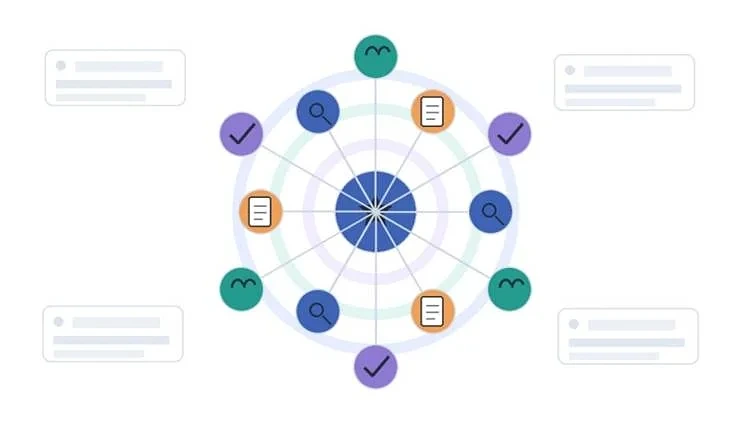
Read the list back and notice what is missing. Not one of these says acquire backlink. Every single one is your magazine turning up, as itself, with named humans attached, in the places where its readers and the machines already spend their time. The links arrive as a side effect, which happens to be the exact order search engines want to see them arrive in.
Off-Page SEO for a magazine is reputation with receipts. Slow, yes. Slower than anyone wants. But things built this way do not fall over when the next update lands, and that is the only guarantee worth chasing now.