


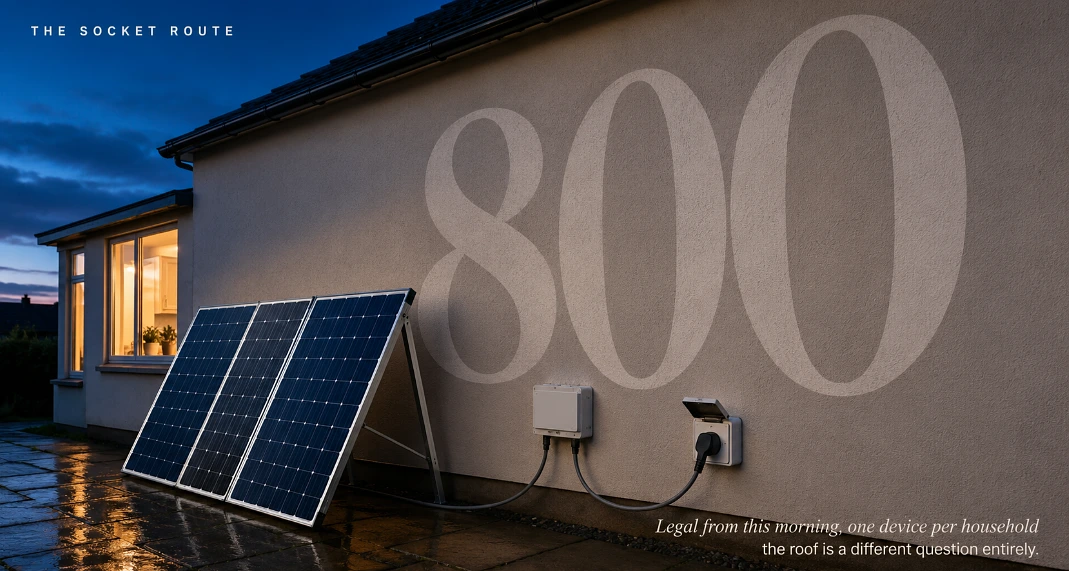
Plug-in solar becomes legal in Great Britain today. SI 2026/848 comes into force on 27 August 2026, and from this morning a certified plug-in device can go into an ordinary 13A socket without an electrician.
For renters and flat dwellers that opens a door that was shut. For anyone with a usable roof, the two routes are not really competing, because they do different jobs at different scales with very different money attached.
The question underneath both is the same one: how much of your electricity are you actually trying to replace? An 800W device and a 4.5 kWp array sit at opposite ends of that answer, and working out what solar power for your home can realistically cover is what decides which end you belong at.
What the Plug-In Route Legally Allows

DESNZ published its consultation response on 16 July 2026 after receiving 466 responses, with 85% supporting the proposed product specification. The regulations were laid before Parliament the following day and came into force on 27 August 2026.
The limits are tight:
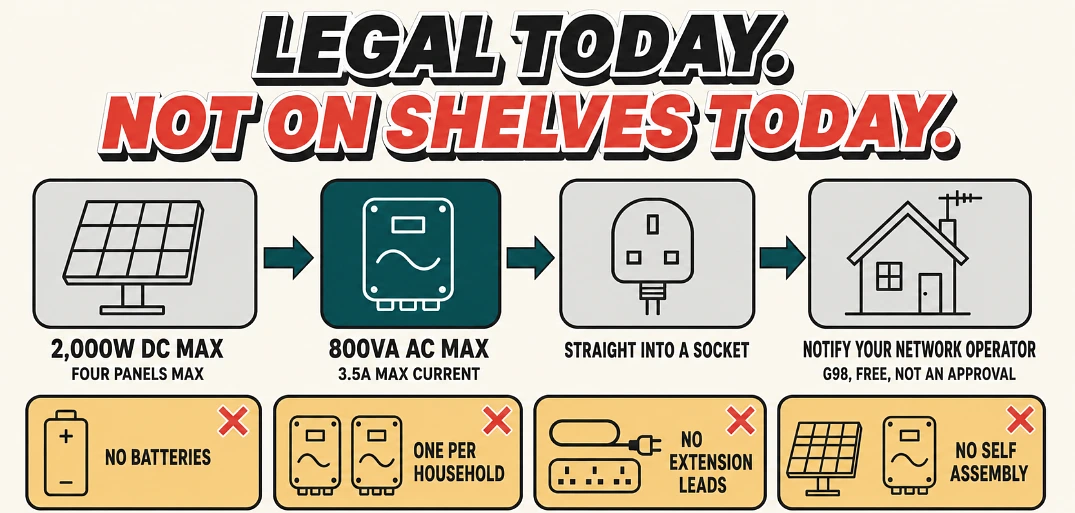
- 800VA maximum AC output from the inverter, with a maximum current of 3.5A.
- Solar panels with a combined maximum output of 2,000W DC.
- One plug-in solar device per household under the current G98 network requirements.
- No batteries. Plug-in solar devices with integrated solar battery storage are excluded from this socket-based route.
- The system must be supplied as a complete product that complies with Interim Product Specification version 2. Combining independently purchased panels, cables and an inverter does not create a compliant system.
- You must notify your Distribution Network Operator within 28 days of commissioning the system under G98. For a single compliant installation, this is normally a connect-and-notify process rather than an application for prior approval.
Before buying, check that the exact manufacturer and model are registered through the Energy Networks Association’s system and that the product documentation includes a declaration of compliance with IPS version 2. A UK three-pin plug or a retailer’s claim that a product is “G98 compatible” does not, by itself, prove that the complete system qualifies for the plug-in route.
What 800W Actually Returns
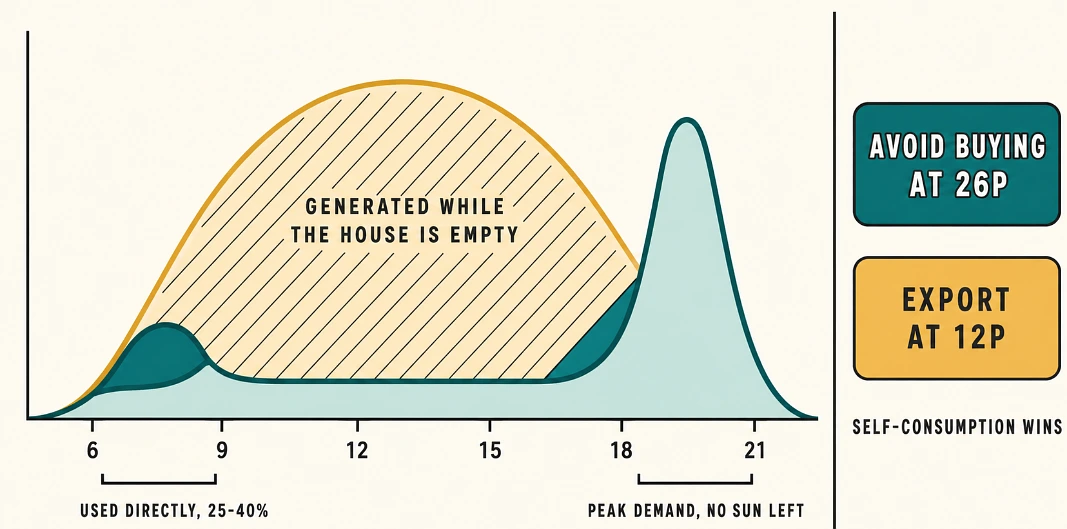
An 800W plug-in system in Britain generates roughly 650 to 800 kWh a year. Without storage you will use maybe 25 to 40% of it directly, since output peaks when most homes are empty.
Assume nothing for export, because plug-in devices have no route into the Smart Export Guarantee.
That works out at around £40 to £85 a year, with payback somewhere between five and ten years. German balcony solar posts claiming two year paybacks generally count every kWh generated, including everything exported for nothing. Different sum entirely.
What a Roof Array Returns, and the Two Things Plug-In Cannot Touch
A typical 4.5 kWp array runs around £6,100 on the Energy Saving Trust’s July 2026 benchmark, before storage or building work.
Two financial mechanisms apply to that route and to nothing else.
Zero rate VAT on solar and battery storage runs until 31 March 2027, worth roughly £1,200 to £1,600 on a domestic installation. From April 2027 it reverts to the reduced rate rather than disappearing, but the current position is the most generous homeowners have had.
Smart Export Guarantee payments need an MCS certified installation and an export meter. Rates vary enormously, from about 3p up to 12p on the best widely available flat tariff, higher on time-of-use tariffs and higher again if you have a battery and can export into the 4pm to 7pm peak. A 4kW system exporting 1,500 to 2,000 kWh a year earns somewhere between £60 and £300 at flat rates.
Keep the MCS certificate and the DNO paperwork when the system is commissioned. The SEG application needs both, and you can take your export tariff from a different supplier than the one selling you electricity.
Start With the Bill, Not the Hardware

Pull up a recent bill and think about a normal weekday.
If the aim is offsetting the fridge, the router and standby load, a plug-in kit does that. If it needs to cover cooking, laundry or an EV, 800W will not get close and the roof is the honest answer.
Timing carries as much weight as total use. A house empty from nine to five exports most of what a roof array makes unless appliances run on timers or a battery holds the surplus until evening. Self-consumption savings beat export income almost every time, because you avoid buying at around 26p while exporting at 12p.
Why the Two Systems Behave Differently
Both convert sunlight to AC through an inverter, and that is where the similarity stops.
A plug-in device is panels, a microinverter and a plug, feeding one circuit inside fixed limits. A roof array is designed around your usable area, orientation, shade and demand, with a dedicated connection and room for export, storage, EV charging or electric heating. Microinverters serve individual panels. String and hybrid inverters manage larger arrays, and a hybrid can coordinate a battery.
Neither one keeps the lights on in a power cut

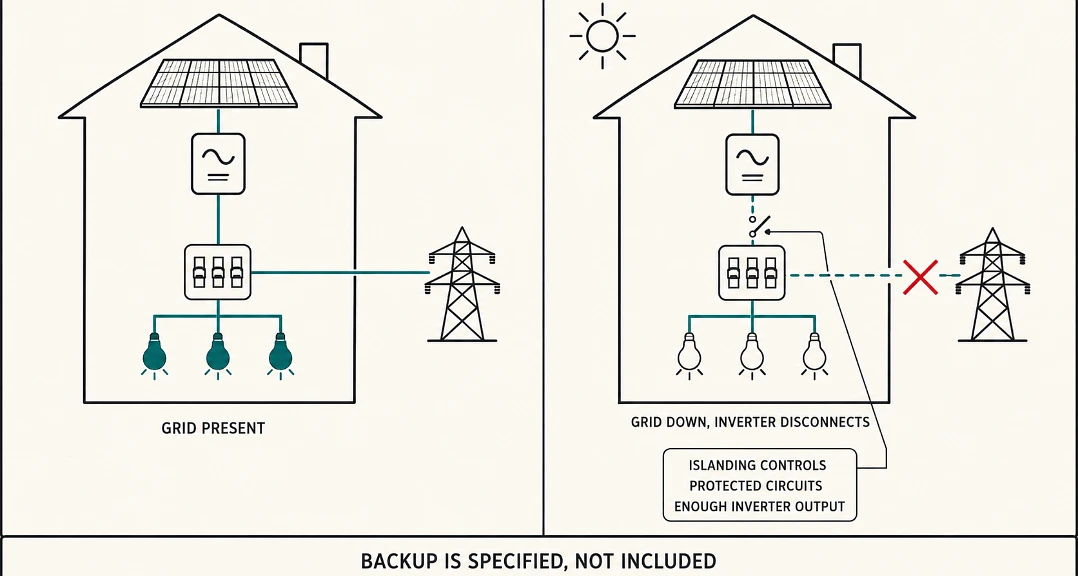
Not by default. Grid connected equipment disconnects automatically to protect network workers.
Backup requires islanding controls, protected circuits or whole-home switching, and enough inverter output. If it matters, specify it. It does not arrive with panels.
Which Route Fits Which Household
| Plug-in kit | Rooftop system | |
|---|---|---|
| Typical role | Offsets a small daytime base load | Serves a large share of demand |
| Cost | Kit price only, no install | Around £6,100 for 4.5 kWp |
| Annual return | £40 to £85 | Self-consumption savings plus SEG income |
| VAT | Standard rate | 0% until 31 March 2027 |
| Export payments | None available | SEG eligible with MCS certificate |
| Storage | Excluded by the specification | Can be designed in |
| Best fit | Renters, flats, no suitable roof | Owner-occupiers with roof space |
Renting or in a flat
The socket route is genuinely open now. Before buying, check the tenancy agreement, any planning constraints, how panels would be fixed, shading across the day, and cable routing.
Research published in February 2026 found panels on balconies create semi-enclosed spaces that trap heat during a fire, so check the building’s fire safety plan before mounting anything.
Owning the roof
Get a survey and a generation estimate accounting for orientation, shade, scaffolding and any repairs due. A south facing roof and an east west split produce noticeably different annual yields, and that difference decides whether storage earns its place.
Growing electrical loads
Heat pumps, EVs and induction hobs shift both annual use and peak demand. Review a full year of bills. A plug-in device shaves base load. A designed array can allocate capacity across what you use now and what you add later.
When the Decision Becomes About the Whole System
Past a certain size the question stops being about panels and becomes about coordinating generation, storage, consumption and backup together.
For owner-occupiers going the rooftop route, EcoFlow’s OCEAN range uses LFP battery chemistry, starts at 5 kWh of modular capacity, covers single and three phase, and manages solar surplus, time-of-use tariffs and backup reserve through one app. That suits a household wanting one managed system rather than a panel-only install, which is a different proposition from anything a socket device can do.
Whichever way you go, size it against measured consumption and a qualified installer’s assessment rather than a headline figure.