


My cousin moved to Texas three years ago. Called me last winter absolutely baffled because her heating comes out of vents in the ceiling. Vents. In the ceiling. She kept looking for radiators that didn’t exist and genuinely thought the house was unfinished.
That conversation stuck with me because it’s one of those things you never think about until you’re standing in a foreign bathroom wondering why nothing works the way you expect it to.
Plumbing — and everything connected to it — is one of those invisible differences between American and British homes that nobody really talks about until they’ve lived in both countries. The pipes are different. The way hot water works is different. Even the toilets flush differently. And once you start noticing, you can’t stop.
The Boiler vs Furnace Situation
This is the big one.
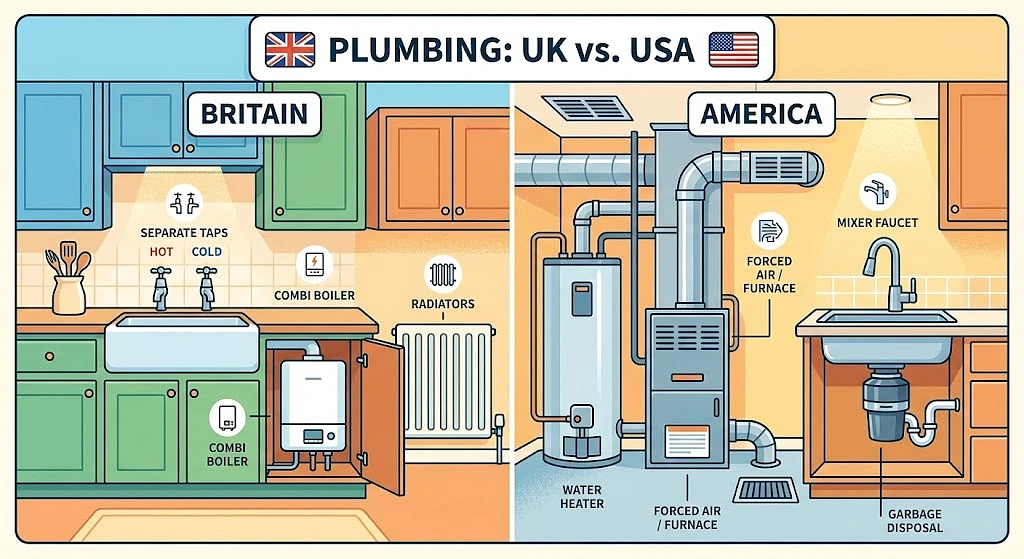
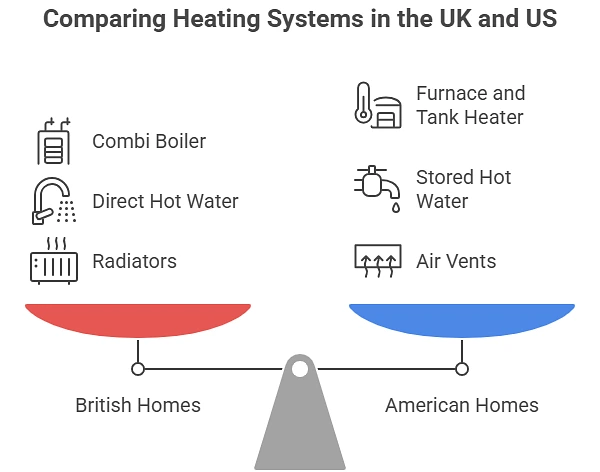
Walk into almost any British home and somewhere — usually a kitchen cupboard, sometimes an airing cupboard upstairs — there’s a combi boiler. One unit. It heats your water and runs your radiators. When you turn the hot tap on, the boiler fires up and sends hot water directly through the pipes. No storage tank needed with a combi, which is partly why they’ve taken over the UK market. Space is tight in most British houses and nobody wants a massive cylinder taking up half the landing cupboard.
American homes? Completely different setup. Most houses run a furnace that blows warm air through ductwork in the walls and ceilings. That’s your heating sorted. Then separately, usually in the basement or garage, there’s a water heater — a big tank that keeps 30 to 80 gallons of hot water sitting there ready to go. Some newer American homes have gone tankless, but the traditional tank heater is still everywhere.
The result is that British homes have radiators and American homes have air vents. Neither system is objectively better, but each country finds the other one slightly mad. Americans think radiators are old-fashioned. Brits think having warm air blowing at you from the ceiling is deeply weird.

Finding a Plumber When Everything Goes Wrong
Here’s where the two countries couldn’t be more different.
A pipe bursts at midnight in Britain and your first instinct is probably to call the bloke your neighbour used last year. Or you check Checkatrade. Or you ring your landlord and make it their problem. There’s a whole culture around having “a plumber” — someone your family has used for years, whose number lives in your mum’s phone under “Dave Plumber” with no surname because she’s never needed one.
Emergency callouts in the UK run somewhere around £75 to £150 just for someone to show up, with hourly rates on top of that ranging from £40 to £120 depending on whether it’s a Tuesday afternoon or 3am on Christmas Day. London prices are predictably worse. The further north you go, generally the cheaper it gets, though try telling that to someone in Edinburgh.
In America, the process is far more transactional. Something goes wrong, you grab your phone and type plumber near me into Google Maps, pick whoever’s got decent reviews and is open right now. Big franchise operations like Roto-Rooter dominate the American market in a way that doesn’t really have a British equivalent. You ring a national number, they dispatch someone local. It’s efficient but impersonal — you’re unlikely to get “Dave Plumber” and his twenty years of knowing your house’s quirks.
American emergency plumbing rates are typically higher overall. Depending on the state, you’re looking at $150 to $500 just for someone to walk through the door after hours, before any actual work starts.
The Garbage Disposal Divide
Americans treat garbage disposals the way Brits treat kettles — as a non-negotiable kitchen essential. Virtually every American kitchen has one built into the sink. Scrape your plate, flick a switch, and the disposal grinds everything into mush that disappears down the drain.
British kitchens almost never have them. Part of it’s practical — UK pipes tend to be narrower than American ones, and the drainage systems weren’t designed to handle ground-up food waste being flushed through them constantly. British homes are also generally older, and retrofitting a disposal into plumbing that’s been there since the 1930s isn’t straightforward.
But there’s a regulatory angle too. Commercial macerators — the industrial version of garbage disposals — have actually been banned in UK business premises since March 2025 under the Simpler Recycling rules from the Environment Act 2021. Scotland banned them back in 2014 and Wales followed. The government wants food waste separated and collected properly, not ground up and flushed into the sewers. So while domestic garbage disposals aren’t technically illegal in Britain, the whole direction of travel is away from them, not towards them.
Americans find this completely puzzling. The garbage disposal is one of those things they’d put in the “basic infrastructure” category, right next to functioning electricity and indoor plumbing itself.
Taps and Why Britain Had Two of Them
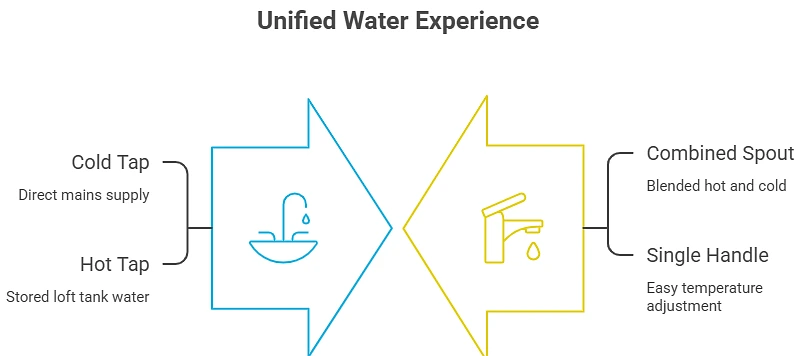
One of the oldest plumbing culture shocks: British homes traditionally had separate hot and cold taps. Two taps. One scalding, one freezing. You want warm water? Figure out the balance yourself, ideally using the plug and filling the basin rather than trying to alternate your hands between the two streams like some kind of temperature roulette.
This existed for a genuine engineering reason. In older British systems, cold water came directly from the mains — clean and drinkable. Hot water came from a storage tank in the loft that wasn’t considered potable because it sat there open to dust, insects, and occasionally dead pigeons. Building regulations kept these two water sources separate for hygiene reasons. You didn’t want loft-tank water accidentally mixing back into the mains supply.
Mixer taps are standard now in newer British builds and renovations, because modern combi boilers heat mains water directly — no dodgy loft tank involved. But plenty of older houses still have the two-tap setup, and it still baffles every American tourist who encounters it.
American homes have had mixer taps — they call them “faucets” — as standard for decades. One handle, one spout, temperature control built in. The idea of separate taps seems about as logical to Americans as having separate doors for entering and leaving a room.

Toilet Mechanics
Even the toilets work differently, and this genuinely surprised me when I first properly looked into it.
British toilets mostly use a siphon or dual-flush mechanism. That button on top with the two sizes? Small flush for liquid waste, big flush for everything else. It’s been standard in the UK for years, partly driven by water conservation regulations. British water bills aren’t cheap and the country takes metered water usage seriously.
American toilets predominantly use a flapper valve system — a rubber flap at the bottom of the tank that lifts when you push the handle, releasing water into the bowl. It’s simpler mechanically but uses more water per flush. The American standard has been dropping over the years (federal regulations now cap it at 1.6 gallons per flush, down from the old 3.5 gallon days), but dual-flush toilets are still relatively uncommon in American homes compared to Britain.
Also — and this is purely observational — American toilets hold much more water in the bowl. Noticeably more. Brits visiting America often find this unsettling for reasons they can’t fully articulate.
Water Pressure Obsession
Brits are obsessed with water pressure in a way that Americans find puzzling. “How’s the water pressure?” is a legitimate question you’d ask before buying a house in Britain. There are entire forum threads — thousands of posts deep — about improving shower pressure, fitting pumps, upgrading from gravity-fed systems.
The reason is structural. Many British homes, especially older ones, relied on gravity-fed systems where a cold water tank in the loft fed water down to the taps and shower. The pressure depended entirely on how far the water dropped from the tank to the outlet. Top-floor bathroom directly below the loft tank? Terrible pressure. Miserable dribble of a shower.
Combi boilers and mains-pressure systems have largely fixed this problem in renovated homes, but the cultural scar remains. Brits evaluate showers like wine critics evaluate Burgundy. Americans, meanwhile, generally don’t think about water pressure at all because their mains supply does the job without requiring a physics degree to understand why the shower is disappointing.
The Certification Question
In Britain, anyone working on gas appliances — including your boiler — must be Gas Safe registered. It’s a legal requirement. If an unregistered person touches your boiler and something goes wrong, your home insurance is void. Full stop. The Gas Safe Register replaced the old CORGI registration in 2009, and it’s taken seriously. You can check any engineer’s credentials online in about thirty seconds.
America doesn’t have a single national equivalent. Licensing requirements vary wildly by state and even by county. Some states require plumbers to be licensed and bonded. Others are more relaxed. The result is a patchwork system where protections depend entirely on where you live. It’s one of those areas where the American preference for local governance creates genuine inconsistency.
What Actually Costs More?
Hard to give a straight answer because the variables are enormous, but broadly: American plumbing work tends to cost more in raw numbers, British plumbing work tends to feel more expensive because average wages are lower.
Getting a boiler replaced in the UK runs somewhere between £1,500 and £3,500 depending on the type and complexity. An American furnace replacement is typically $3,000 to $7,000. A new water heater tank on top of that adds another $800 to $2,500. So Americans are often paying for two separate systems where Brits pay for one.

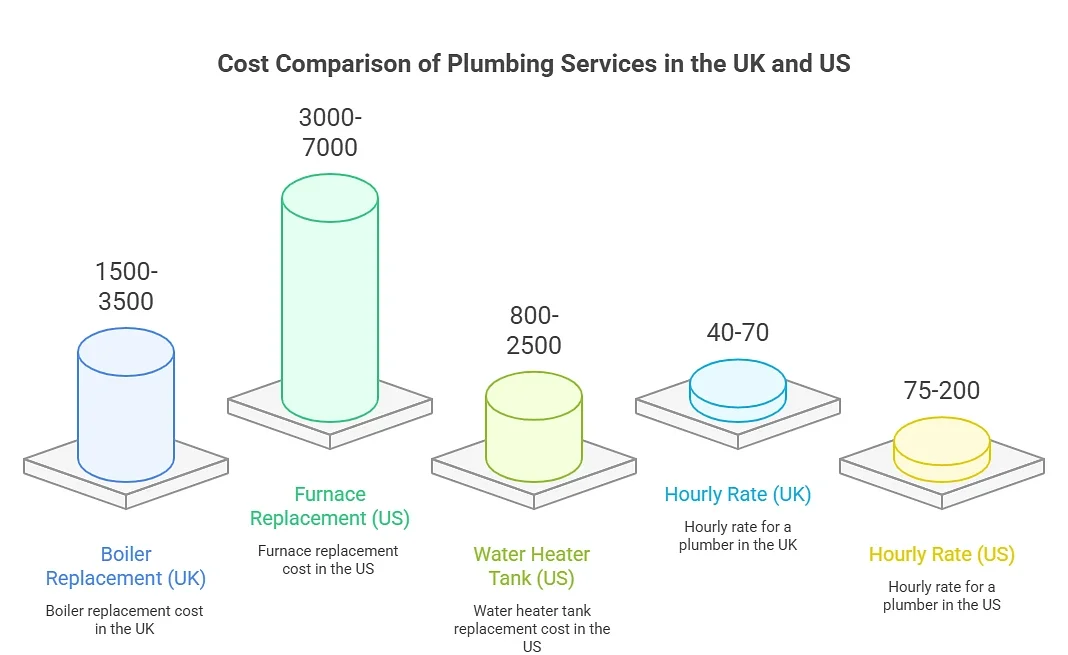
Hourly rates for a standard plumber in Britain sit around £40 to £70. In America, $75 to $200 depending on the state. But those numbers don’t mean much without context — cost of living, insurance structures, tipping culture (Americans sometimes tip their plumber, which would genuinely confuse a British tradesperson), and the scope of what “plumbing” covers all muddy the comparison.
The Honest Summary
Neither country has it figured out perfectly. British plumbing is compact, efficient, and designed for small spaces — but the legacy infrastructure in older homes creates problems that Americans simply don’t deal with. American plumbing is built for scale, with bigger pipes, bigger water heaters, and bigger everything — but the cost reflects that scale, and the regulatory patchwork means quality control varies massively between states.
What’s genuinely interesting is how much your home’s plumbing shapes daily life without you ever noticing. The way you shower, wash dishes, heat your house, deal with emergencies — all of it traces back to engineering decisions made decades ago by people you’ll never meet, in a regulatory environment you probably don’t fully understand.
Move countries, though, and you’ll notice immediately. Just ask my cousin, still looking for radiators that aren’t there.