



- Post-Brexit driver: Since 2021, UK citizens face a 90-day Schengen limit, making Portugal’s Golden Visa one of the most practical routes to regain European travel, residency, and a path to EU citizenship.
- Real estate route eliminated: Portugal removed property purchases from the Golden Visa program in October 2023 due to housing affordability concerns — similar to Spain shutting down its entire Golden Visa in April 2025.
- Fund-based route now dominates: The qualifying investment is €500,000 into a CMVM-regulated fund (Portugal’s securities regulator), with at least a five-year maturity and 60% of the portfolio invested in Portuguese-headquartered companies. Over 30 qualifying funds are now tracked across sectors like tech, renewables, and healthcare.
- Funds are simpler than property: No stamp duty, property transfer taxes, tenant management, or maintenance headaches. Exits are structured into the fund’s lifecycle rather than dependent on finding a buyer in an uncertain market.
- Minimal physical presence required: Just 7 days in year one, then 14 days per two-year period — no need to relocate from the UK.
- Tax landscape has shifted: The popular NHR tax regime closed to new applicants (final deadline was March 2025), replaced by the narrower IFICI program offering a 20% flat rate for qualified professionals in specific sectors. Fund structures give investors more control over when taxable events occur compared to property.
- Citizenship timeline in flux: Parliament approved extending the residency-to-citizenship requirement from 5 to 10 years, but the bill is still being finalized. Existing holders have grandfathering protections under the original five-year rule.
- Shrinking list of alternatives: Spain, Ireland, and the Netherlands have all closed their Golden Visa programs; the UK ended its Tier 1 Investor Visa in 2022. Portugal remains one of the few viable options and has signaled no plans to end the program.
- Processing is improving: Portugal’s immigration authority (AIMA) cleared its backlog in late 2025 and is rolling out digital application submission in 2026, with processing times tightening from the historical 12–18 month window.
Brexit changed things for British investors in ways that are still unfolding. Since 2021, UK passports no longer grant freedom of movement across Europe. That 90-day Schengen limit hits harder than most people expected, especially for anyone with business ties on the continent, kids at European universities, or a retirement plan that involved spending more than three months a year in southern Europe.
Portugal’s Golden Visa has quietly become one of the more practical solutions. The program has been running since 2012 and has issued over 12,700 residence permits to main applicants, with more than 20,400 additional permits for family members pulling in over €7.3 billion in foreign investment along the way. British investors specifically have been increasingly active as Get Golden Visa noted, UK citizens are targeting Portugal for three reasons: travel rights across Europe, lifestyle, and a path to European citizenship.
The catch is that the program doesn’t work the way it used to. Real estate, which was the route most people associated with the Golden Visa, was pulled from the menu in October 2023. Property purchases, residential or commercial, no longer qualify. What’s left is a fund-based route, and it’s actually turning out to be a better fit for most investors than property ever was.
Why Property Got Dropped
Portugal killed the real estate route for the same reason Spain shut down its entire Golden Visa program in April 2025, due to housing affordability. Foreign money was pouring into Lisbon, Porto, and the Algarve, pushing prices beyond what locals could manage. The European Commission had been putting pressure on member states about these programs for years, flagging them as potential security and economic risks in a 2019 report.
So the Portuguese government did what governments do: kept the parts that feed productive investment into the economy and cut the parts that were inflating asset prices. Real estate was the casualty. Fund investment, business creation, scientific research, and cultural donations survived.
For UK investors who were already thinking about Portugal primarily as a property play, this forced a rethink. And for most of them, the rethink led somewhere better.
How the Fund Route Works
The minimum commitment is €500,000 into a CMVM-regulated fund that’s Portugal’s securities market regulator, similar in function to the FCA. The fund must have a maturity of at least five years, and at least 60% of its portfolio must be invested in companies headquartered in Portugal. Real estate funds don’t qualify.
These are typically private equity or venture capital funds investing across sectors like technology, renewable energy, healthcare, and export-driven businesses. The Portugal Pathways 2025 Golden Visa Investment Fund Index now tracks more than 30 CMVM-regulated funds specifically designed for residency-by-investment, comparing them on strategy, projected returns, fee structures, and risk exposure.
You invest, a professional fund manager handles everything from there, and your subscription serves as the qualifying investment for the Golden Visa application. Your spouse and dependent children (and in some cases, dependent parents) can be included under the same investment.
The physical presence requirement is minimal seven days in Portugal during the first year, then 14 days across each subsequent two-year period. You don’t have to relocate. You don’t have to give up your life in the UK. After five years, you can apply for permanent residency or citizenship.
Funds vs Property
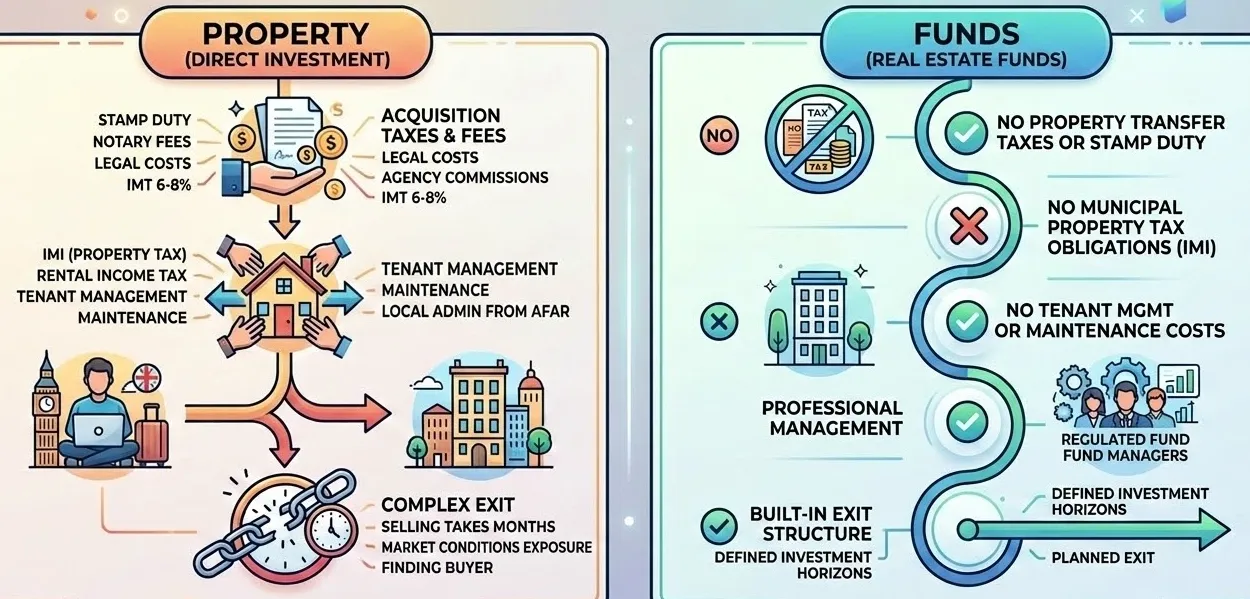
If you’d gone the property route back when it was available, here’s what the real experience looked like: stamp duty, notary fees, legal costs, agency commissions on both ends of the transaction. Property transfer tax in Portugal (IMT) alone could run 6-8% of the purchase price. Then ongoing municipal property tax (IMI), income tax on rental earnings if you let it out, and capital gains tax when selling. All while managing tenants, maintenance, and local admin from across a continent.
Funds strip most of that away.
- No property transfer taxes or stamp duty
- No municipal property tax obligations
- No tenant management or maintenance costs
- No need to find a buyer when exiting fund exits are built into the structure
- Capital gains treatment is typically cleaner and planned around the fund’s lifecycle
- Professional management by regulated fund managers, not you chasing a letting agent in Lisbon from London
The exit is where it really counts. Selling Portuguese property can take months. Market conditions, buyer demand, legal procedures, you’re exposed to all of it. Funds have defined investment horizons. You know roughly when and how the exit happens because it was designed that way from the start.

None of this means funds are risk-free. Private equity carries its own risks illiquidity during the investment period, performance depends on the fund manager’s skill, and your capital isn’t guaranteed. But the structure is designed for investors who want predictability and clean reporting, not for people who want to renovate a Lisbon apartment and rent it on Airbnb.
Tax Changes Worth Knowing About
Portugal’s tax picture has shifted significantly. The old Non-Habitual Resident (NHR) tax regime, which had been a massive draw for expats and investors since 2009, officially closed to new applicants. The final deadline for registrations under transitional rules passed on 31 March 2025.
It’s been replaced by the IFICI program (Tax Incentive for Scientific Research and Innovation), sometimes called NHR 2.0. This offers a 20% flat tax rate on qualifying Portuguese income for 10 years, but eligibility is much narrower it targets highly qualified professionals in specific sectors like technology, healthcare, R&D, and green energy. You need at least a bachelor’s degree plus three years of relevant experience, or a PhD.
For Golden Visa holders who aren’t relocating full-time and aren’t deriving Portuguese employment income, the direct impact is more about how fund distributions and capital gains are treated versus the property-level taxes they’d have faced under the old real estate route. This is where individual tax advice from someone who understands both UK and Portuguese tax systems becomes essential the interplay between the two jurisdictions matters enormously.
The broader point stands: fund structures offer more control over when and how taxable events occur than direct property ownership does. That’s not a small thing when you’re planning across borders over a decade or more.
The Citizenship Timeline Question
This is where things got complicated in 2025. In October, the Portuguese Parliament approved amendments to the Nationality Law that would extend the general residency requirement for citizenship from five years to ten for most applicants. The Constitutional Court then reviewed the proposals in December 2025 and rejected four out of seven proposed changes, but approved the extended timeline.
The bill has been sent back to parliament. It’s not enacted yet. The final shape of these rules is still developing, and existing Golden Visa holders who got in under the old terms have grandfathering protections they can renew and apply for citizenship on the original five-year timeline as long as they maintain their qualifying investment.
For UK investors considering the program now, this is worth monitoring closely. Even if the citizenship timeline extends to ten years, the residency rights themselves living, working, studying in Portugal and travelling freely across the Schengen Area kick in from the moment your Golden Visa is approved. The citizenship question is downstream from that.
Why UK Investors Are Moving on This
Post-Brexit, Portugal ticks boxes that are hard to replicate through other routes. Schengen-wide travel rights. Access to Portuguese (and by extension EU) healthcare and education systems. A stable economy The Economist named Portugal its “economy of the year” for 2025, based on a combination of growth, inflation control, and stock market performance. Venture capital investment in the country hit €1.2 billion into local startups in 2025. The country is pulling in serious institutional money, not just Golden Visa applicants.
Spain’s Golden Visa ended in April 2025. Ireland’s is gone. The Netherlands closed theirs. The UK killed its own Tier 1 Investor Visa back in 2022. The number of countries offering a meaningful investment-based path to European residency is shrinking. Portugal is one of the few still standing, and its government has publicly stated there are no plans to end the program in fact, measures to increase its appeal are being studied.
In 2024, Portugal issued 2,081 main applicant Golden Visas according to AIMA’s migration and asylum report, with another 2,909 family reunification permits tied to the program, which family figure nearly doubled from 1,554 the year before.
Choosing Who to Work With
Not every fund is built the same. Strategy, governance, fee structures, track record, sector focus all of this varies. Some funds have been around for years with over €1 billion in capital raised from institutional sources like state pension funds. Others are newer and built specifically for Golden Visa investors.
Working with experienced advisors matters here. Platforms like the Portugal Golden Visa Fund route through firms that have been involved in residency-by-investment planning for years tend to offer clearer guidance on fund selection, due diligence, and how the whole process fits together from NIF registration and bank account setup through to biometric appointments and residency card renewals.
The Portuguese immigration authority (AIMA) cleared its enormous application backlog in Q4 2025 and is now processing applications from Q3 and Q4 of that year. Digital submission of applications is rolling out in 2026, which should speed things up further. Processing times have historically run 12 to 18 months from submission, but that window is tightening.
For British investors specifically, this is about restoring something Brexit took away the ability to move freely through Europe, access its institutions, and plan long-term without being locked into 90-day tourist windows. The fund route does that without requiring you to become a landlord in a country you may not live in full-time. It’s a financial commitment with a residency outcome, managed by professionals, with defined timelines and transparent reporting.
That’s a better deal than a Lisbon flat you’d need to manage from 1,500 miles away.