


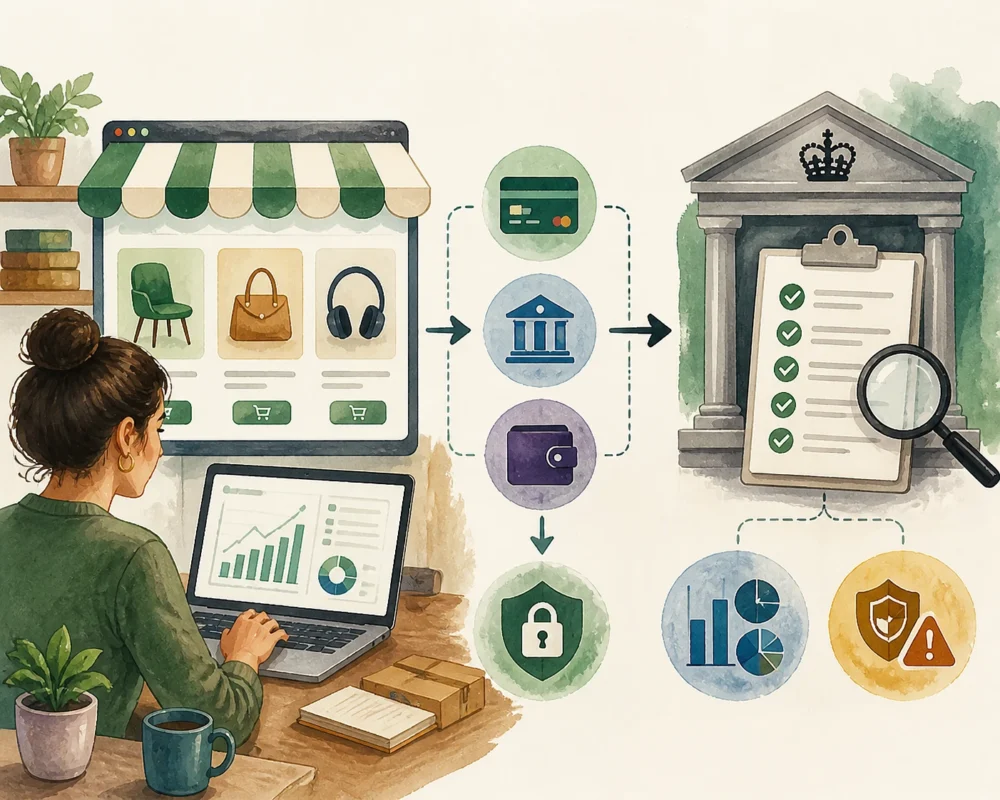
If you’re running an online marketplace in the UK right now — or thinking about starting one — the payments side has just got a lot more complicated. Not because of the technology. The technology’s actually fine. It’s because HMRC has spent the last two years quietly building a database of nearly 4 million online sellers, and the compliance pressure is now starting to bite.
The 31st of January 2026 was the date everything changed. That’s when digital platforms — Vinted, eBay, Etsy, Airbnb, Uber, Amazon, the lot — had to submit their first full year of seller data to HMRC under the new OECD reporting rules. Names, addresses, National Insurance numbers, total sales, transaction counts. According to figures obtained by accountancy firm BDO via Freedom of Information request and reported in March 2026, HMRC received reports on 3,988,892 online sellers in calendar year 2025 — a 272% increase on the 1.46 million reported in 2024. Total online earnings linked to those sellers came to almost £55 billion.
If you’re operating a marketplace yourself, that means your payment system isn’t just a checkout flow any more. It’s a compliance instrument. The way you collect, hold, and pay out funds determines whether your sellers — and you — stay on the right side of the rules.
What “Accepting Payments” Actually Involves on a Marketplace
Marketplaces aren’t shops. A shop has one seller, one bank account, one VAT number. A marketplace has dozens or hundreds of sellers, all needing to be paid, all generating data that now needs to be reported.
A working marketplace payment setup has to do four things at once:
- Take the buyer’s money cleanly, in whatever currency they use
- Hold the funds somewhere safe while the order’s fulfilled
- Take your platform’s commission off the top
- Pay each seller their share, on a predictable schedule, with a paper trail
That’s it. Everything else is implementation detail. The challenge is that getting all four right with one provider, in 2026, is harder than it sounds — especially if your sellers are based in different countries.
Picking the Right Payment Model
There are roughly four ways marketplaces handle the money flow. The right one depends on how much risk you want to carry and how much trust your buyers need before they hand over a card.
Direct payments. The buyer pays the seller; you take a fee separately. Simple, but you’ve got no control over disputes or refunds. Works for low-risk categories like digital downloads, less so for anything physical that might not arrive.
Escrow. The buyer’s money sits with the platform until the order is confirmed delivered. Then it goes to the seller. This is what most secondhand marketplaces use, because it’s what gives nervous buyers the confidence to send £80 to someone they’ve never met.
Split payments. Money comes in, gets divided automatically between the platform and the seller, leaves on its way out. Stripe Connect and Adyen both handle this, and it’s usually the cleanest setup for a growing platform.
Wallet-based. Sellers and buyers both keep balances on the platform. Faster transactions, but holding customer funds typically requires authorisation as an e-money institution under FCA rules — a regulatory step most early-stage marketplaces are not set up for.
For UK-based marketplaces in 2026, escrow or split payments are usually where you land. Direct payments don’t give you the audit trail you’ll need when HMRC asks questions.
The Compliance Side That’s Caught Most Operators Off Guard
Here’s where it gets uncomfortable. A lot of marketplace operators built their platforms before the OECD reporting rules came in, and now they’re scrambling to retrofit the data collection.
The information your platform now needs to capture for every seller, by law:
- Full legal name and address
- Date of birth
- Tax identification number (National Insurance number for individual UK sellers, UTR or company number for businesses)
- Bank account details where payouts are sent
- Gross sales totals, transaction counts, and any fees you’ve withheld
You also have to give each seller a copy of the report you’ve sent to HMRC. Most platforms are doing this in January, just before the self-assessment deadline, which has caused predictable confusion — sellers receive a calendar-year summary while their tax year runs April to April.
Beyond reporting, the rest of the compliance stack hasn’t gone anywhere:
- PCI DSS if you’re handling card details directly
- KYC checks on sellers, particularly any moving meaningful volume
- Anti-money-laundering monitoring, which the FCA is taking more seriously every year
- Strong Customer Authentication under PSD2, which means most card payments now need two-factor confirmation
Skipping any of this isn’t a minor compliance issue. The fines are real, the reputational damage is worse, and HMRC has publicly stated it is in the final stages of building automated systems to extract and analyse the new platform data — meaning compliance activity is expected to increase through 2026 and beyond.
Handling Payouts to Sellers Without Causing a Riot
The single biggest source of complaints on any marketplace is “where’s my money?” Sellers who can see the sale on the platform but haven’t been paid yet will email you, repeatedly, regardless of how clearly you’ve explained the payout schedule.
A few things that actually help:
- Be specific about timing. “Weekly payouts every Tuesday” beats “regular payouts” every time. Sellers want a date, not a vibe.
- Automate everything you can. Manual payouts work until you’ve got fifty sellers. After that, errors compound.
- Multi-currency support matters more than people think. A French seller paid in euros doesn’t want to lose 3% on conversion every fortnight.
- Real-time transaction visibility. Sellers need to see, on their own dashboard, exactly what they’ve earned, what’s in clearing, and what’s been paid.
A purpose-built marketplace payment solution handles the split, the FX, and the payout scheduling without you having to build the plumbing yourself. Whether that’s the right fit depends on your scale and which markets your sellers operate in, but trying to bolt this together from generic payment gateways usually ends in tears six months down the line.
The Bit Most Guides Skip: Tax on Your Side of the Equation
Most marketplace payment guides talk about how sellers handle tax. They rarely mention the platform’s own obligations.
If you’re charging commission, that’s revenue. If your turnover crosses £90,000, you’re VAT-registered. If you’re holding seller funds for any meaningful period, you need to be very careful about whether you’re operating as an e-money institution under FCA rules — that’s the line a lot of marketplace operators don’t realise they’ve crossed.
Then there’s Making Tax Digital for Income Tax, which became mandatory from 6 April 2026 for self-employed individuals earning over £50,000. If you’re running your marketplace as a sole trader and crossing that threshold, you’re now on quarterly digital reporting, whether you’re ready for it or not.
The £1,000 trading allowance is the cut-off most casual sellers care about. Below that, no declaration needed. Above it, self-assessment — and now, with HMRC holding the platform data, the chances of getting away with not declaring are essentially zero.
What This Means If You’re Setting Up a New Marketplace
Build for compliance from day one. Retrofitting a payment system to capture seller National Insurance numbers eighteen months after launch is genuinely painful, and it’s the position a lot of operators who launched in 2022 and 2023 are now in.
Pick a payment provider that handles split payments, multi-currency, and reporting natively. Cheaper providers that don’t handle the compliance side end up costing more once you factor in what you’ll spend on accountants and developers patching the gaps.
And accept that the era of running a quiet little side-marketplace where nobody asks too many questions is over. HMRC has the data now. So do you, whether you wanted it or not.