


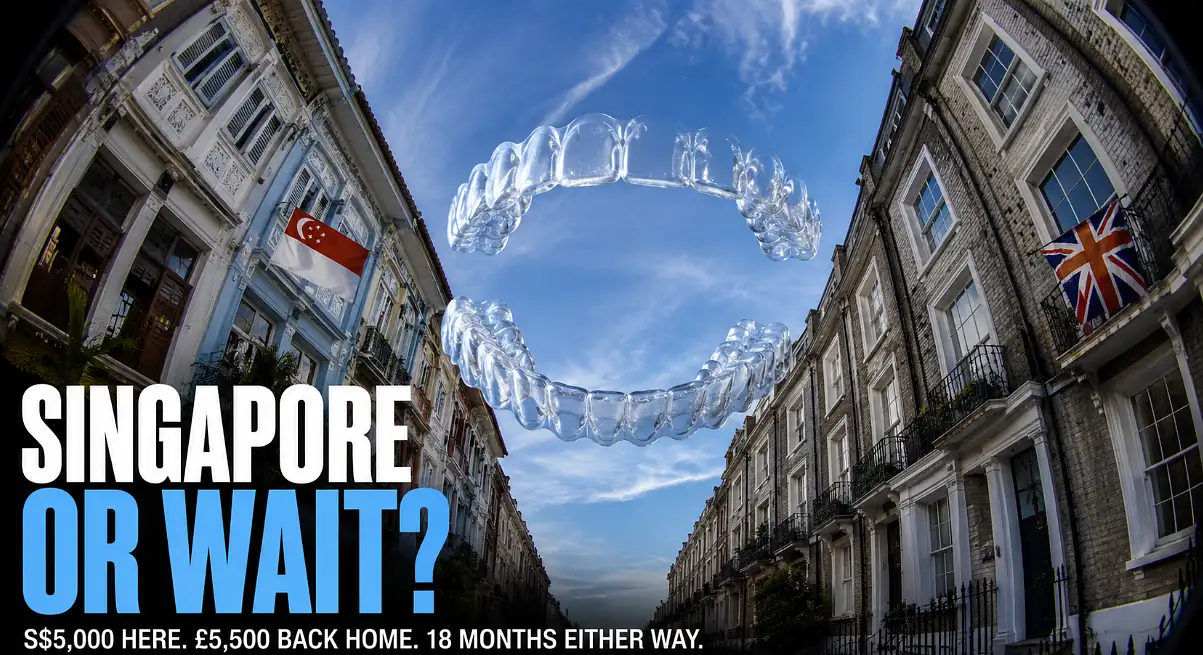
- 3 years in? Start Invisalign with a specialist for best results.
- Under 18 months? Wait for UK continuity.
- Always compare full quotes including refinements & retainers.
So you’re sitting in your Singapore flat, three years into a posting, and the orthodontic question keeps creeping up the to-do list. You’ve been meaning to sort your teeth out since your late twenties. The NHS made it clear years ago you weren’t eligible — they don’t really do adult orthodontics unless your bite is causing actual medical problems, and yours isn’t. Private treatment in London was always quoted at numbers that made you wince. Now you’re in a country where the dental care is excellent, English-speaking, and apparently considerably cheaper than home. The catch is you don’t know how long you’ll be here, treatment runs eighteen months minimum, and the idea of starting teeth straightening in Singapore and finishing it somewhere else makes your stomach turn slightly.
This is genuinely a decision worth thinking about properly rather than just defaulting to whatever’s most convenient this month. The numbers move in interesting directions once you actually look at them.
1. The NHS isn’t going to help you, and that hasn’t changed
Worth getting this part out of the way first because a lot of British expats hold onto a vague hope that they’ll just get it done on the NHS when they come home. You almost certainly won’t.
The NHS uses a measurement called the Index of Orthodontic Treatment Need (IOTN) to decide who qualifies for free orthodontic treatment. The grading goes from one to five. You need to score a four or five to get free NHS braces, and even then the system is set up almost entirely for under-eighteens. Adults are essentially excluded unless their case involves complex multidisciplinary care — usually meaning surgical intervention is needed alongside the orthodontics. Mild crowding, an overbite that bothers you cosmetically, slight crookedness at the front — none of that gets you anywhere near eligibility.
The NHS waiting time for those who do qualify currently runs one to two years, sometimes longer depending on your area. So even in the rare scenario where you’d qualify on medical grounds, you’re looking at waiting eighteen months just for the chair, then another eighteen months to two years for the treatment itself.
For most adults wanting their teeth straightened in the UK, private is the only realistic route, and prices currently sit between £1,500 for basic metal braces and £5,500-plus for clear aligners like Invisalign. Some London clinics push higher than that — central London Invisalign Comprehensive can run £5,000-£7,000 once you factor in retainers and refinements. The “wait until I’m home and do it on the NHS” plan isn’t a plan. It’s a way of putting it off forever.
2. Singapore Invisalign costs S$3,500 to S$10,500, which translates well below UK private rates

Is it actually cheaper, though, once you’ve done the maths properly?
Yes, but with caveats worth understanding.
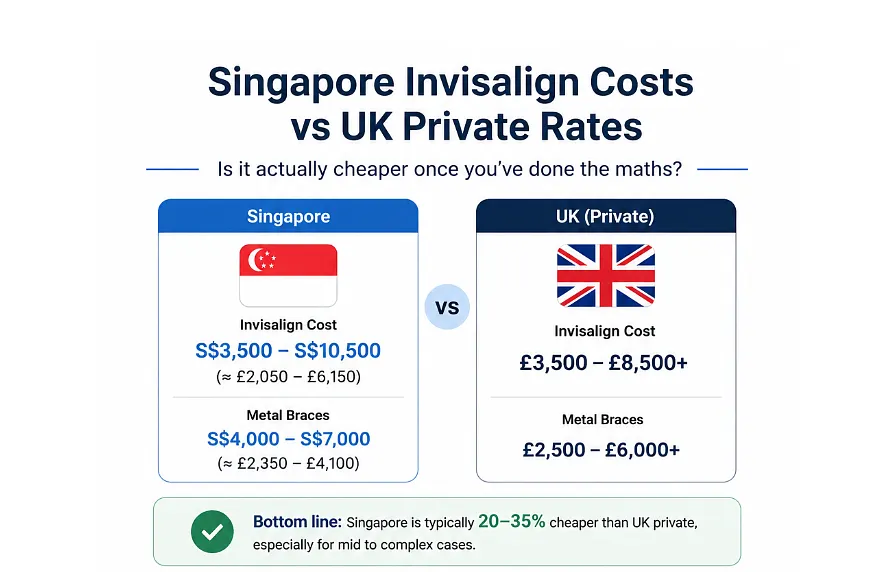
Singapore Invisalign currently costs between S$3,500 and S$10,500 depending on case complexity and whether you’re treated by a general dentist or a specialist orthodontist. At current exchange rates, that’s roughly £2,050 to £6,150. Metal braces in Singapore run S$4,000 to S$7,000 (about £2,350 to £4,100). The difference between Singapore and UK private orthodontics isn’t dramatic at the bottom end — a basic case might cost similar amounts in both countries — but at the middle and upper end, where most adult cases actually sit, Singapore typically comes in 20 to 35 percent cheaper than UK private.
A few things worth knowing about the Singapore market:
- MediSave doesn’t cover orthodontic treatment. It’s classified as elective, so even if you’ve been working in Singapore long enough to build up MediSave contributions, none of it goes towards Invisalign or braces.
- Most corporate medical insurance won’t cover it either unless you’ve specifically got an orthodontic rider. Worth checking your policy line by line — typical coverage caps where included sit around S$1,000 to S$3,000 annually, which barely scratches the cost.
- Consultation fees vary wildly — anywhere from S$25 to over S$200 depending on the clinic. The cheaper consults often skip digital scans or full records, so they’re closer to a sales conversation than an actual orthodontic assessment.
- Specialist orthodontists charge more than general dentists doing Invisalign. Around S$7,000-S$9,500 versus S$4,500-S$8,000. Whether the specialist premium is worth it depends entirely on your case complexity.
The headline number being lower doesn’t tell the full story. Once you’ve added consultation fees, retainers, refinement aligners and the post-treatment monitoring, Singapore total cost is typically S$5,000 to S$11,000 all-in for a standard adult Invisalign case. That converts to roughly £2,900 to £6,400 — still cheaper than UK private but not by as much as the headline pricing suggests.
3. How long you’ve got left in Singapore is the question that decides everything
Here’s the bit that catches most expats out, and it has nothing to do with money.
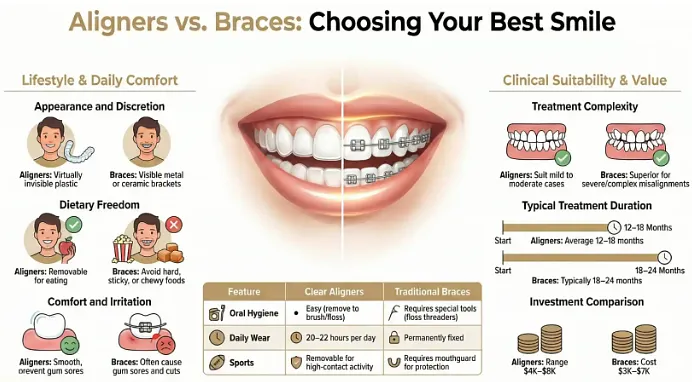
Orthodontic treatment is not a procedure you finish in a fortnight. A standard adult Invisalign case takes 12 to 18 months. Complex cases push to 24 months. Fixed braces typically run 18 to 24 months minimum. That’s a lot of time, and during it you’ll need adjustment appointments roughly every six to eight weeks for Invisalign, every four to six weeks for fixed braces. You can’t skip these. The treatment plan depends on the orthodontist seeing you regularly, scanning progress, and switching to new aligners or tightening wires on a fixed schedule.
So the real question isn’t “is Singapore cheaper” — it’s “do you have enough time left on your posting to actually finish what you start?”
Run the maths against your own situation:
- If you’ve got three or more years left in Singapore, you can comfortably start and finish treatment locally. Even a complex case fits inside that window with margin.
- If you’ve got eighteen months to two years left, it’s tight but doable for a moderate case. Aligners only, not fixed braces, and only if your orthodontist confirms it’s a straightforward case.
- If you’ve got under eighteen months left, starting in Singapore is a bad idea unless you’re comfortable transferring care mid-treatment to a UK clinic. Doable, but it adds cost, complication and risk to the result.
- If your departure date is genuinely uncertain — typical expat posting that “might be extended, might not” — you’re gambling. And the gamble has real consequences if you have to stop halfway through.
Mid-treatment transfers happen, and orthodontists are used to handling them, but the receiving UK clinic will charge you separately to take over your case (typically £500-£1,500 just to assess and plan continuation, on top of whatever the remaining treatment costs). Records transfer between clinics in different countries, but expect some friction — Singapore clinics aren’t always set up to send digital files in formats UK practices use, and there’s usually a bit of back and forth before everything’s where it needs to be.
4. Aligners travel better than fixed braces, and that matters more than you think

If you’ve decided the timeline works and Singapore makes sense, the type of treatment you choose matters more for an expat than for someone settled in one country for life.
Clear aligners are far more portable than fixed braces. Here’s why:
- The aligners themselves are physical objects you can carry. If you have to leave Singapore mid-treatment, you take your remaining trays with you and continue under remote supervision until a new clinic in the UK takes over.
- Records and digital scans transfer between Invisalign-providing clinics worldwide because the system itself is centralised through Align Technology. Your treatment plan exists in their database, accessible to any certified provider.
- Adjustment appointments for aligners are less frequent and shorter than for fixed braces. Six to eight weeks between visits gives you flexibility around travel.
- If you genuinely can’t get to a clinic for a few weeks because of work travel or relocation, you can usually continue with the aligners you have on hand and pick up monitoring afterwards.
Fixed braces are a different proposition entirely. The wires and brackets have to be physically adjusted by a clinician every four to six weeks. Miss appointments and your teeth either stop moving or move incorrectly. If you have to leave Singapore mid-treatment, you cannot just continue at home — you need a UK clinic to take over the physical management, and not all UK orthodontists will pick up another practitioner’s fixed-brace case.
For an expat with any uncertainty about how long they’re staying, aligners are the safer choice even if your case might be slightly better suited to braces. The flexibility is worth more than a marginal clinical advantage you’ll only see in the final result.
5. What to actually look for in a Singapore orthodontic clinic
Once you’ve decided to go ahead in Singapore, a few things separate the clinics genuinely worth visiting from the ones running on volume:
Specialist orthodontist versus general dentist offering Invisalign. Both are legal, both are common, both can produce good results for straightforward cases. For complex bite issues, severe crowding, or cases involving extractions, an orthodontist with the additional three years of specialist training has more depth. For mild-to-moderate cases, a general dentist who does a lot of Invisalign will usually be fine and cheaper.
Ask about case numbers. A clinic that’s done five hundred Invisalign cases is in different territory to one that’s done thirty. Volume builds judgement, and judgement matters when your treatment plan needs adjusting mid-course.
Get the price quoted properly. Singapore clinics vary in what they include in headline pricing. Some quote treatment-only and add retainers, refinements, scans and consultations as separate line items. Others quote all-in. Always ask: does this price include refinement aligners, retainers, X-rays, and post-treatment monitoring? A “lower” headline price often ends up similar or higher once everything’s added.
Check the technology. Modern orthodontic care uses 3D digital scanning, treatment simulation software and progress monitoring tools. Clinics still working from physical impressions and 2D X-rays for orthodontics are working with last-decade methods.
Look for an honest treatment-options conversation. A good clinic discusses braces, aligners, ceramic options and which is most appropriate for your specific case. A clinic that recommends Invisalign before they’ve even properly assessed your teeth is selling, not advising. Dentists at Nuffield Dental and other established Singapore practices have pointed out that the consultation should always start with a full clinical assessment — scans, bite analysis, X-rays where needed — before any treatment recommendation gets made. If the recommendation precedes the assessment, that’s a flag worth taking seriously.
Communication and language. Singapore dental care is typically excellent at English-language communication, but quality of explanation varies. You should leave the consultation understanding your case, your options, the timeline, and the all-in cost. If you don’t, the clinic isn’t doing its job.
6. When waiting until you’re back in the UK genuinely makes more sense
Honest counter-section worth thinking about. Singapore isn’t automatically the right answer.
If you’re returning to the UK within twelve months and your treatment would take longer than that, wait. Starting something you can’t finish locally creates more problems than it solves. Pay the UK premium and have continuity of care.
If your case is genuinely complex — surgical orthodontics, severe skeletal issues, multidisciplinary care involving prosthodontics or implants alongside the alignment — you might actually qualify for NHS treatment when you return, given that adult eligibility focuses on exactly these complex multidisciplinary cases. Worth checking with a UK orthodontist before paying privately abroad.
If your employer’s medical insurance only covers UK-based treatment, and includes orthodontic provision, the maths shifts entirely. Always check your benefits properly before assuming Singapore is cheaper.
If you’ve got specific UK-trained orthodontists you’ve researched and trust, and the cost difference is marginal for your case, the relationship value of being treated by someone you’ve vetted properly may outweigh the savings.
The honest answer for a UK expat in Singapore weighing this up isn’t “always do it locally.” It’s: work out how long you’ve got left, get a proper consultation in Singapore that includes the all-in cost, compare it to a UK private quote you’ve actually obtained (not estimated), and choose based on the maths plus your tolerance for mid-treatment complexity if your timeline shifts.
For most expats with two-plus years remaining, decent insurance that doesn’t cover orthodontics, and a moderate case that suits aligners, Singapore makes sense and saves real money. For everyone else, it’s worth doing the calculation properly before committing to either path.