


Most break-ins in this country come through a door, not a window.
That’s the fact the whole steel door market is built on, and it’s why these doors have quietly moved from warehouses and shop backs into ordinary British homes, flats with shared entrances, houses backing onto alleys, rural properties where the nearest neighbour is a field away, and anywhere that’s already been done over once. A steel security door isn’t about living in a fortress. It’s about making your door the argument a burglar doesn’t fancy having, because the average one gives up in minutes and moves on to an easier house.
A Steel Door Is Only as Good as What’s Hidden Inside It

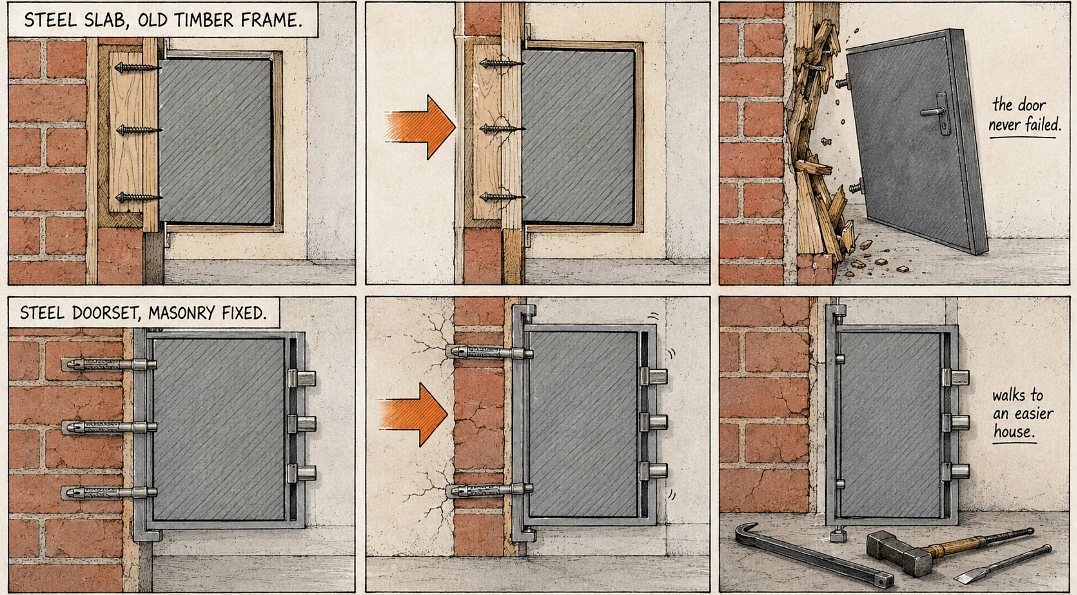
Nearly all steel doors are made the same way, two steel skins welded around a core, and from the pavement they all look identical. What sits between those skins is the difference between a £200 door and a £2,000 one. The cheap version has a hollow or lightly braced core and a single point lock, which will still beat a tired timber door but not by the margin you’re paying for. A proper security door has a reinforced core, a multi point locking system that throws bolts around the whole perimeter at once, hinge side dog bolts so it can’t be levered off its hinges, and, crucially, a steel frame built to the same strength and fixed directly into the masonry.
That last part gets overlooked constantly and it’s the one that matters most. Kicking a door in rarely breaks the door, it breaks the frame around it. A steel slab hung in the old softwood frame is a bank vault door fitted to a garden shed.
Steel Security Doors Costs in the UK
The Door Itself
A decent single steel security door with a kitemarked cylinder and galvanised steel runs £300 to £600 supply only, with bespoke and higher rated models going from £500 up past £2,000. Have a browse of what’s on the market before anyone surveys your opening, Dasco Entrance Technology list their steel security door range with the specs shown, which makes it easier to walk into a quote knowing what a rating and a locking spec should look like. Lead times are shorter than people expect, typically 5 to 10 working days for a standard door, since most are made to measure rather than pulled off a shelf.
The Fitting and the Looks
Fitting adds £200 to £600 for a straightforward swap, more if the opening needs building work. For comparison, a fitted composite front door commonly lands between £1,800 and £3,500, so steel is not the expensive option people assume, it’s often the cheaper route to a higher security level. And the prison door look is long gone. Modern doors come in any RAL colour and convincing wood grain finishes, and once it’s painted and handled, your neighbours won’t know it’s steel until they knock on it.
The Ratings: RC2 or PAS 24 Covers Most Homes


Steel doors are tested under the European standard EN 1627, which grades resistance from RC1 to RC6, and the grades are easiest to understand as how long a burglar with a given toolbag gets held off:
- RC1 resists shoulder barges and kicks, no tools.
- RC2 holds off screwdrivers, pliers and wedges for around three minutes, which is longer than an opportunist ever spends.
- RC3 adds a crowbar to the attacker’s bag and holds for about five minutes.
- RC4 and up deal with drills, axes and saws, and belong on gun rooms and bank stores, not semis.
For a house, RC2 is the sensible target, RC3 if you’ve had trouble before or you’re storing something worth targeted effort. Worth knowing alongside this: the UK’s own domestic standard is PAS 24, it’s what Building Regulations require on new build homes in England, and a door certified to either standard puts you ahead of most of the street. If a seller can’t name a rating at all, that tells you what the core is probably made of.
How the Installation Day Goes
A proper job starts with a survey, because British door openings, especially in Victorian and interwar housing, are rarely square, and a made to measure steel frame has none of the forgiveness a timber one does. On the day itself, the old door and frame come out, the opening gets checked and sometimes packed level, the new frame is bolted through into brick or block, never just screwed to old timber, then the slab is hung, the locks are adjusted, and the gaps are sealed and made good. Half a day for a clean swap, a full day if the opening fights back. If a fitter quotes you an hour, that isn’t efficiency, that’s a frame going in on four screws.
Condensation and Rust Are the Two British Problems


Steel and the British climate need managing, and this is exactly where cheap doors go wrong within a couple of years. A bare steel skin on a north facing entrance runs cold all winter, and warm indoor air hitting cold metal means condensation streaming down the inside of the door by December. The fix is an insulated core with a thermal break, standard on decent domestic models, so ask the question directly rather than assuming it’s there.
Rust is the other one. Mild steel with a thin finish can show corrosion inside twelve months, while galvanised steel under a powder coat lasts decades, and anywhere near the coast, salt air justifies stepping up to marine grade finishes even at roughly 20% extra. The saving on an ungalvanised door isn’t a saving, it’s a deferred replacement.
If You Live in a Flat, the Door Has to Be a Fire Door Too
One rule catches flat owners out. An entrance door opening onto a shared corridor or stairwell has to be a fire door, self closing and rated to hold back fire and smoke for 30 minutes, and the freeholder or managing agent will usually have a say in what gets fitted. The good news is that steel takes fire ratings well, so combined fire and security doors exist as a single certified unit. Buy one door that does both jobs, with the paperwork to prove it, rather than a security door that quietly breaks the building’s fire strategy.
Maintenance Is Ten Minutes Twice a Year
Wash the powder coat with soapy water so grime doesn’t sit and dull it, put a drop of light oil on the hinges and the moving parts of the lock, run the key and handle through their motion feeling for new stiffness, and check the seals and threshold drainage before winter. That’s the whole regime. The multi point mechanism is the one part that resents neglect, and a stiff mechanism forced daily for six months is how a £150 gearbox replacement gets booked.
The Questions That Sort a Good Fitter From a Bad One
Ask what rating the doorset carries and for the certificate that says so, doorset meaning door and frame tested together, because a rated slab in an unrated frame is theatre. Ask how the frame will be fixed and expect to hear masonry anchors. Ask whether the cylinder is three star rated, since a snapped cylinder walks straight past everything else you’ve paid for. Ask what the guarantee covers and who honours it, the maker or the fitter. A firm doing this properly answers all four without blinking, and a firm that starts explaining why ratings don’t really matter on your street has just told you everything you need to know.