


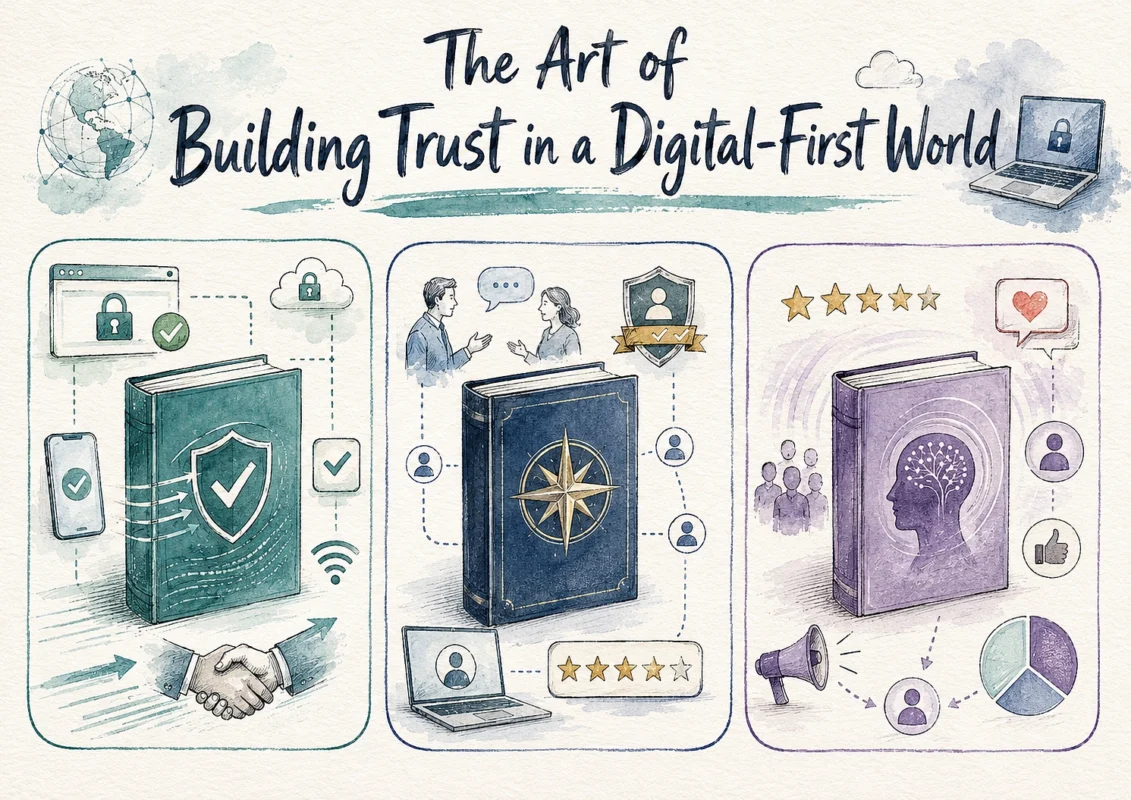
Of every business book I keep on the shelf, the one I find myself returning to most is Stephen M.R. Covey’s The Speed of Trust, published in 2006. Its central claim has aged better than almost any management text from that era: trust isn’t a soft virtue, it’s a measurable economic asset. Where trust is high, Covey writes, speed of execution goes up and costs go down. Where it’s low, every transaction quietly pays what he calls a “trust tax” — slower decisions, more verification, more hesitation, more contracts to redraft.
That observation cuts deeper now than it did when the book came out, because almost every buying journey today begins on a screen. Customers no longer rely on a single recommendation or a familiar shopfront. They cross-reference, they read reviews, they check social profiles, they search for evidence that a business is what it claims to be. Trust gets built — or quietly eroded — across dozens of digital touchpoints before the first conversation ever happens.
What follows is how I’ve come to think about that work, framed through Covey’s book and two others I’d recommend to anyone serious about building reputation online: David Maister, Charles Green, and Robert Galford’s The Trusted Advisor, and Robert Cialdini’s Influence: The Psychology of Persuasion.
Trust now decides the sale before the customer ever speaks to you
What customers do before they ever click “buy”:
- Read reviews on platforms outside the brand’s own website
- Check independent ratings and search for negative experiences
- Browse social profiles for tone, activity, and how complaints are handled
- Look for editorial coverage and third-party mentions
- Compare pricing and policies across competitors
- Read about the people behind the business before reading about the product
The decision is largely made before a human conversation begins. By the time a customer fills in a contact form or adds something to a basket, they’ve already auditioned the business across half a dozen touchpoints, and the verdict is usually settled.
Covey’s argument fits this reality almost perfectly. He treats trust as the variable that determines whether a transaction happens quickly and cheaply or slowly and expensively. Online, that variable is being calculated in real time, often in under a minute, and the business never sees the parts of the audit that went badly.
Consistency is the cheapest trust signal a business can send
The signals customers register without consciously looking for them:
- The same brand voice and visual identity across website, social, packaging, and email
- Contact information that matches across every platform, with no outdated phone numbers or dead addresses
- Pricing that doesn’t shift between the landing page, the advert, and the checkout
- Response times that don’t swing wildly between channels
- Service quality that holds steady whether the customer reaches you on a Tuesday morning or a Saturday night
- Policies that read the same way in the FAQ as they sound when the team explains them on the phone
In The Speed of Trust, Covey lists thirteen behaviours common to high-trust individuals and organisations. Consistency runs through several of them — “deliver results,” “meet commitments,” “be accountable” — and the reason it works isn’t dramatic. Consistency simply removes the small frictions of doubt. When something doesn’t quite line up, the brain flags it, even if the customer can’t articulate exactly what’s wrong.
This is the part most businesses underestimate. Inconsistency rarely produces a clean rejection. It produces a quiet drift, where prospects who would have converted simply move on without explanation.
The trust equation explains why some businesses still feel slightly “off”
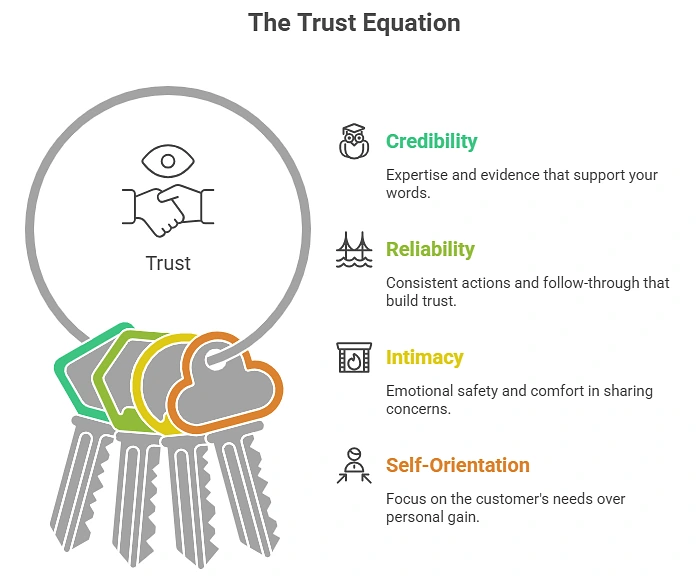
Maister, Green, and Galford published The Trusted Advisor in 2000, and the most useful idea in it is what they called the Trust Equation:
Trust = (Credibility + Reliability + Intimacy) / Self-Orientation
The four variables, in their words:
- Credibility — what you say, and the expertise you bring (the words and the proof)
- Reliability — what you do consistently (the actions, the follow-through)
- Intimacy — how safe people feel sharing concerns or questions with you (the emotional safety)
- Self-Orientation — how focused you appear to be on yourself rather than the customer (the denominator, where lower is better)
This is the cleanest diagnostic I’ve come across for figuring out why a business is struggling with trust despite ticking the obvious boxes. Most companies pour effort into credibility and reliability — qualifications, testimonials, case studies, certifications — because those are tangible and easy to measure. But the equation puts self-orientation underneath the whole numerator. A credible, reliable business that comes across as self-interested still produces a low trust score.

Online, self-orientation shows up in subtle places. Pop-ups that demand an email before a single line of useful content has been read. Comparison pages that pretend to be neutral but only ever favour one product. Reviews where every five-star piece of praise is featured prominently and every two-star concern is buried. Customers feel the bias before they can name it, and the equation explains exactly why.
Third-party validation outperforms whatever the business says about itself
Independent signals customers actively look for:
- Editorial coverage in publications they already read
- Mentions on industry-leading websites and trade journals
- Awards and recognitions from genuinely independent bodies
- Expert commentary from sources with verifiable credentials
- Reviews on platforms the customer didn’t have to be redirected to
Robert Cialdini’s 1984 book Influence provided two of the most relevant mental shortcuts here: authority and social proof. Authority is the human inclination to defer to recognised experts and credible institutions. Social proof is the tendency to look at what others have already done when we’re uncertain. Both apply directly to how customers vet a business online, and neither can be manufactured purely through self-published content.
Is a business’s own website credible? Yes, but only up to a point. What does the customer do next? They check whether anyone independent has said the same things the business is saying about itself. If they have, trust climbs sharply. If they haven’t, the claim sits in a kind of unverified limbo, even when it’s perfectly true.
This is the practical reason many businesses now invest in PR link building as part of their reputation strategy. Earning coverage in publications a customer already respects does something a company website cannot do for itself — it borrows that publication’s authority and applies it to the brand. A mention in a respected outlet carries weight that a self-published claim never will, however well written it might be.
Content earns trust by solving problems before pitching anything
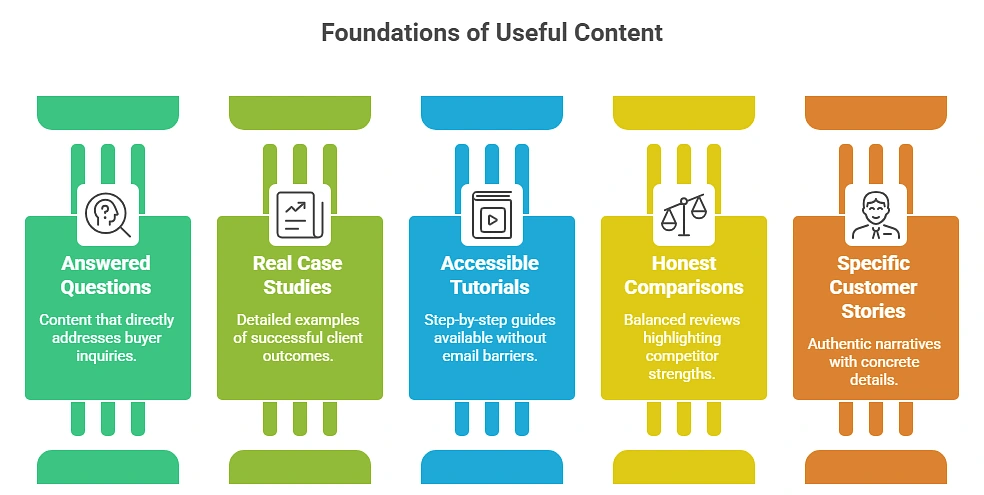
What genuinely useful content looks like, in practice:
- Articles and guides that answer the actual questions a buyer is searching for
- Case studies with real numbers, real timelines, and named clients where possible
- Tutorials and explainers that don’t require an email address before unlocking
- Comparison pieces that admit where competitors are stronger
- Customer stories told with specific details rather than generic praise
Covey describes “extending trust” as one of the most counterintuitive of his thirteen behaviours. High-trust people, he argues, give trust before they’ve fully received it, and the same principle works in published content. A business that publishes helpful material without immediately demanding contact details is extending trust to the visitor — and most visitors reciprocate.

People remember the company that helped them understand something. They rarely remember the one that hard-sold them in the first paragraph.
Trust online isn’t built through a single dramatic move. It’s the sum of consistent signals, an honest self-orientation, third-party endorsement that the business has actually earned, and content that genuinely helps before it asks for anything in return. Covey, Maister and his co-authors, and Cialdini wrote in different eras and from different angles, but the underlying point is consistent: trust is the asset that compounds quietly when it’s deserved, and drains just as quietly when it isn’t.