

Blog
The ASA Banned A Garnier Serum Ad, And The Ingredients Were Never The Problem
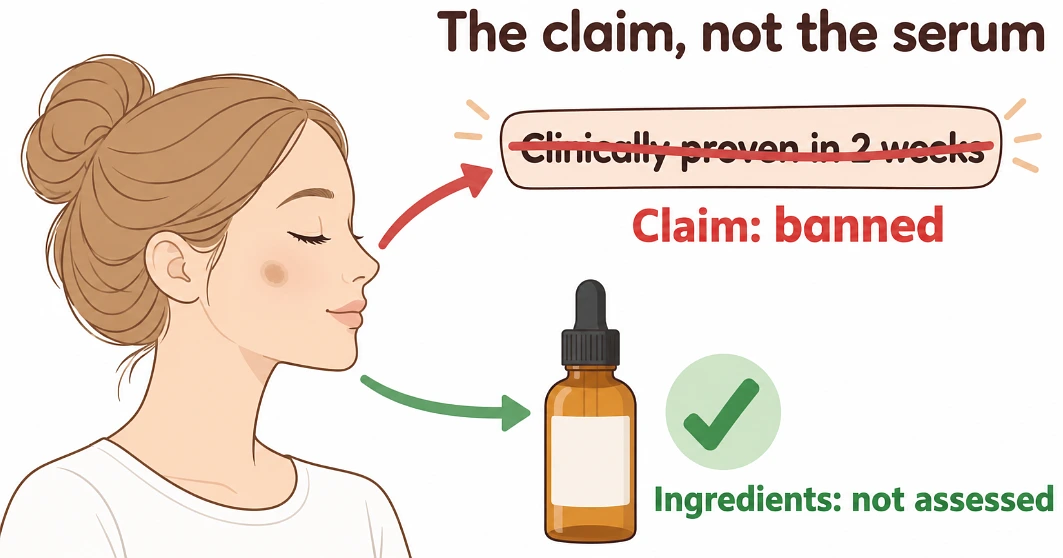
The Advertising Standards Authority ruled against L’Oréal (UK) Ltd, trading as Garnier, on 22 April 2026. The ruling concerned a video-on-demand advert for Garnier’s Vitamin Cg Serum, seen on 28 October 2025, which said the serum was “clinically proven to reduce hyperpigmentation in 2 weeks.” The advert must not appear again in that form.
The ASA did not rule against the ingredients. It ruled against the evidence supporting the clinical claim printed over them.
Garnier Supplied Two Pieces Of Evidence

The ASA asked Garnier to substantiate the claim. Garnier provided an unpublished clinical trial and a published paper.
The trial had 44 subjects and ran for 10 weeks. Dark spots were measured with a device and compared against a control group. Garnier asked that the details of the trial be kept confidential.
The ASA found the sample small and the randomisation method unclear. The conditions of the trial, including the climate, the mix of skin types and the restrictions on UV exposure, limited how far the results applied to typical use in the UK. The measured changes were small and appeared in a minority of subjects.
The advert’s 82% figure came from the same study, but from a different kind of evidence. It was the share of participants who said their dark spots looked less visible after two weeks. The ASA treated that as a subjective, self-reported result, which could not support the words “clinically proven.”
The published paper concerned Melasyl, a patented ingredient. It was a placebo-controlled study of 35 people and looked at the prevention of UV-induced pigmentation in healthy skin. The claim concerned the treatment of hyperpigmentation already present. The ASA judged the paper not relevant.
The Ad Broke Three Rules
The ruling found breaches of CAP Code rules 3.1, on misleading advertising, 3.7, on substantiation, and 12.1, on beauty products. Garnier was told not to say the serum was clinically proven to reduce hyperpigmentation in two weeks unless it held robust evidence.
There were also two errors in the advert itself. The voice-over gave the active concentration as 4%, and one line of on-screen text gave it as 5%. Garnier told the ASA that a qualifier reading “72% of 111 women agree” had appeared in error, where the intended qualifier was “Clinical study, 44 subjects, 10 weeks.” The ASA judged the claim on the intended qualifier and did not find that the error changed its conclusion.
What The Serum Contains Was Not Assessed

Garnier described the formula to the ASA. Ascorbyl glucoside, the “Vitamin Cg” of the name, is a stable precursor to vitamin C, which Garnier said provides antioxidant protection and inhibits tyrosinase, the enzyme involved in pigment production. Niacinamide, Garnier said, inhibits the transfer of melanosomes into skin cells. Melasyl, Garnier said, captures melanin precursors.
The ASA did not assess whether those ingredients work as described. Its concerns were limited to the evidence for the clinical claim.
That distinction is the useful one for anyone reading a serum box. An ingredient list is a statement about what went into the formula. A clinical claim is a statement about what the finished product did on tested skin, over a stated period, measured in a stated way. The second kind of statement is the one the ASA polices, and the one that failed here.
Ascorbyl glucoside also answers a question the ruling does not raise. Pure vitamin C, L-ascorbic acid, is particularly vulnerable to oxidation caused by light, oxygen, heat and the conditions of the formula, and loses its effect as it degrades. Ascorbyl glucoside is a more stable derivative, which makes formulation and storage easier, although its stability is not absolute. Packaging still matters for both, in dark glass or an airless pump against a clear jar, and it matters most for products containing the pure acid.
The Same Questions Apply To Any Brand

Alastin, an American skincare company, lists the ingredients of its brightening serum on its product page, as Garnier described its own formula to the ASA. The ruling supplies the questions to put to any such page. How many people were tested, and for how long? How were the results measured, and has the study been published?
Garnier’s trial answered the first two with 44 and 10, and the last with no. Alastin’s product page identifies a randomised, blinded study of 43 subjects, reports outcomes over up to 12 weeks, and the company links to published research on the product.
Oils in a formula raise a separate question. An oil such as castor oil is used as a skin-conditioning ingredient, and like other components of a formula it may influence how some compounds pass into the skin. Its presence alone does not establish that a particular active ingredient reaches its target at an effective concentration. A claim that an oil base delivers a serum’s active ingredients would need evidence for the finished formulation, under the same rule that caught Garnier.
The serum remains on sale with the same ingredients. The advert is the only part that had to change.