



January goals tend to die in March, and it’s rarely the goal’s fault.
Motivation runs out, that’s all. It always runs out, it’s a fuel, not an engine. Knowledge behaves differently, it stacks, and it’s still there on the mornings you don’t feel like anything. Which is why reading, the least glamorous habit on anyone’s self improvement list, keeps quietly outperforming the flashier ones. People who read consistently learn faster, decide better and stay pointed at what they wanted for longer than people who don’t, and there are some genuinely interesting reasons why.
Books Make You Hold a Whole Argument in Your Head


A feed hands you fragments, thirty seconds of someone’s conclusion with the working out missing. A book walks you through the working out, two hundred pages of evidence, context and pushback, and your brain has to hold all of it at once to follow along. Psychologists call the skill that builds cognitive flexibility, and it maps directly onto decision making, because chasing any real goal means juggling competing ideas without dropping them. Nothing else in daily life trains that muscle as cheaply.
And it doesn’t care about the format. Paper, an e-reader, a phone screen on the bus, the training is the reading, not the object.
The Most Successful People Read Like It’s Their Job
Warren Buffett reportedly spends most of his working day just reading, reports, filings, books, and has done for decades. Bill Gates gets through around 50 books a year and deliberately picks topics outside his lane. Neither of them frames it as a hobby, it’s treated as the work before the work.
There’s a much repeated study on the calming side of it too, the one claiming reading lowers stress faster than music or a walk. The exact percentage gets quoted more confidently than the original research probably deserves, so I’ll leave the number out, but the direction of it matches what any regular reader will tell you anyway. A calmer head wastes fewer moves, and goals mostly die from wasted moves.
A Book Is Someone Else’s Decade, Compressed
You can’t reach a goal you don’t understand, and understanding has two prices. You can pay in your own trial and error, years of it sometimes, or you can pay £9 for the account of someone who already made the mistakes and wrote them down. Starting a business, fixing your finances, sorting your health, repairing a relationship, every one of those has a shelf of people who went first.
Psychologists call it vicarious learning, absorbing the strategies and the warnings without paying what the author paid for them. It’s the closest thing to a legal shortcut that self improvement has.
Reading Rebuilds the Attention Your Phone Has Been Eating
Twenty minutes with a book is twenty minutes of telling distraction no, over and over, and that resistance trains like anything else trains. Do it daily and the concentration carries out of the book and into everything, the gym plan, the course, the business admin, whatever the goal actually needs from you.
The neat twist is that the phone that shredded your attention can be turned on itself. FictionMe puts full novels on the thing already in your pocket, which quietly removes the oldest excuse in reading, that the book was at home. The queue in the post office just became a chapter.
Match the Book to the Goal, Then Mix It Up
Not every book earns its place, and matching the book to the goal matters more than reading volume:
- Career goals suit biographies from your field plus one properly practical skills book at a time.
- Health, money and relationship goals respond best to psychology and communication titles, the readable ones, not the textbooks.
- Fiction pulls real weight too, it builds empathy and creative range, and honestly it’s what keeps the habit alive when non-fiction starts feeling like homework.
Alternate between them. A novel between two business books is not a break from the project, it’s part of it, and if the paperback pile at home is all serious stuff, finding a novel to read online for the in-between evenings keeps the rotation going without another trip to the shop.
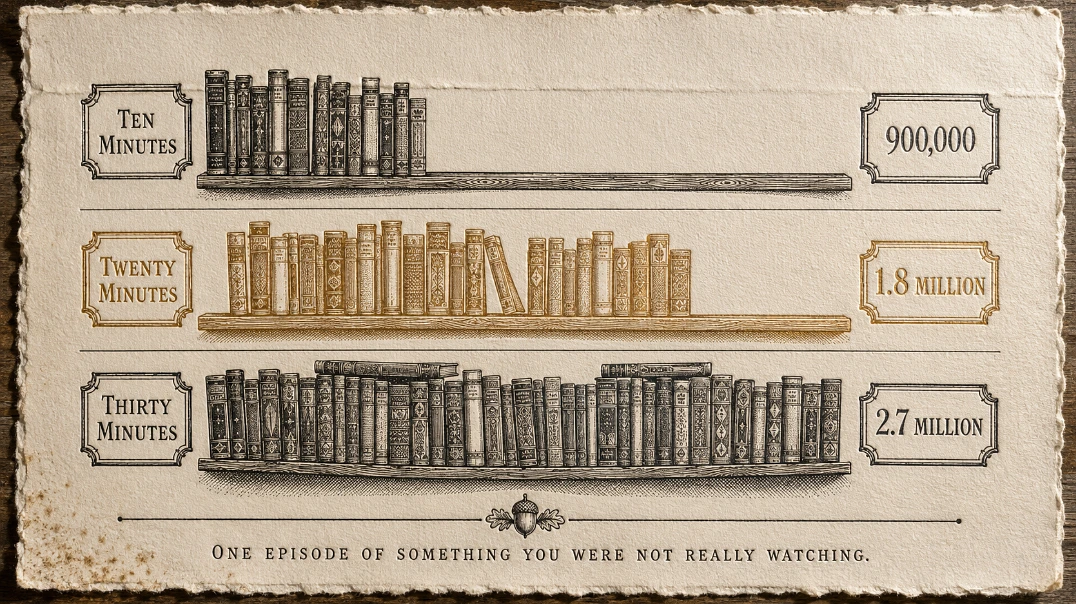
Twenty Minutes a Day Is 1.8 Million Words a Year
That’s the arithmetic that convinced me more than any brain study, and it scales in a way that’s worth seeing laid out:
| Daily reading | Words in a year | Books finished |
|---|---|---|
| 10 minutes | ~900,000 | 10 to 15 |
| 20 minutes | ~1.8 million | 20 to 30 |
| 30 minutes | ~2.7 million | 30 to 45 |
Twenty minutes is one episode of something you weren’t really watching anyway, and it returns a shelf of finished books inside a year. No diary in Britain is too full for that.

The slots that work in practice: a chapter before you look at your phone in the morning, which also happens to be the hardest one. Reading in the bath instead of scrolling in it. The last twenty minutes before sleep, where a book beats a screen for what comes after anyway. None of these cost time you weren’t already spending, they just change what fills it.