


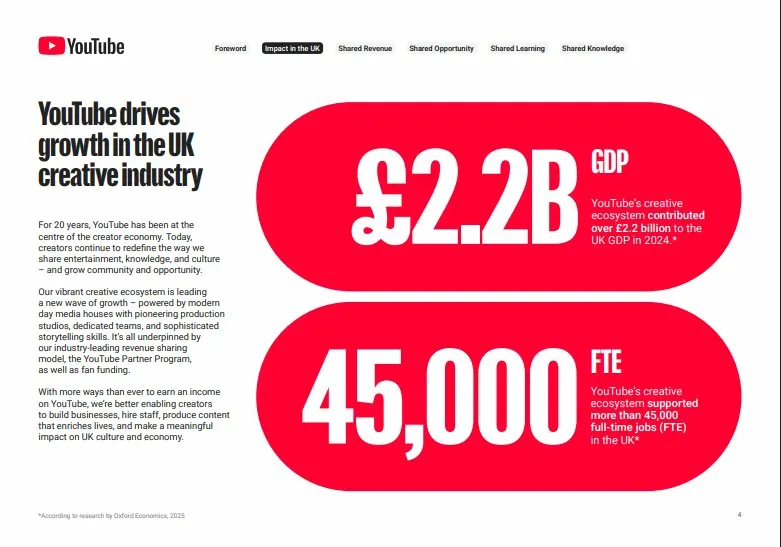
London, UK — Ten years ago, if you told someone that YouTubers would contribute more to British GDP than a decent chunk of traditional industries, they’d have laughed you out of the room. And yet here we are. An Oxford Economics report from September 2025 found that YouTube creators alone pumped £2.2 billion into the UK economy in 2024 and supported 45,000 jobs. Just YouTube — not TikTok, not Instagram, not Twitch.

The tools driving a lot of this aren’t glamorous. They’re video trimmers and free video editors — browser-based software that lets anyone cut footage, add captions, fix colour, and export something professional. No subscription fees, no film school degree. That accessibility has completely rewritten the rules on who gets to make content in the UK.
The UK creator economy by the numbers
The UK has roughly 16.6 million creators — about 25% of the population. Most aren’t quitting their day jobs (the average UK creator earns around £28,000 a year), but the volume tells you how deeply content creation has embedded itself into ordinary life.
| Metric | Figure | Source |
|---|---|---|
| YouTube’s UK GDP contribution (2024) | £2.2 billion | Oxford Economics |
| Jobs supported by UK YouTube ecosystem | 45,000+ | Oxford Economics |
| UK share of European creator economy (2025) | $9.8 billion | Coherent Market Insights |
| UK creators who feel adequately supported in training | 17% | YouTube/Public First |
| UK creator watch time from international audiences | 80%+ | YouTube/Public First |
| Projected European creator economy by 2032 | $157.3 billion | Coherent Market Insights |
That 80% international watch time figure is worth sitting with. British creators are cultural exporters in a very real sense, and the government has started treating them that way — MPs formed an All-Party Parliamentary Group for creators and influencers in 2025. YouTube also launched a Creator Incubator with the National Film & TV School, the first of its kind in the UK.
But the support infrastructure hasn’t caught up. Only 7% of creators surveyed felt access to business capital was adequate. One incubator programme doesn’t fix a systemic gap.
Why trimming matters more than your camera
Everyone thinks about cameras and lighting, but the edit is where content lives or dies. This is especially true for short-form, which is where the audience attention sits. Ofcom’s Online Nation 2025 report confirmed it: YouTube is the second most-watched service in the UK behind the BBC, with adults averaging 51 minutes daily. TikTok’s reach hit 56% of UK adults — up 14 percentage points in a single year.
Videos under 90 seconds retain roughly 50% of viewers. Go past two minutes and drop-offs get steep. Every second of dead air, every slow intro, every “umm” left in the edit is a second where someone swipes away. Trimming isn’t a minor technical step — it’s the core skill that determines whether your content gets watched.
AI-powered trimmers now auto-detect silences and filler, turning what used to be twenty minutes of timeline scrubbing into a couple of clicks. Not perfect — the AI occasionally cuts something you wanted — but as a first pass, genuinely useful.
Free editors: what they do well, where they fall short
| Tool | Best for | Strengths | Limitations |
|---|---|---|---|
| CapCut | Short-form social (TikTok, Reels) | Auto-captions, templates, TikTok integration, free | Templates so widely used your content can blend in |
| DaVinci Resolve (free) | YouTube, longer content | Pro-grade colour grading, solid audio suite | Steep learning curve for beginners |
| Adobe Express | Small business promos | Stock music, social resizing, clean interface | Limited compared to full editing suites |
| InVideo AI | High-volume marketing | Text-to-video generation, template library | Output feels generic without heavy human editing |
These tools removed the financial barrier to professional-looking content. They haven’t removed the need to be good at what you do — there’s a difference — but the money thing was a real barrier, and knocking it down has opened up creation to people in smaller towns, without formal training, and without production budgets.
The numbers back this up. About 58% of UK video marketers now use AI tools in their editing workflows, up from 51% the year before. The UK leads Europe in generative AI adoption for video — 24% of professionals versus 17% across the continent.
AI in editing: useful, not magic
AI is brilliant at the boring parts and mediocre at the creative parts. Here’s where the split falls:
What AI handles well:
- Auto-captioning and subtitle generation
- Silence and filler word detection
- Smart cropping (horizontal to vertical reformatting)
- Background removal and noise reduction
- Colour matching across clips
What still needs a human:
- Comedic timing and emotional pacing
- Deciding which take has the right energy
- Knowing when a sequence needs breathing room vs. tightening
- Building narrative arc and story structure
- Developing a distinctive editorial voice
MIDiA Research projects global creator numbers will surge 76% to 1.1 billion by 2032, with AI tools central to that growth]. Video creator tools revenues hit $8.7 billion globally in 2024, and AI tool revenues within that nearly doubled in one year.
The UK AI video market specifically is projected to reach £2.8 billion by 2034. The tools will keep improving — but “improving” means handling mechanical work better, not replacing editorial judgement.
Beyond influencers: business, education, community
If you run a small business and you’ve been putting off video because it seemed expensive or complicated, those excuses have expired. Short-form video generates about 2.5 times more engagement than long-form, and 75% of consumers prefer watching a video about a product over reading about it.
A smartphone, a free editor, and basic trimming knowledge can get you content that competes visually with bigger companies. And AI-powered video editor with smart trimming features can trimmers now auto-detect silences and filler, turning what used to be twenty minutes of timeline scrubbing into a couple of clicks. Not perfect — the AI occasionally cuts something you wanted — but as a first pass, genuinely useful.

In education, 68% of UK higher education institutions have built video production into their curricula. Community organisations — local charities, sports clubs, campaign groups — are using free editors to produce event recaps and fundraising appeals that reach further than a noticeboard ever could.
The problems nobody talks about
- Platform dependency — Your audience belongs to TikTok or YouTube, not to you. Algorithm shifts can wipe out years of audience building overnight.
- Saturation — Millions of people with the same free tools means more content fighting for the same finite attention. The barrier to creating fell; the barrier to standing out didn’t.
- Income inequality — That £28,000 average hides a brutal gap. Kolsquare/NewtonX research found 21% of UK creators earn under €500 a month, while 30% earn over €3,000. The gender pay gap is stark too — only 23% of female creators cross that €3,000 threshold versus 38% of males.
- Copyright grey areas — AI-assisted content raises unresolved questions about ownership and intellectual property. The UK government’s AI White Paper should provide clearer guidance during 2026, but for now creators are operating without firm answers.
Where this is heading
The direction is clear even if specifics aren’t. Tools will get smarter, more mechanical editing will be automated, and collaborative real-time editing will become standard. Europe’s creator economy is forecast to hit $157.3 billion by 2032, and the UK — with its English-language advantage and high digital literacy — is positioned to capture a disproportionate share of that.
But the creators who’ll benefit most aren’t the ones with the best tools. They’re the ones who invest in the craft — the storytelling, the pacing, the ability to hold attention. The tools are free. What you do with them is what costs effort.