


Every piece of energy advice published in this country since the bills went mad tells you the same thing. Turn it down. Drop the flow temperature, take a degree off the thermostat, shut the valves in the rooms you never sit in, put a jumper on. Most of that is sound and I have said versions of it to people myself, in kitchens, holding a mug, while they nod and then go and do nothing about it.
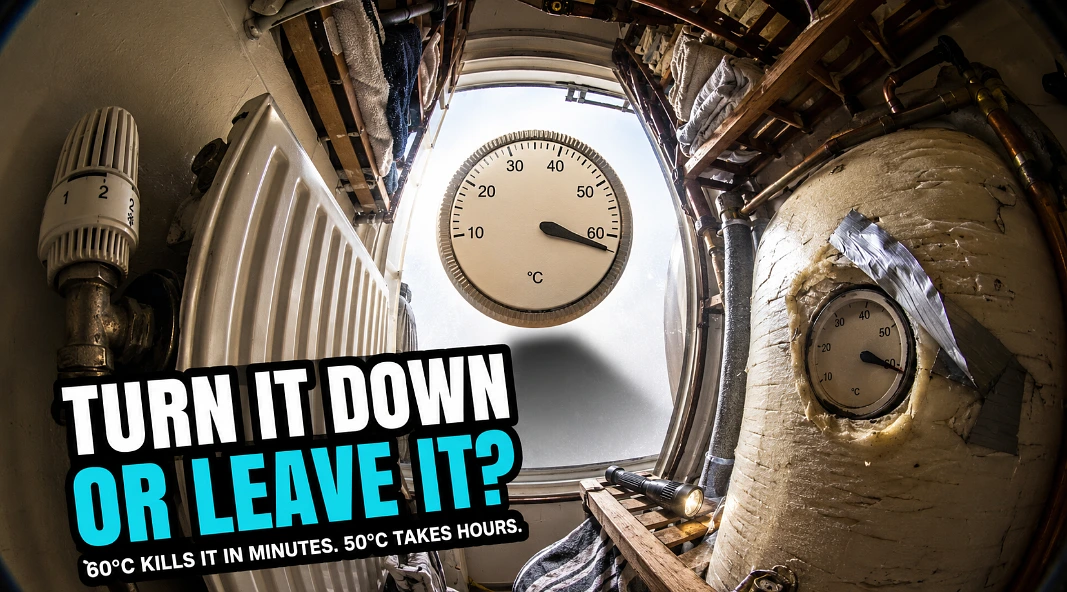
There is one dial it does not apply to, and it is not in a room. It is in the airing cupboard, on the side of the cylinder, usually sitting under a strip of insulation that somebody taped back down badly after the last service and has not been touched since.
That one stays at 60.
The number is a biology setting, not an efficiency setting

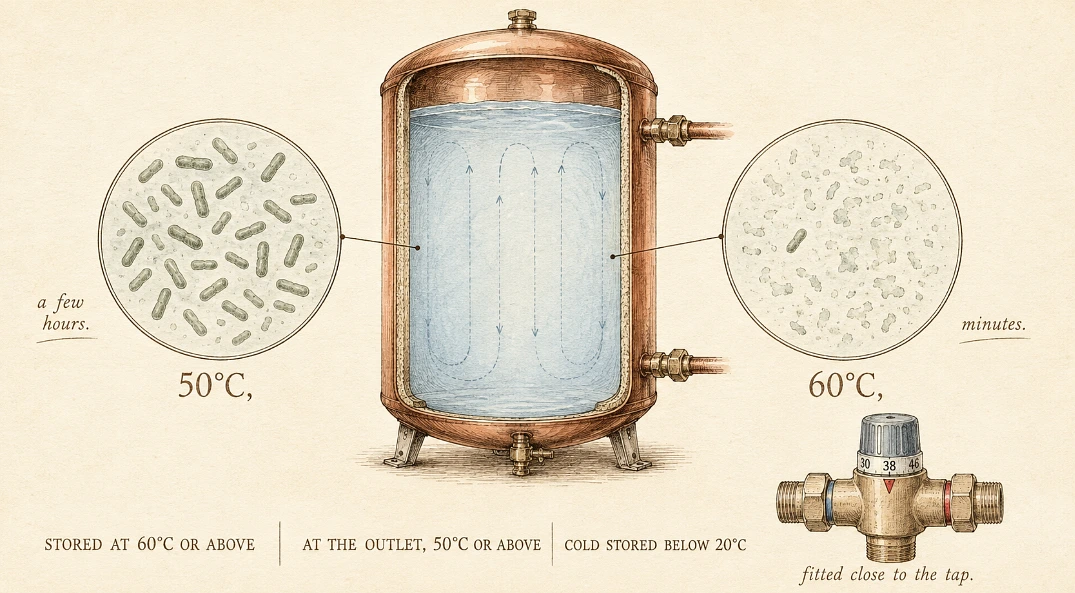
A hot water cylinder is a tank of still water that spends most of the day doing nothing, and still warm water is exactly the environment legionella bacteria are happy in. That is the whole reason the number exists. It has little to do with how hot you want your bath and everything to do with what is or is not alive in the tank when you run it.
The Health and Safety Executive puts it plainly. Hot water storage cylinders should hold water at 60°C or higher, hot water should reach the outlets at 50°C or higher, and cold water should be stored and distributed below 20°C, with thermostatic mixer valves fitted as close to the tap as possible anywhere there is a genuine scald risk. And the gap between those two hot numbers is bigger than it looks, because at 60°C most legionella is killed within minutes, whilst at 50°C the same job takes a few hours. Your cylinder does not have a few hours. It has however long the water sits there between somebody having a shower and somebody else filling the sink.
Now, an honest caveat, because I would rather give you this than have you find it out and think I was overselling. That HSE guidance is written for duty holders. Employers, landlords, care homes, facilities managers, the people who carry a legal responsibility for a building full of other people. If you own the house you live in, there is no inspection coming for your airing cupboard and no fine waiting if you drop it to 55 to shave a few pounds off the bill.
The bacteria are not aware of your tenure, though. That is the part that stays true regardless of who the guidance was written for.
So is a combi safer, then?
Different, rather than safer. A combi heats water as it passes through and stores none of it, so there is no tank of still warm water to be a problem in the first place. That is a real advantage and it is worth being honest about it. What you give up in exchange is capacity, which is why anybody with two bathrooms and a family ends up back at a cylinder eventually, and back at this number.
What has to be fitted around the boiler, and it is more than one appliance
A system boiler quote arrives looking like it is about a single box on a wall, and it is not, which catches people out when they see the list written down. In England, a compliant system boiler installation needs:
- A room thermostat
- A programmer or timer
- A cylinder thermostat
- Thermostatic radiator valves on every radiator except the one in the room where the thermostat lives
- Motorised zone valve or valves, so the heating and the hot water are controlled separately
And the boiler itself has to hit a minimum 92% ErP efficiency and be wired with a boiler interlock, meaning it shuts off when nothing is calling for heat rather than idling away because a valve stayed open.
Scotland, Wales and Northern Ireland run their own regulations, which are broadly similar in intent and not identical in detail, so if you are outside England take the shape of this rather than the letter of it.
Three layers, and one of them does not reset itself

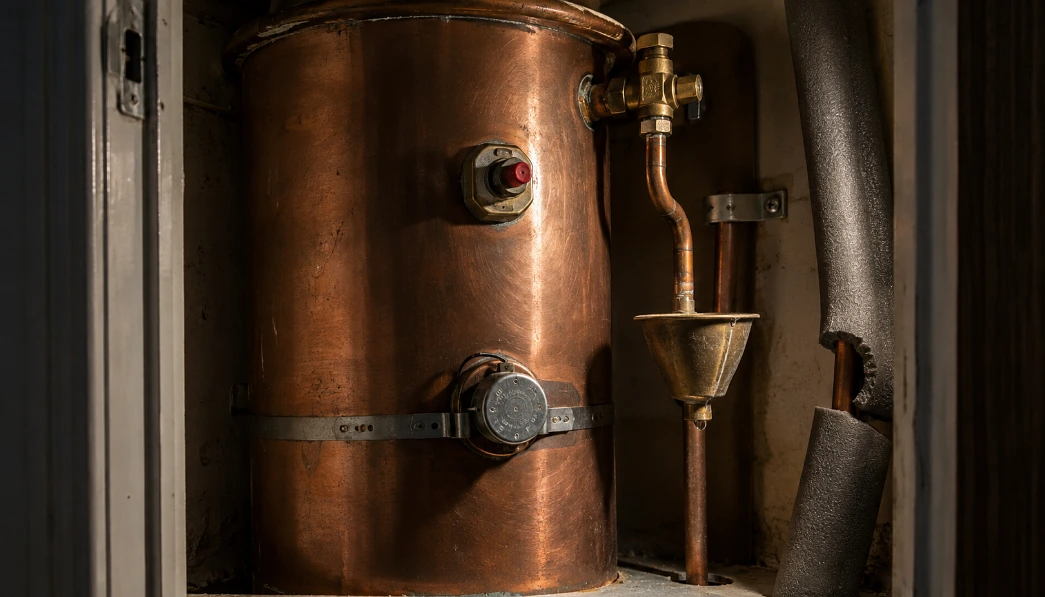
If your cylinder is unvented, which most modern ones are, it is a sealed vessel full of mains-pressure water sitting at 60 to 65°C, and the protection against that going wrong comes in three independent layers. The normal thermostat. Then an energy cut-out that does not reset itself, so it has to be attended to by a person rather than quietly recovering overnight. Then a temperature relief valve as the last line, which dumps scalding water out through the tundish before pressure can build.
Independent is the important word there. They are not meant to be a backup of each other in the sense of sharing anything.
Your Gas Safe card runs out at the cylinder
Gas Safe registration covers the gas. It is a legal requirement, it is the right thing to check, and it stops at the cylinder. That split rarely gets explained to a homeowner and I only worked it out for myself by going to the Building Regulations rather than to anybody selling anything.
Unvented hot water storage sits under Approved Document G section G3, and any vessel over 15 litres without a vent pipe open to atmosphere has to be installed, commissioned and serviced by somebody holding a current G3 qualification, typically the BPEC unvented hot water certificate or the City and Guilds equivalent. It is notifiable work. It gets registered either directly with Building Control or self-certified through a competent person scheme such as WaterSafe or BESCA, and a Building Regulations compliance certificate should reach you afterwards.
That is not paperwork for its own sake. Unvented cylinders fitted without the proper safety devices have killed people, which is precisely why the qualification exists and why the three layers above are not optional.
So the useful question on a quote is not really which boiler is it. Manufacturer and installer pages will tell you plenty about the appliance, Boilerhut lay the system boiler side out clearly enough if you want the basics before you speak to anyone, but almost none of that material tells you who is fitting the cylinder or what that person is qualified to do. Ask it directly. Ask for the G3 card and ask whose name goes on the notification. A firm that does this right will answer in about four seconds and a firm that does not will start explaining.
Then ask for the Benchmark commissioning document at handover, with the controls recorded on it, because that is your evidence when the manufacturer wants to know whether the guarantee still stands in year seven.
Airing cupboards are quietly vanishing from new builds

Slight detour, and I am not sure it goes anywhere useful.
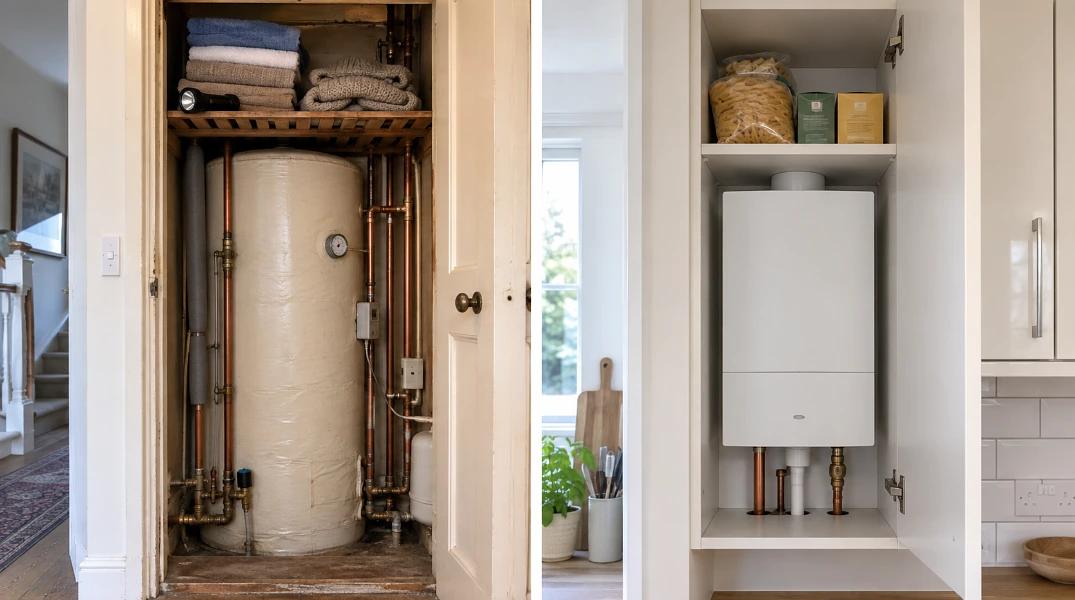
The airing cupboard is disappearing from new build housing, and it took the cylinder with it, and it took with it the one place in a house where you could stand and look at your own hot water system without a torch. Every property I go into that was built before about 1985 has one, usually with a slatted shelf and a jumper on it that somebody has forgotten about since 2011. Every property built after about 2005 has a combi in a kitchen cupboard and no equivalent space at all.
Whether that is a loss or just a change in how houses work, I genuinely do not know. I notice that the people who have one tend to know where their stopcock is, and the people who do not, mostly do not.