


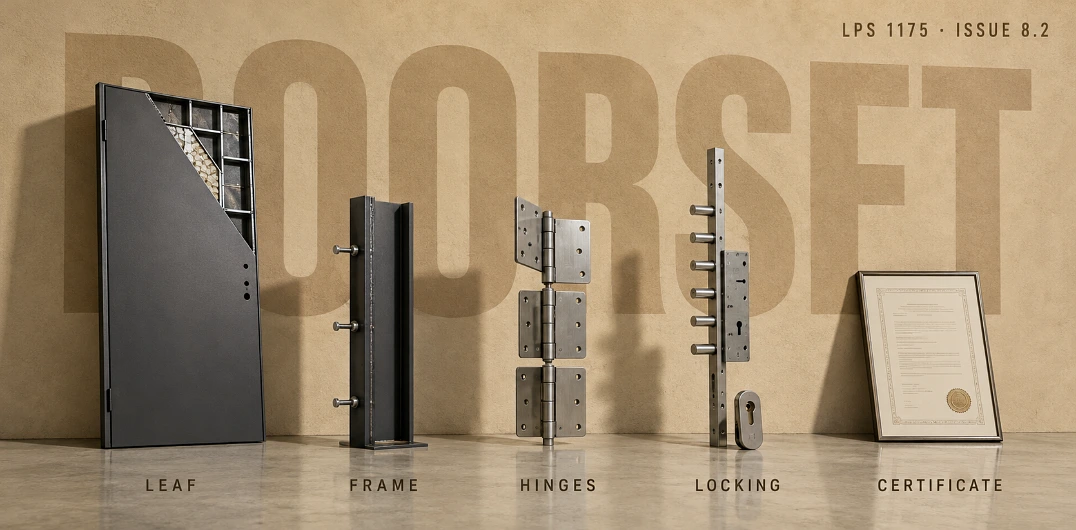
A quote lands and it says LPS 1175 C5 (SR3). Two codes for one door, and the trade is split down the middle on which one it uses.
The letter is the toolkit the door was tested against. The number is how many minutes it held.
LPS 1175 comes from the Loss Prevention Certification Board, part of BRE, which has worked alongside insurers for over a century. Insurers and police forces lean on it for higher risk sites because it is a test result rather than a sales claim.
How to Read an LPS 1175 Rating Code

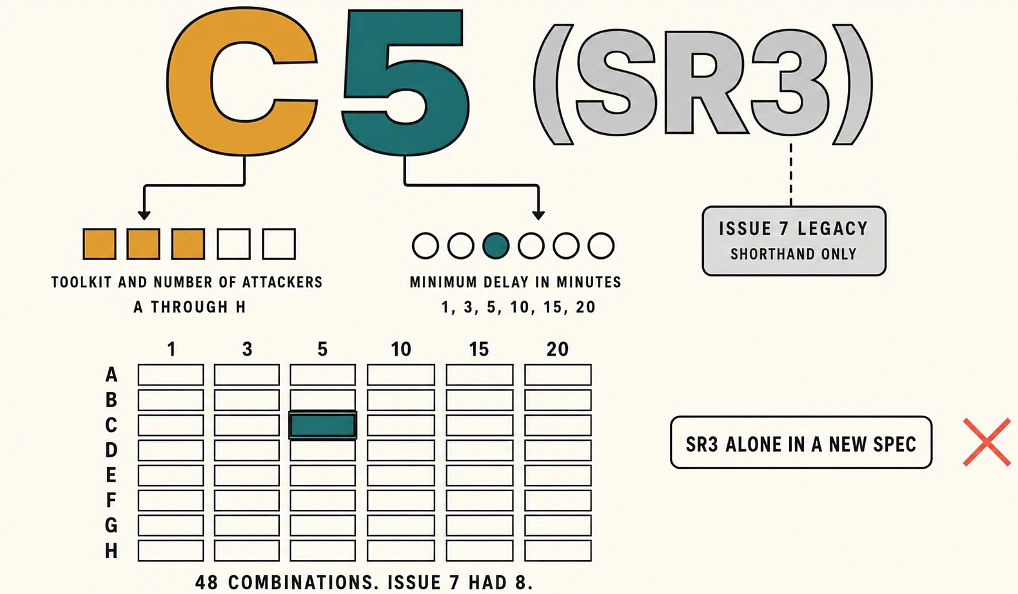
Issue 8 broke the old scale into two halves. A letter from A to H covers the tools and how many attackers were involved. A number, one of 1, 3, 5, 10, 15 or 20, gives the minimum delay in minutes.
C5 therefore means the door resisted Category C tools for at least five minutes.
Forty eight combinations exist under that system. Issue 7 ran a single SR1 to SR8 scale that welded tools and time together, so asking for a heavier toolkit at a shorter delay was impossible.
What Each Rating Resists, and Where It Gets Used
Both notations turn up on the same quote, so here is the map.
| Issue 8 | Old rating | What it faces | Typical use |
| A1 | SR1 | Screwdrivers, small hammers, one minute | Low risk domestic and commercial |
| B3 | SR2 | Concealed tools with more leverage, three minutes | Offices, schools, small shops |
| C5 | SR3 | Disc grinder, larger crowbars, chisels, sledgehammers, five minutes | Warehouses, server rooms, building envelope |
| D10 | SR4 | Powerful battery tools, ten minutes | High commercial and critical assets |
| E10 | SR5 | Specialist power tools | Professional attack, high value storage |
What “Working Time” Means on the Certificate

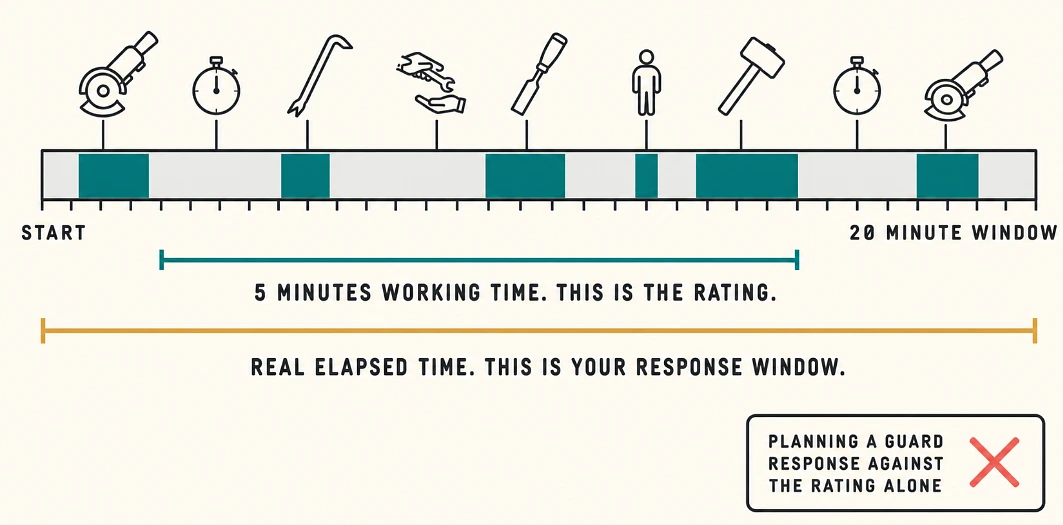
The delay figure counts working time only, which is the time an attacker spends with tools against the door.
Rest breaks are excluded. So are tool changes and any pause to reassess. A C5 door faces five minutes of working attack inside a test window that can run to 20 minutes, and at D10 the window stretches to 30.
Anyone planning around a guard response or an alarm receiving centre needs that distinction. Five minutes of working time occupies a much longer stretch of real elapsed time.
How LPCB Attack Testing Is Carried Out
A test team runs it, one leader with either one or two operatives depending on the rating being targeted. The leader times each attack, directs the operatives and keeps the event record.
Exploratory attacks are permitted before the timed run, so the team can identify the approach likely to produce the lowest attack time. Where two operatives work together at the higher ratings, their tools are pooled into a single kit rather than counted separately.
The certified rating reflects the worst result the team achieved.
Which Rating UK Projects Usually Specify
Standard practice puts B3 (SR2) on outer perimeter elements and C5 (SR3) on the building envelope.
C5 carries most of the load in UK specifications. It is the level used across critical national infrastructure, data centres, substations, water treatment, utilities and the government estate.
Four Mistakes That Cost People Money

These four repeat, and each one gets expensive after the money has gone out.
- Writing SR3 into a new spec without the C5 alongside it. Issue 8 is the current standard, now at Issue 8.2, and most insurers expect Issue 8 compliance. Legacy SR ratings are fine as shorthand on a product with dual labelling, and plenty of manufacturers print both. Used alone in a fresh spec, they invite a supplier to hand you something certified years ago against a different test.
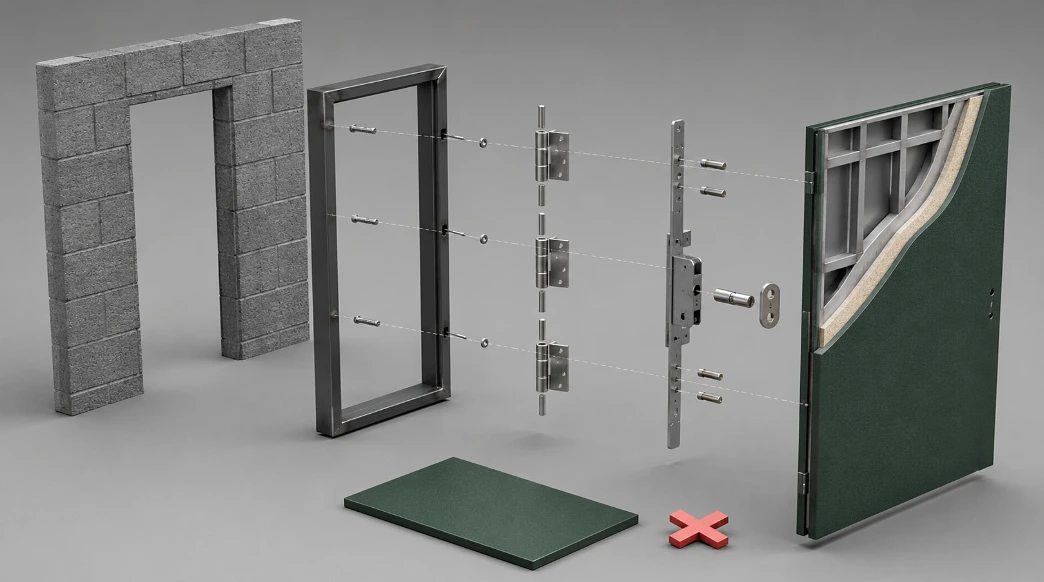
- Assuming thicker steel means a higher rating. It does not. The rating comes from how the whole doorset behaves under attack, the leaf, the frame, the hinges and the locking points together. A heavy leaf hung in a weak frame fails at the frame.
- Changing the doorset after certification. The certificate covers the tested configuration only. Swap the ironmongery, add a vision panel, or fit it into a substrate the test never covered, and you are outside it. Installation guidance from the manufacturer is part of what was certified, not advice you can take or leave.
- Treating the door as the security measure. A C5 doorset in a wall someone can grind through in ninety seconds has bought you very little. LPCB thinking assumes layered barriers.
When Two Lower Rated Doors Beat One Higher Rated Door

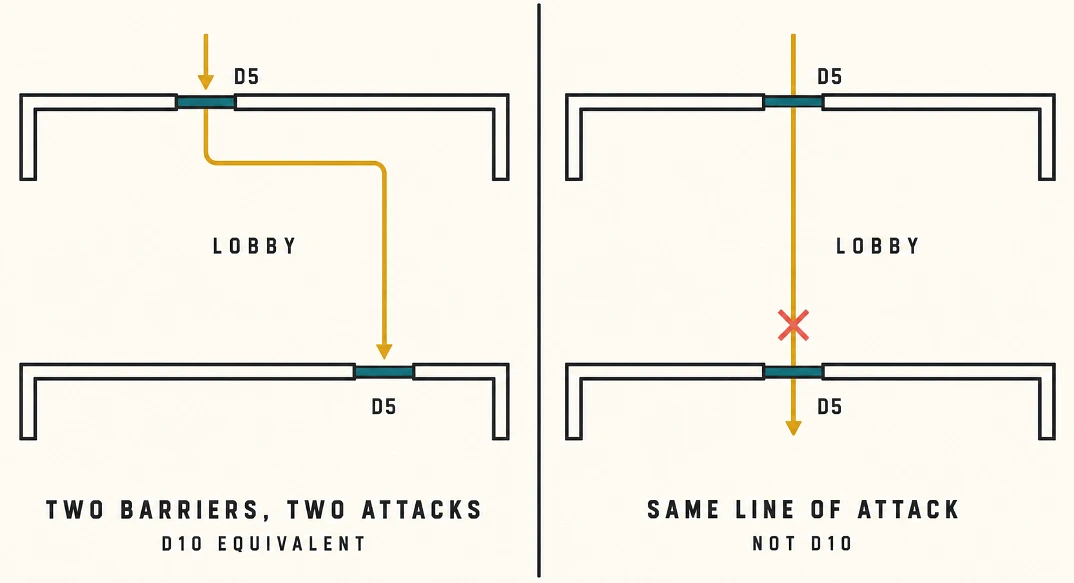
Layering sits inside how Issue 8 was designed. Two products at D5, arranged so an attacker has to defeat both, can deliver a D10 equivalent.
Building layout decides whether that holds. Two barriers sitting in the same line of attack with nothing between them will not give you the combined figure.
Fire, Ballistic and Blast Are Separate Certificates
A security rating says nothing about fire performance. Those sit under EN 1634-1 for fire, EN 1522 for ballistic and EN 13123-2 for blast.
One doorset can hold several at once and many do. Each is tested and certified on its own, so ask for the certificates individually rather than accepting a line about a door being both fire rated and secure.
What Decides the Lead Time on a Steel Doorset
Steel doorsets are made to order, so the programme date carries real risk on any job. In my experience the step that moves it most often is finishing.
Where a manufacturer sends leaves and frames out to a third party for powder coating, your delivery date sits in someone else’s queue. Doing it in house removes that dependency, and a number of UK manufacturers have invested accordingly, among them the Middlesbrough steel door company Metador, which added a powder coating plant in 2025 alongside extra CNC punch capacity.
Two questions worth asking any supplier. Where is the coating done, and what is the current queue on the CNC side.
How to Check a Certificate Is Real
Ask for the certificate number rather than the claim. LPCB approvals are listed publicly on RedBookLive and checking one takes about a minute.