



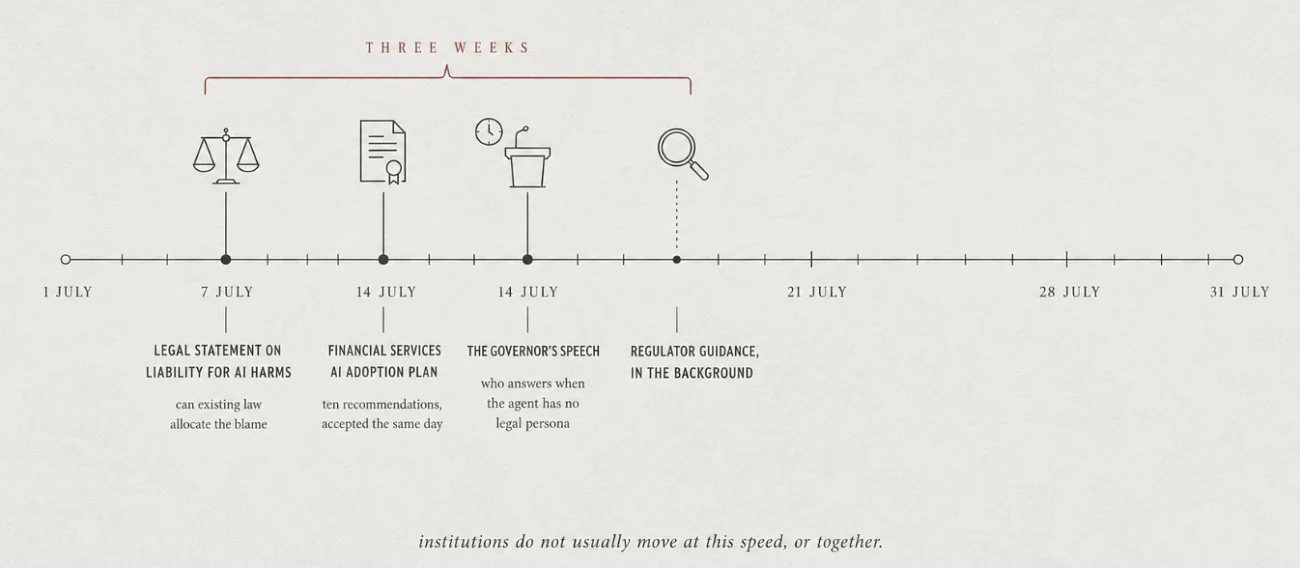
I have been watching British institutions long enough to know their natural speed, which is somewhere between a canal boat and a glacier. So when three of the most cautious bodies in the country all move on the same subject inside three weeks, I sit up, because that is not routine behaviour, that is a building deciding it can smell smoke.
So let me lay the month out the way I had to piece it together myself, because I went back and checked the dates twice before I believed the clustering. On 7 July the UK Jurisdiction Taskforce put out its legal statement on who carries the blame when AI causes harm. A week later, on 14 July, the Treasury published its Financial Services AI Adoption Plan and accepted the recommendations on the same day, which anyone who has ever waited on a government response will recognise as indecent haste. And that same evening the governor of the Bank of England, Andrew Bailey, stood up at a City dinner and asked the question that sits underneath all of it, while the competition watchdog has been circulating its own guidance on consumer facing agents in the background. That is four institutions landing on one subject in a single month, and I genuinely cannot remember the last time I watched that happen.

And to be clear about what the subject is, because it is not chatbots, we are talking about agents, which is software that does not just answer your question but goes off and acts for you, so it books the appointment and files the report and moves the money and reorders the stock without waiting for you to click anything. Which brings us to the governor’s question, and it deserves a proper moment, because it is a genuinely good one.
If a piece of software with no legal personhood acts on a company’s behalf and botches the job, who is responsible?
The old answer is centuries old and it worked fine for centuries, a principal answers for their agent as long as the agent stays inside the job it was given, and the moment the agent wanders outside that job it starts answering for itself. Which was all very tidy while agents were people, or at least companies, something a judge could actually summon into a courtroom. An AI agent is neither of those things. And Bailey’s worry, which I happen to share, is that if the company stays on the hook for absolutely everything the software does then the legal departments will strap these agents down so tightly that we end up paying enterprise prices for a glorified form filler, and if the company is somehow not on the hook then heaven help whoever ends up on the receiving end of the mistake. The Taskforce reckons the common law can stretch to cover most of it, and English common law has stretched around stranger things over the years, but the gaps they flagged are real ones, and when the Treasury and the Bank and the lawyers are all chewing the same problem in the same month, my read is that the arrival has stopped being theoretical.
The Numbers Landed This Week and They Are Calmer Than the Headlines

Now the data, because the Office for National Statistics dropped its figures this very week and I would encourage reading them slowly rather than in headline form.
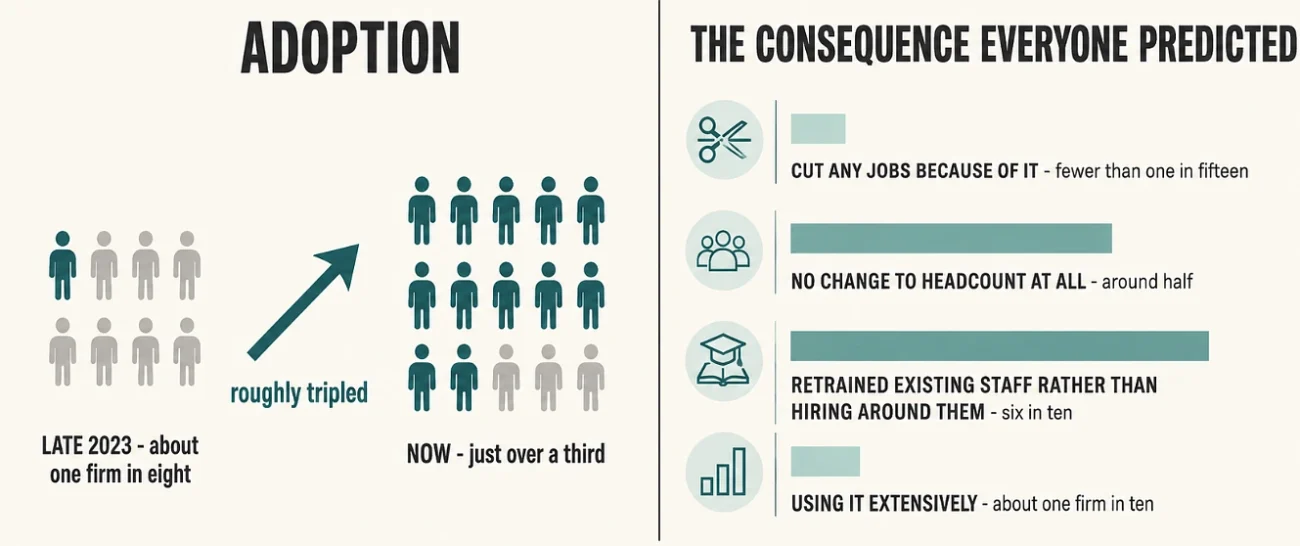
Adoption among British businesses with ten or more staff has roughly tripled since late 2023, going from about one firm in eight to just over a third, and that is fast movement by any standard, but the massacre that was supposed to arrive with it simply has not turned up. Of the firms that adopted, fewer than one in fifteen reported cutting a single job because of it, around half said it changed their headcount not at all, and where firms found themselves short of know-how, six in ten chose to retrain the people they already employ rather than hire around them. London is out in front, naturally, with over half of workers in the capital using AI daily against just over a third nationally, and the strangest line in the whole release is the hiring one, because businesses with AI at the centre of their operations are taking on more junior staff than everyone else, at double the rate, which means the technology that was supposed to pull the career ladder up appears for now to be holding it steady.
Am I telling you the fear was all nonsense, then?
No, and honesty demands the other column gets read too. Ocado cut a thousand roles back in March while analysts talked about rivals copying its automation faster and cheaper, and HSBC announced a strategy this week that leans on AI for cost cuts and then went noticeably quiet when anyone asked what that means for staff numbers. Stories like those are real and more of them will come. But the national picture the statisticians can actually measure shows businesses using this stuff to get through the boring middle of their work rather than to empty their offices, and the ONS also found the whole thing is a mile wide and an inch deep, since most adopters run one or two tools and only about one firm in ten uses AI extensively. Britain has dipped a third of itself into the water and very few firms have actually swum anywhere yet.
The Real Shortage Turned Out to Be People Who Can Build the Things
Here is the twist I find genuinely funny, in the way this industry is often accidentally funny, because the great worry was machines replacing workers, and the actual crisis of 2026 is a shortage of workers who can build the machines.
Malt’s research this month put the growth of its AI engineer freelance community at 229% in a single year, and demand is still outrunning them comfortably. The talent that can take a messy business process and turn it into a working agent, one that does not hallucinate an order or leak a database or cheerfully email a customer something libellous, is scarce and priced like it, which is why firms specialising in AI agents development are having the busiest year they have ever had. And there is a quieter story feeding the scramble, because the big AI providers have been shifting from flat subscriptions toward usage based billing this year, and some companies discovered the hard way that an enthusiastic month of experimentation can burn through an annual budget in a few weeks, so suddenly everyone wants a professional who knows where the meter is running.
Building one of these things properly turns out to be deeply human work, since somebody has to decide what the agent is allowed to touch and what it must never touch, who checks its output, and what happens on the Tuesday it does something no one predicted. That is judgement, and judgement is the one line on the invoice that has not been automated.
We Have Watched This Film Before and the Ending Was Not the One Advertised
My honest opinion, for whatever an opinion is worth against a trend line, is that we have run this experiment before. The spreadsheet was going to finish off the accountants, and instead Britain ended up with more accountants doing more interesting sums. The word processor really did empty the typing pools, so I am not pretending the changes come free, but the profession that grew up around the new tool ended up bigger than the one it replaced, and I suspect agents will run the same arc, where some roles genuinely go, mostly the ones that were already a checklist wearing a lanyard, and the larger effect is a pile of new work that has not been named yet. The July flurry in Whitehall is the paperwork stage of exactly that.
So no, I do not think July 2026 makes any highlight reel, because there was no keynote and no demo and no queue outside a shop, just a Treasury plan, a legal statement, a regulator’s memo and a governor thinking out loud over dinner. But institutions write the boring documents before the interesting decade arrives, and this month they wrote rather a lot of them.