


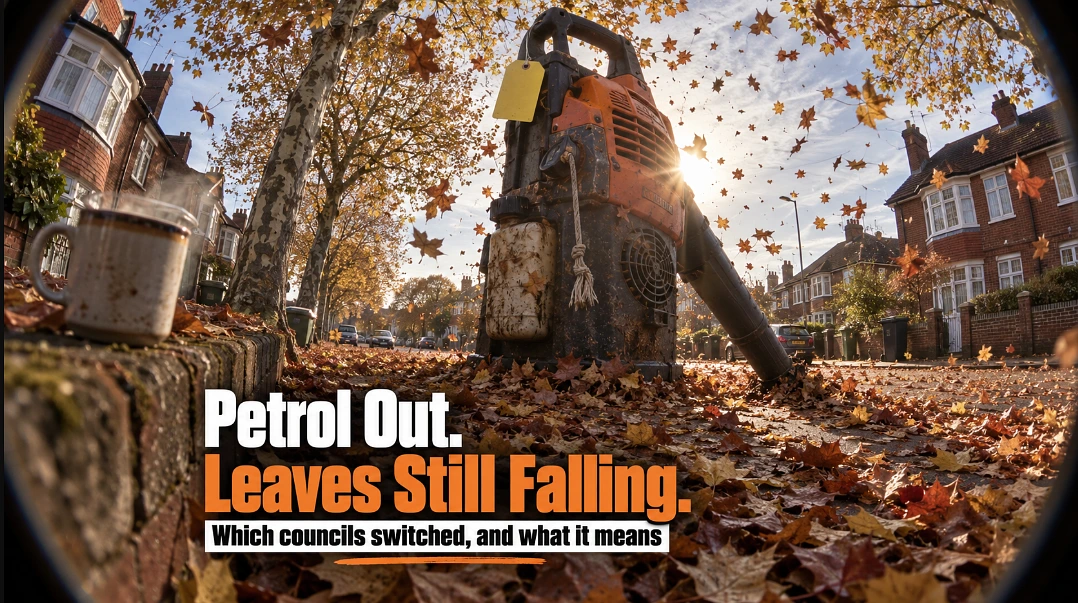
The leaves are about to start coming down, which means the blowers come out of the sheds this week, and in a few places in Britain they are not coming out at all any more because the council got rid of them.
Now, if you have ever been sat in the garden with a coffee on a Saturday morning and one of these things has started up 2 doors down, you already know why this is an argument. It is not a small noise. It is the kind of noise that ends whatever you were doing.
Edinburgh Voted To Ditch Them And The Grounds Crews Pushed Back
Edinburgh councillors backed a ban on fuel powered leaf blowers over health and pollution fears, and the coverage at the time made a lot of the fact that councillors were talking about going back to old fashioned rakes. Then the council actually went and did it, swapping the petrol driven leaf blowers for electric ones as part of its net zero drive.
And the reaction from the people who have to do the work was not polite at all.
There is a forum called the Landscape Juice Network where UK grounds staff talk to each other, and the thread on this is worth reading because they were not arguing about the environment, they were arguing about the job. One of them put it in a single line, that an hour’s work with the blower could take days with a rake. Another one asked whether the council was now going to pay compensation to every past employee who ends up with a lung condition, since it had just stood up in public and said the fumes were harmful, which is a fair question and nobody answered it. And somebody else made the point that if the petrol blowers go then all the other handheld petrol tools have to go too, because you cannot really ban one and keep the rest.
So that is a proper argument, and it does not really get had in the coverage. It gets reported as councillors versus leaf blowers and that is about it.
There Is No UK Ban, But The Councils Already Have The Powers
Here is the thing that a lot of people get wrong about all this. There is no national rule. There is no ban coming down from government.
There are currently no specific UK-wide regulations that ban or limit the use of petrol powered gardening tools. What there is instead is councils having the authority to impose restrictions themselves, based on noise or air pollution concerns, and they have had that authority for a very long time.
The 2 they are using are old ones.
- The Control of Pollution Act 1974, which lets councils control noise from machinery and tools used outdoors, particularly in densely populated areas
- The Environmental Protection Act 1990, under which a petrol mower, strimmer or blower disturbing the peace can be treated as a statutory noise nuisance
So none of this needed anybody to pass anything new. It just needed somebody at the council to decide to use what was already there, which is probably why it is happening in some places and not others with no real pattern to it.
And it goes back further than people assume. Campaigners point out that Camden Council and the University of London banned leaf blowers during the spring and summer months back in 2011, so that is 15 years ago now.
What The Noise Is Doing To The Person Holding It

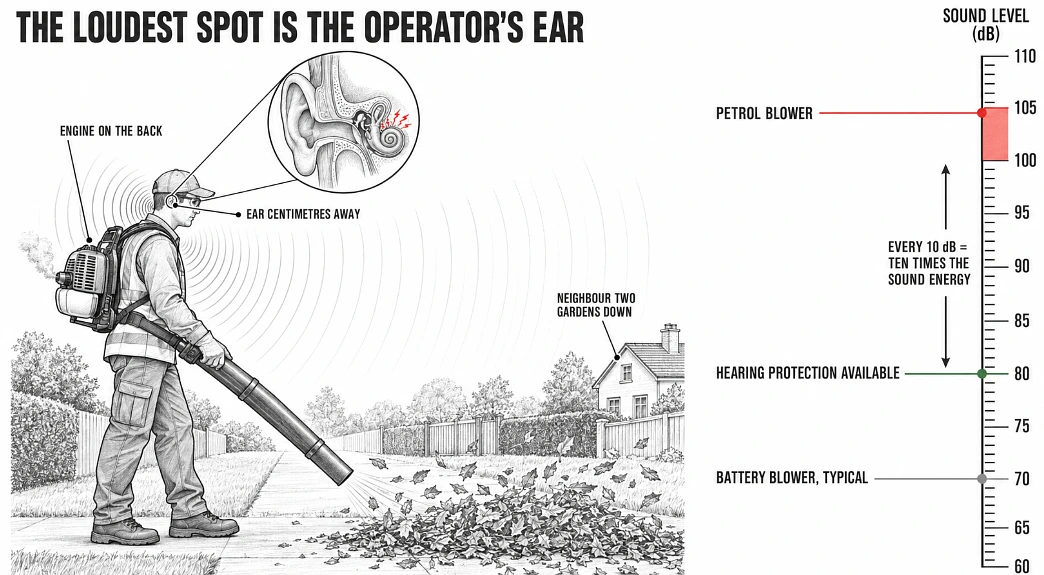
Now this is the part that gets skipped, because the whole thing tends to get framed as residents against gardeners, when the gardener is the one stood right next to it for most of the day.
The noise from a petrol leaf blower can be over 100 dB, and the campaigners who want them banned put the loudest ones at 105. And in the UK, employers are legally required to provide hearing protection for workers exposed to more than 80 dB. So hearing loss and tinnitus are common among the people who use this equipment regularly, which is not surprising when you put those 2 numbers next to each other.
100 against a legal limit of 80. That is not a near miss. That is 20 over, every day, and the person holding it is the one wearing it.
The Pollution Numbers Everyone Quotes
Now, these figures turn up in every single argument about leaf blowers, so it is worth knowing where they come from rather than just repeating them the way everybody else does.
The one about a commercial petrol leaf blower generating as much pollution as driving a small car about 1,100 miles, that comes from the California Air Resources Board. The US Environmental Protection Agency has estimated that a lawnmower can produce the same air pollution as 11 cars. And a Swedish study found that an hour on a petrol mower puts out roughly what a car does on a 100 mile journey.
1,100 miles, from clearing a car park. It does sound mad, and to be fair these are other people’s numbers rather than anything independently checked here, but they are the numbers the whole debate has been running on for years now.
What Happened In St Albans When The Contractor Actually Switched

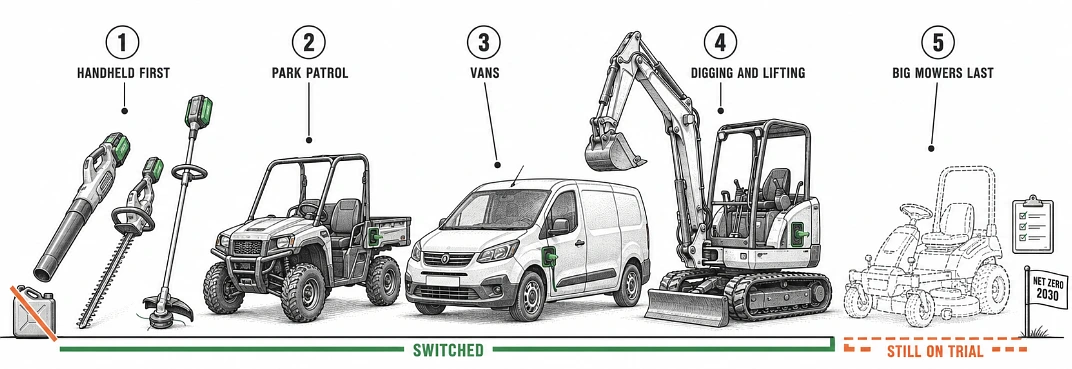
This is the bit worth paying attention to, because it is a real switch that happened rather than a vote about a switch.
John O’Conner, who is St Albans City and District Council’s grounds maintenance contractor, ditched the petrol driven machines for battery powered ones, in line with the council’s commitment to cutting emissions to net zero across the district by 2030. The handheld stuff went over first, so strimmers, leaf blowers and hedge cutters. And then alongside that they brought in an all electric all terrain vehicle for park patrols, 2 vans, and a JCB excavator for the digging and heavy lifting.
A battery excavator. That is honestly further than most people would guess this has got.
But now look at what was still on trial, because that is the interesting part. They had been trialling all electric grass cutters including ride-on mowers, with a view to replacing the petrol ones eventually, which means the big mowing machines had not been signed off yet even while the blowers and hedge cutters already had. So the order things switched over in tells you where the technology actually is, and it is not everywhere yet.
Everywhere Else Is A Long Way Ahead Of Britain

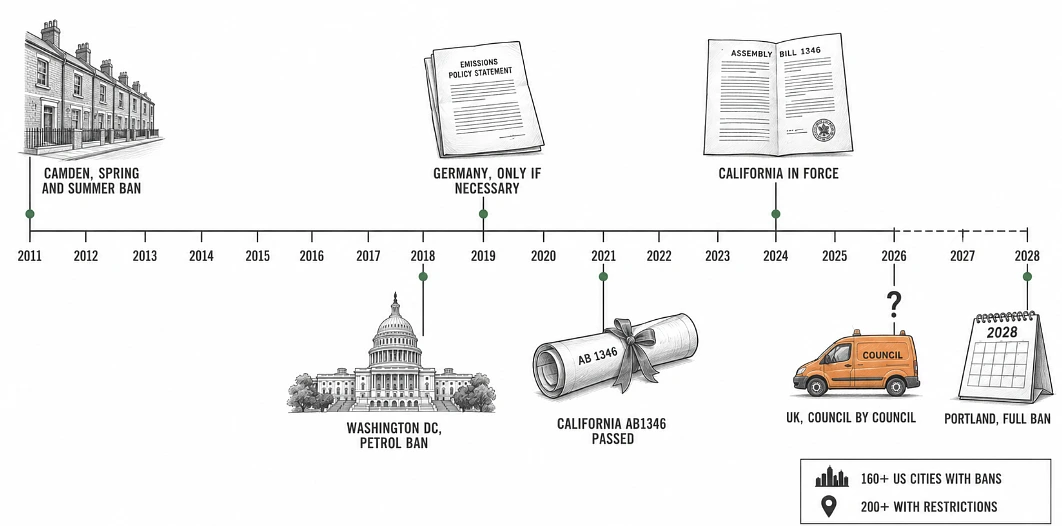
For all the fuss about Edinburgh, Britain is nowhere near the front of this.
- Washington DC banned petrol powered leaf blowers back in 2018
- Over 160 US cities have bans according to the CoPIRG Foundation, and over 200 places have restrictions of some sort
- Portland, Oregon is banning them by 2028, with the phase out period starting this year
- California passed AB1346 in October 2021 phasing out small off-road engines, and it took effect on 1 January 2024
- Germany’s government put out a statement in 2019 saying leaf blowers should only be used if completely necessary
So the direction of this is not really in question any more. It is the date that is in question, and in Britain the date is whenever your particular council gets round to it.
The Rake Argument Is The Real One
And here is where it gets awkward, because those grounds crews on the forum were not being awkward for the sake of it. They were right.
The leaves do not come down gently across 3 months. They come down in a few weeks, pretty much all of them at once, and a crew with rakes is not clearing a school site or a park inside that window. It is not a fair comparison and everyone in the trade knows it.
One of the more reasonable posts on that thread got closest to the actual answer, which is that electric blowers would be a real benefit but it might mean the leaves that are only being cleared for the look of the place get left where they fall to rot down instead.
So the choice most councils are really making is not rake against blower. It is how much of that leaf clearing was ever needed in the first place, and nobody wants to say that part out loud because it sounds like the council giving up.
What This Means If You Are Buying One
If you are buying rather than campaigning, the handheld end of this is basically sorted now. Blowers, hedge trimmers and brushcutters on a decent battery platform will do professional work, and the quiet is worth real money on a site with classrooms or houses right next to it, because it means you can work at 9 in the morning instead of waiting.
The 2 things that decide whether it works are runtime and whether the batteries fit more than one tool. And that second one matters more than people expect, because a platform shared across the blower, the trimmer and the hedge cutter means you rotate charged packs and keep going, rather than standing about waiting for one machine to charge. Suppliers such as Ron Smith deal in the professional battery ranges and can tell you which platform covers which machines, and that is the question to ask before you ask anything about the machine itself.
Mowing is the one to hold off on if the area is big. St Albans is still trialling it and they are further along than most.
Where This Goes From Here
Petitions to ban the sale and use of petrol garden tools keep getting filed and keep closing without getting near the 10,000 signatures needed for a government response, so nothing national is arriving that way any time soon.
What is more likely is what has already been happening. A council decides, the contractor changes its fleet over, and 3 years later nobody remembers it was ever an argument.
Worth finding out what your own council is running in its parks this autumn, though. That is usually one phone call, and it tells you whether this has reached your area yet or whether you have got another few years of being woken up on a Saturday.