


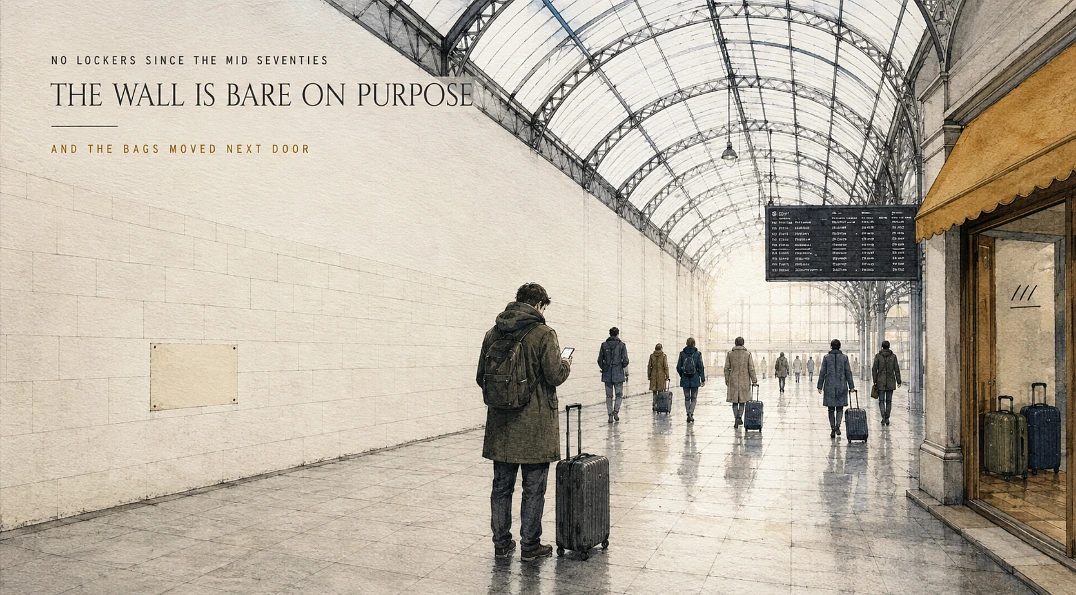
Arrive at almost any big station in Europe and you will find a wall of luggage lockers. Munich has them. Paris has them. Rome has them. Coins or card in, bag in, and off you go.
Now arrive at London Paddington and look around. No lockers. Walk to King’s Cross, Victoria, Liverpool Street, Euston. Same thing. Not one self service locker in any major London station, and most visitors think they are simply failing to find them.
They are not failing. The lockers are gone, and the reason they are gone is a piece of British history that most people walk straight past.
The Lockers Were Removed Because of Bombs
During the IRA bombing campaigns of the 1970s, London learned a hard lesson. A locker is a place where anyone can leave a sealed box, walk away, and come back never. Bombs with timers went into station lockers, and even the threat of one was enough, since a single phone call could shut a whole terminus while every locker was opened and searched by hand. So in the mid 1970s the self service lockers were removed from the major London stations. All of them. The rubbish bins went too, for the same reason, and for decades a London platform had nowhere to throw a crisp packet. Bins have only crept back in recent years, and even now they are clear plastic bags on hoops, so anyone can see what is inside.
- And here is the detail that shows how far back this goes. The IRA was putting bombs in station left luggage as early as 1939, at Tottenham Court Road, Leicester Square, King’s Cross and Victoria Underground stations, killing one person and wounding seven. The locker problem is older than the Second World War.
Paddington itself is part of this story. In February 1991, a bomb exploded at Paddington station in the early hours, and a second device went off at Victoria that morning, hidden in a litter bin, killing one man and injuring 38 people. Heathrow was shut the same day by a hoax call. After years like that, no British railway manager was ever going to bring the locker walls back, and none has.
What Replaced Them Was Safer but Worse for Travellers
The stations kept a version of left luggage, but a very different one. A staffed counter, where a person takes your bag, puts it through an airport style scanner, checks your ID, and stores it behind the desk. Safer, without question. But staff cost money, so the counters keep office hours, the queues build at busy times, and the prices are what regular travellers on the forums politely call far from great. And smaller stations simply dropped the service, so whole cities ended up with no public luggage storage at all.
Which leaves the modern Paddington problem, and anyone who has done a last day in London knows it. The hotel wants you out at ten in the morning. The flight from Heathrow leaves at nine at night. Between those two moments sits a full, glorious London day, and a suitcase that turns all of it into misery. You cannot take a case around the British Museum. You do not want it in a pub, a park, or a packed Elizabeth line carriage. So thousands of people every week end up standing under the departure boards, typing luggage storage paddington station into a phone, and this is where the story takes its modern turn.
The Fix Came From Shops, Not From Stations
Because the stations could not bring lockers back, the answer grew up around them instead. App based networks now sign up ordinary businesses near the station, cafes, convenience shops, hotels with a spare back room, and those places hold bags for a flat fee, booked from a phone in a minute. Radical Storage is one of the networks running this around Paddington, with storage points spread through the surrounding streets rather than inside the station building.
Is it as convenient as a locker wall on the concourse would be?
Honestly, not quite. You walk a few minutes, and you deal with a human. But it is cheaper than the staffed counters, it does not run out of space the way one office can, many points keep longer hours, and there is something quite fitting about the solution. Britain removed the anonymous metal boxes because anonymous was the danger, and what replaced them, half a century later, is the least anonymous system possible, a named shopkeeper, a booked bag, a record of who left what and when. The security worry of 1975 and the convenience problem of today finally fit together.
So next time you are dragging a case through a London station and cursing the missing lockers, spare a thought for why the wall is bare. It is not poor planning. It is memory. The lockers went because people put bombs in them, the bins went for the same reason, and the city has never fully trusted a sealed, unclaimed box since. The bags did not stop needing storing, though. They just moved into the shops next door, and honestly, London being London, there is probably a queue.