



There is a story that repeats itself in old houses across Britain, and it usually goes like this. A family buys a lovely Victorian terrace or a Georgian cottage. There is a bit of damp on one wall, nothing dramatic, so they get a builder in. The builder hacks off the old crumbly plaster, puts on a nice smooth coat of modern gypsum, paints it with a good plastic emulsion, and it looks brilliant for about eight months. Then the damp comes back, worse than before, and now it is spreading.
Nobody did anything wrong on purpose. The builder used the materials he uses on every job. The paint was good quality. And that is exactly the problem, because the materials that work perfectly well on a house built in 1995 are quietly wrecking a house built in 1895.
Old walls were built to get wet and then dry out again
Here is the bit that most people never get told. A modern house has cavity walls, two skins of brick with a gap in the middle and a damp-proof course keeping ground moisture out. It is designed to keep water on the outside, full stop.

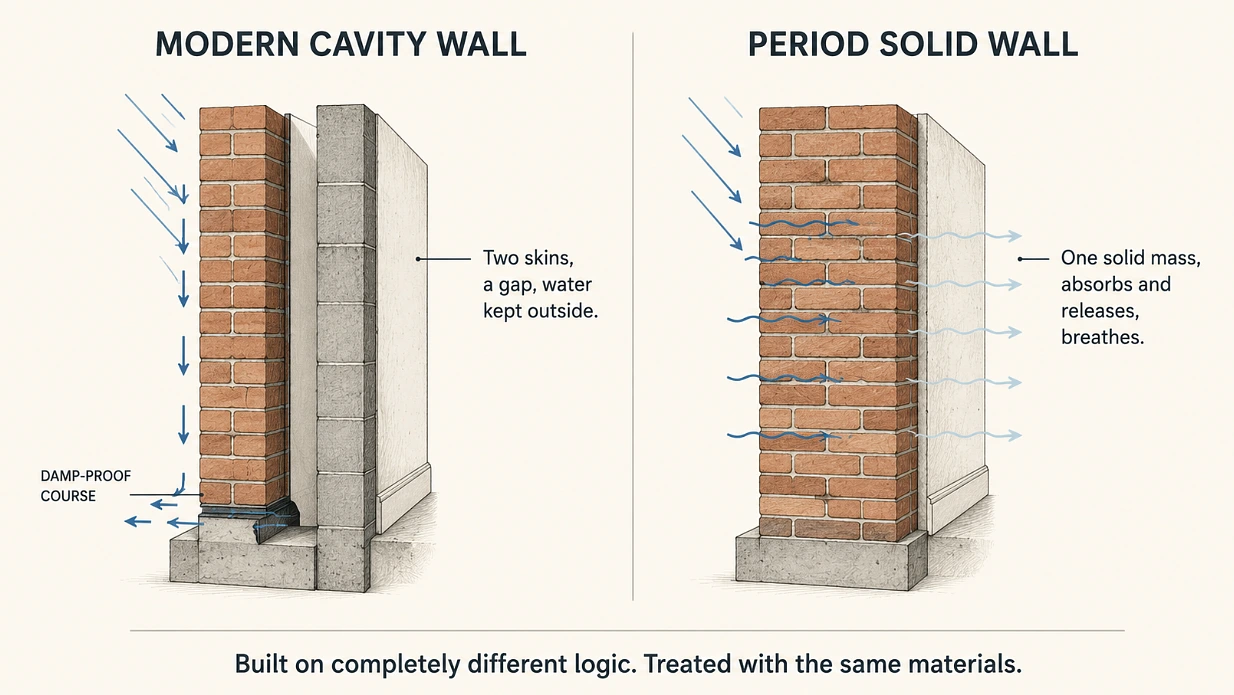
A period home does not work like that at all. Solid walls, no cavity, no plastic membrane. These walls were built on the understanding that they would absorb some moisture, and then release it again through the surface as the weather changed. They breathe. Water goes in when it rains, water comes back out when it dries, and the whole system stays in balance as long as nothing stops that moisture from evaporating.
Lime plaster and limewash were the materials that made this work. Lime is porous. It lets water vapour pass straight through it, which means the wall can do its breathing thing without any obstruction. A wall finished in lime can get damp and recover from it on its own, over and over, for a couple of hundred years. Most buildings put up before the early 1900s were built this way because lime was simply what you used.
Then modern materials arrived, and they are the opposite of porous. Cement render and gypsum plaster are hard and rigid and they seal the surface. Plastic emulsion paint puts a waterproof skin over everything. Apply those to a solid wall and the moisture that was quietly evaporating for a century suddenly has nowhere to go. It gets trapped inside the wall, builds up, and then finds its way out wherever it can, usually as a spreading damp patch, blown plaster, or that musty smell that never quite shifts.

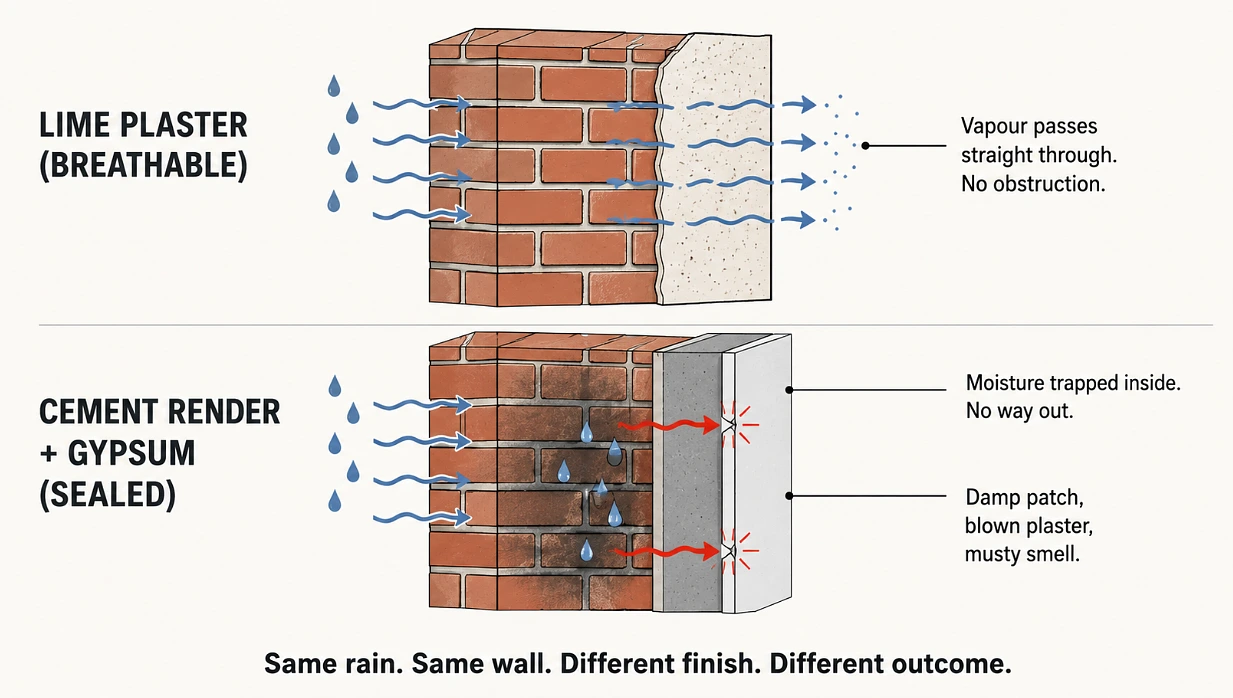
The heritage specialists at Heritage House put it more bluntly than I would. Strip the hollow-sounding cement render off a Georgian townhouse, replace it with lime, and the building dries out and the internal dampness disappears. The “rising damp” people spend thousands trying to chemically inject away is, very often, just a breathable wall that has been suffocated by the wrong materials.
This is not a niche problem, it affects millions of homes
Britain has the oldest housing stock in Europe, and it is not close. According to Historic England, around 4.4 million houses were built before 1919, which is roughly 20% of the entire housing stock. That is one in five homes in the country sitting on solid-wall construction that needs to breathe.
The consequences of getting it wrong show up in the data. The Health Foundation, using Valuation Office figures, found that almost a third of homes built before 1919 are classed as non-decent, compared with around 5% of homes built after 1980. Damp is one of the main reasons. And damp is not just a cosmetic nuisance, it affects respiratory health, which is part of why housing condition has become a public-health conversation rather than just a buildings one.
Some of these older homes are listed or sit in conservation areas, where you are actually required to use appropriate materials. But the majority have no legal protection at all, which means nobody is stopping a well-meaning owner from sealing up their breathable walls with the wrong plaster and creating a damp problem that did not exist before.
The look people pay thousands to recreate comes from the material itself
There is another side to this that has nothing to do with damp, and it is why lime has quietly become fashionable again in the restoration world.
If you have flicked through the property supplements or spent any time looking at restored period interiors, you will have noticed a particular quality to the walls in the best ones. Soft, chalky, slightly uneven, with gentle tonal variation and a matte finish that catches light in a way flat modern paint never does. That look is not an expensive paint effect. It is what lime plaster and limewash actually look like.
When Grand Designs Magazine covered the restoration of a listed Georgian family home in London, the whole approach was built around stripping back decades of vinyl paint to reveal the original plasterwork and using breathable materials to bring the building back. A restored Georgian townhouse in East London, later featured in books on old London houses and in the journal of the Georgian Group, was brought back using haired lime plaster, distemper and linseed oil finishes, giving the interiors that warm, time-softened tone that people find so hard to fake.
When Homes & Gardens featured a couple restoring an eighteenth-century cottage, the story was the same on repeat. Pebbledash cement render stripped off the front and replaced with breathable limewash, colour-matched to a fragment of the original paint found underneath. Cement render chiselled off the inside walls around a bay window and replaced with lime. Every time, the modern material was the thing causing damage, and the traditional one was the fix.
That undulating, characterful surface is a direct result of how lime behaves. It is not trying to be perfectly flat, and that slight imperfection is exactly what reads as authentic. You genuinely cannot buy that look in a tin. It comes from the material and the hand that applies it.
The catch is that most plasterers cannot actually do it
Now for the honest bit, because this is where a lot of restoration projects come unstuck.
Working with lime is a completely different skill from modern plastering. It goes on in multiple coats, each one has to cure slowly on its own timescale, the ratio of lime to sand matters, the temperature while it is curing matters, and you cannot rush any of it. A gypsum job might be done in a room in a day. A proper lime job takes far longer and demands someone who genuinely understands the material.
Real Homes, in their guide to plaster in old houses, put it about as plainly as it can be put. Lots of plasterers will tell you they can do lime work. Most of them cannot. And the cost difference is real, a standard gypsum job on the walls of an average room might run £450 to £750, and specialist lime or clay work can be roughly double that.
That price gap is exactly why it is worth being careful about who you hire. Paying twice as much for someone who does it badly is worse than not doing it at all, because you can end up with a lime finish that fails and a wall that still cannot breathe. Anyone serious about a period restoration should get quotes from vetted plasterers who have genuine lime experience and can show you old work they have actually done, rather than someone adding it to their service list because it is in demand.
What to do if this sounds like your house
If you own a period home and you have damp that keeps coming back no matter what you throw at it, the first thing worth checking is what is actually on your walls. Cement render on the outside, gypsum on the inside, plastic emulsion paint, any of those on a pre-1919 solid wall is a likely culprit.
The fix is rarely a chemical damp-proof injection, which does very little on a wall that was never meant to have a damp-proof course in the first place. The fix is usually letting the wall breathe again, which means getting the modern sealing materials off and putting lime and breathable finishes back on. It is slower and it costs more up front, but it works with how the building was designed to work rather than fighting it.
Old houses are not badly built. They are built to a logic we mostly forgot, and once you understand that logic, most of their damp problems stop being mysterious and start being fixable.