


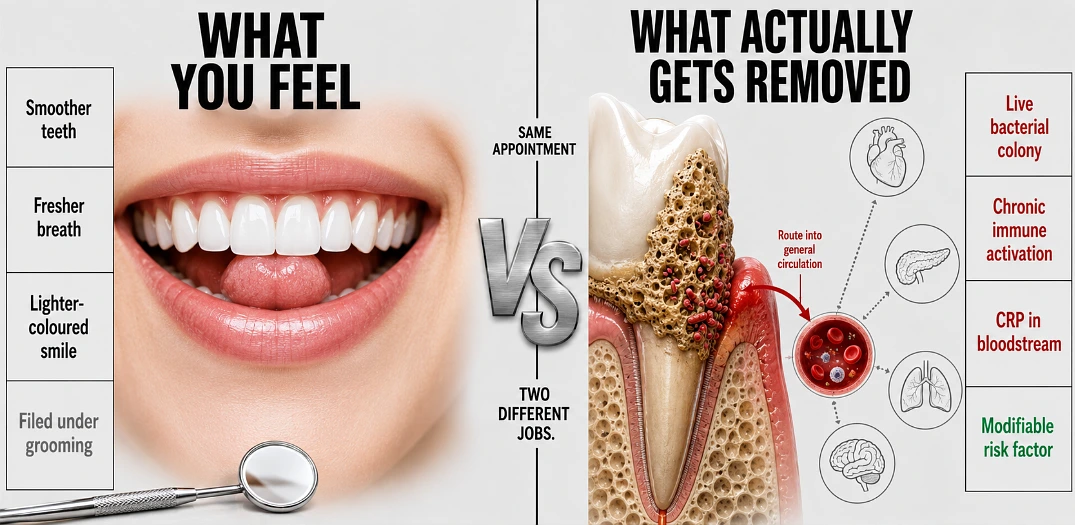
You book the appointment, sit in the chair, wince slightly at the scraping, and twenty minutes later your tongue keeps finding teeth that feel suspiciously smooth. Job done, smile sorted, back to your day. scaling and polishing sits in most people’s heads next to a haircut or a facial, a bit of upkeep, nice to have if you can be bothered with it.
What actually gets removed from your gum line during those twenty minutes isn’t just cosmetic build-up. It’s a live bacterial colony with a direct route into your bloodstream, and the size of that colony has more to do with your heart, your blood sugar, and possibly your brain than most people assume.
Your Mouth Isn’t Sealed Off From The Rest Of Your Body


For a long time, medicine treated the mouth as its own department.
Physicians dealt with everything below the neck. Dentists dealt with teeth and gums. The two rarely compared notes. That divide hasn’t held up well. The last couple of decades of research have mapped a genuine two-way relationship between what’s happening at your gum line and chronic disease elsewhere in the body.
The mechanism is mostly about access.
Healthy gum tissue forms a tight seal that keeps oral bacteria exactly where they belong. Once tartar builds up along the gum margin, that seal is compromised, and bacteria, along with the inflammatory chemicals your immune system produces to fight them, get a route into general circulation.
Once they’re travelling, the research points to effects turning up in your heart, your lungs, your pancreas, and in earlier, less settled research, your brain.
How Soft Plaque Turns Into Something Your Toothbrush Can’t Touch

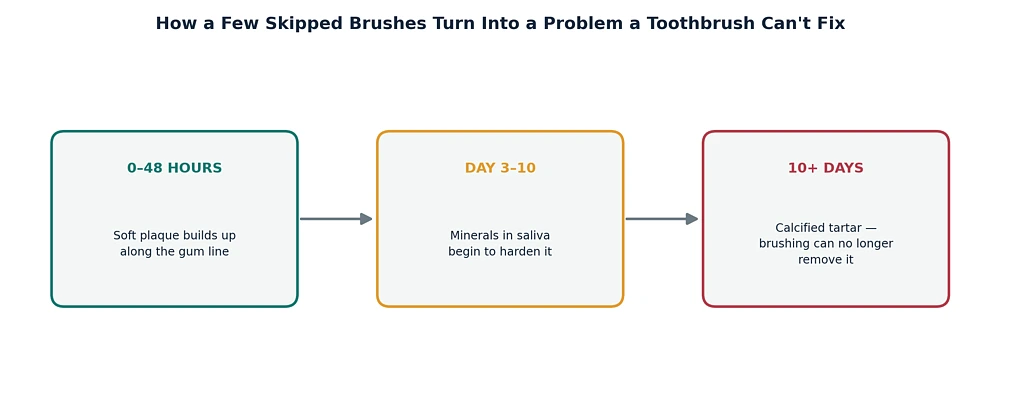
Plaque forms fast.
Within a day or two of normal eating, a thin bacterial film is already sitting along your gum line. More or less regardless of how well you brushed that morning. Left undisturbed, minerals naturally present in your saliva start to harden it within a matter of days.
Once it’s calcified into tartar, no amount of brushing pressure will shift it with an electric toothbrush. Which is the actual reason this is a clinical job rather than a personal hygiene failing?
The hardened layer is also more porous than most people picture, behaving almost like a sponge that holds a dense, constant population of bacteria directly against your gum tissue. That reservoir is where most of the wider health effects start.
The Heart Link Is The One With The Most Evidence Behind It
Of the oral-systemic connections researchers have studied, the cardiovascular one is the best documented.
Chronic gum inflammation keeps your immune system in a low, constant state of activity, which means a steady release of inflammatory markers, C-reactive protein (CRP) among them, into your bloodstream. Circulating CRP and oral bacteria have both been associated with irritation of the blood vessel lining, a process connected to arterial plaque build-up and, over time, to raised blood pressure.
Worth being precise about what that does and doesn’t mean.
Gum disease is one contributing factor among several for cardiovascular risk, not a standalone cause of heart attacks. But it’s a modifiable one, which is rarer than it sounds in preventative medicine. And a decent reason not to skip the appointment.
Your Blood Sugar And Your Gums Affect Each Other In Both Directions
This relationship runs both ways. Worth knowing even if you’ve never had a cavity in your life.
Poorly controlled blood sugar weakens immune defences, which is part of why people with diabetes are more prone to gum infections. Less well known is that the relationship runs in reverse too.
Persistent gum inflammation releases inflammatory chemicals that interfere with how efficiently your cells respond to insulin, nudging insulin resistance in the wrong direction. For anyone already managing diabetes, letting tartar build up unchecked isn’t a neutral decision. It’s adding friction to a daily balancing act that’s already hard enough.
A Tentative Line To Your Lungs, And A Much Earlier One To Your Brain
The lung connection is the most mechanically straightforward of the lot.
You inhale thousands of times a day, and a mouth carrying a heavy bacterial load means more of that gets micro-aspirated down into the airway with each breath. In older adults, or anyone with reduced respiratory resilience, that’s a credible contributor to chest infections and to flare-ups of conditions like COPD.
The brain link is the one to hold more loosely.
Researchers have identified Porphyromonas gingivalis, a bacterium strongly associated with gum disease, in the brain tissue of some Alzheimer’s patients. There’s an active research effort into whether chronic oral inflammation accelerates the disease processes involved. That’s a genuinely interesting area of study. It isn’t yet the same as proof that treating your gums protects your memory. Reason for cautious interest, not a guarantee.
What Actually Happens During The Appointment

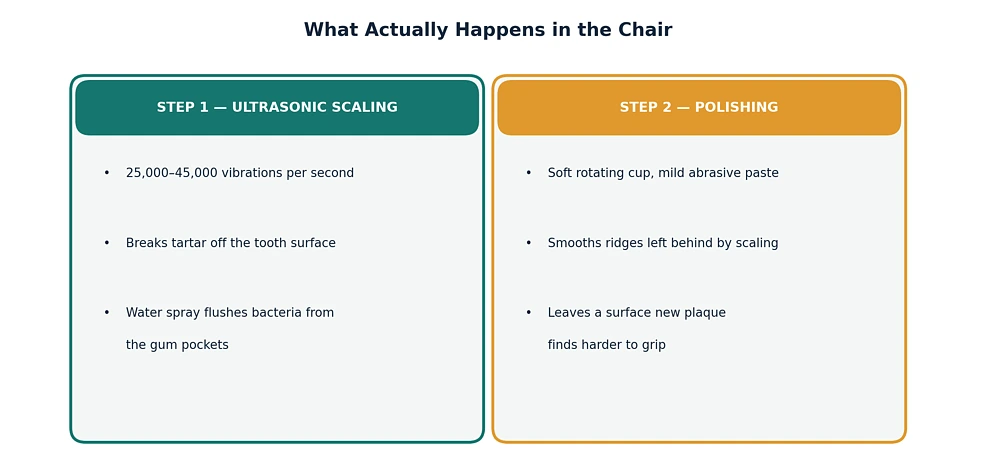
The procedure itself is a two-stage process, and each stage is doing a distinct job.
The first stage is the scaling process most people associate with the appointment overall, but the two halves are technically different.
The scaling stage removes the calcified material itself. An ultrasonic tip vibrating somewhere between 25,000 and 45,000 times a second breaks the physical bond between tartar and tooth, while the accompanying water spray helps disrupt bacteria sitting in the gum pockets. Wherever calculus has reached awkward spots, a hygienist finishes the job by hand with a fine instrument called a curette.
The polishing stage isn’t just cosmetic, even though it looks like the finishing part.
Scaling can leave microscopically rough patches on the enamel, and an unpolished surface like that gives new plaque somewhere easier to grip. A motorised rubber cup and a mildly abrasive paste smooth those patches out, which is most of why a freshly polished tooth resists new build-up for longer than an unpolished one would.
Getting The Rhythm Right Matters More Than Which Practice You Use
The honest sticking point for a lot of people isn’t whether scaling matters. It’s getting an appointment at all.
NHS dental access in the UK has been under real strain for some years now. Plenty of people have given up trying to register and gone looking at private options instead. Not because they’re chasing anything cosmetic. Because they want to be seen this year rather than next.
The point isn’t really which specific practice you end up with. It’s getting back into a six-monthly rhythm with whoever you can reasonably get in front of, since the interval matters more than the provider. A good hygienist working monthly on the same patient produces better outcomes than a top-tier specialist seen once every three years.
If NHS access is genuinely impossible where you live, the practical options are private practices, dental school clinics where supervised students do the work at reduced cost, and community dental services for specific eligible groups. Each of those has its trade-offs but any of them keeps the rhythm going.
Frequently Asked Questions
Does scaling lower my risk of a heart attack?
It can help reduce one contributing factor, chronic gum inflammation and the associated rise in markers like CRP. It isn’t a standalone guarantee against heart attacks, which have several contributing causes. Think of it as removing one variable from the equation rather than solving it outright.
How does gum health affect blood sugar control?
Chronic gum inflammation releases chemicals that interfere with insulin sensitivity, which can make blood sugar harder to manage. Regular scaling reduces that inflammatory load. It’s one of several factors that can support steadier control rather than a fix on its own, but for anyone managing diabetes it’s worth keeping in the routine alongside the medical side of the picture.
Is scaling safe for older adults with existing health conditions?
Generally yes. Often more important for this group given the added respiratory risk from inhaled bacteria. Anyone on blood thinners or with a complex cardiac history should flag it to their dentist beforehand so the appointment can be adjusted accordingly.
Will my teeth feel loose afterwards?
In most patients, no. In cases of more advanced, longstanding gum disease, a thick mass of tartar can occasionally have been acting as a temporary brace holding a loose tooth in place. So there can be a brief adjustment period after it’s removed. Long term, removing that tartar is what allows the gum and bone to heal and tighten back up. Leaving it in place doesn’t.
The Part You Can’t Feel
A scale and polish gets filed under grooming because that’s the part you can feel and see. Smoother teeth, fresher breath, a lighter-coloured smile.
The part that doesn’t get felt is the bacterial colony that was sitting against an already-inflamed gum line, with a more direct route into your bloodstream than most people assume.
None of this means a six-monthly clean replaces a cardiologist, an endocrinologist, or a GP. It means a fairly unglamorous appointment is doing more preventative work than its reputation suggests. The case for not skipping it has very little to do with how your smile photographs.