


Walk into most homes, and you’ll find the same setup in every room, a single ceiling fixture doing all the work. The builder put it there, the previous owner never changed it, and now you’re living under a flat wash of light that makes your carefully chosen furniture look like it belongs in a dentist’s waiting room. Sounds familiar, probably.
The weird thing is, people will spend thousands on a sofa, repaint walls three times to get the shade right, then leave the lighting exactly as they found it. Lighting isn’t decoration in most people’s heads. It’s infrastructure. On or off. Working or broken. But the gap between a room that feels cold and one you actually want to sit in almost always comes down to how light moves through the space.
Why a Single Ceiling Light Ruins Everything
One fixture in the centre of the ceiling throws light straight down. Floors get bright. Walls stay dim. Corners disappear. The eyes have shadows under them, which makes you look so tired even when you have slept ten hours. The room is mostly flat and bright, something that even kills any illusion of depth and coziness.
- There are three types of lights that should be combined in rooms, and in the majority of houses, these lights can be found.
- The general base is ambient light – ceiling, recessed downlights, oversized pendants. It keeps you from tripping over things. Nearly every home has this covered, and then stops.
- The task light is pointed where you actually do something. Reading lamp beside the sofa. Under-cabinet strips in the kitchen so you can see an onion from a shallot at 7 pm. A desk lamp that means you’re not squinting at your laptop in the dark. Without it, you’re asking one overhead bulb to handle everything, and it’s not up to the job.
- Accent light singles out the objects that are worth paying attention to in a painting, such as a brick wall with its texture, bookshelves, and a nice design. It provides a visual appeal and prevents the room from looking like a box with furniture pieces in it.
Once you have all three engines going, you can transform the atmosphere of a room entirely by choice of what to have on and what not to have on. Lighted ceiling, accent lights on, one task lamp on, all in the same room, but the entire mood of the room was completely changed compared to noon.
Wall Lights and the Gap Nobody Thinks About
A majority of the light in the home is either through the ceiling or table lamps. And the rest of the middle of the wall, onto which you devote in reality the greatest part of your eyes, is left idle.
That is filled by wall-mounted fixtures. They do not run downwards, but rather push the light to the side and upwards, which creates the room with softer, three-dimensional light. In a hallway, they guide you through without overhead harshness. In a bedroom, paired either side of the headboard, they replace bedside table lamps and free up surface space for the stuff you actually reach for at night, water, phone, glasses, and whatever.
They’re also brilliant beside mirrors, artwork, and textured walls. A picture you’ve walked past for two years suddenly looks intentional when there’s a light next to it instead of above it.
Material matters for these. Top luxury timeless brass wall lights keep showing up in design projects because brass sits comfortably across different styles, it looks classic in a period home, and sculptural in a modern flat. Brass also ages in a way that adds character rather than looking worn, which you can’t say about chrome or painted finishes that chip.

The Number on the Bulb Box You’re Ignoring
Consumers purchase bulbs depending on brightness (lumens or wattage) and absolutely fail to consider colour temperature. Then they cannot understand why the bedroom seems like a hospital aisle or why the kitchen seems to be strangely yellow all around.
Colour temperature takes the form of Kelvin. smaller Kelvins=warmer and amber-coloured light. The more the Kelvin, the colder and bluish-white the light. The effect of a 2700K bulb and a 5000K bulb in the same lamp is radically different. The warm one provides a cosy and relaxed room. The cool one makes it feel like a laboratory. Blue-heavy light above 4000K also suppresses melatonin, which messes with your sleep if you’re using it in bedrooms or living rooms during the evening.
| Room | Kelvin Range | What It Feels Like |
|---|---|---|
| Bedroom | 2700K | Warm amber, relaxing, good for winding down |
| Living room | 2700K–3000K | Comfortable and inviting |
| Dining room | 2700K–3000K | Food and skin tones look their best |
| Kitchen | 3000K–4000K | Clear enough for chopping, still pleasant |
| Bathroom | 3000K–4000K | Functional for grooming, not sterile |
| Home office | 3500K–4000K | Keeps you alert, reduces eye strain |
Stay between 2700K and 3000K, where you relax. Go up to 3000K–4000K, where you need to concentrate or see detail. Past 4000K starts feeling commercial.
One thing that trips people up, a 2700K bulb against white tiles or white walls can look too yellow. The same bulb against natural wood or warm-toned paint looks perfect. If you install new bulbs and something feels wrong, the colour temperature might be clashing with your surfaces rather than the bulb being faulty.
Dimmer Switches: Cheap and Underrated
About £15–£25 and maybe twenty minutes with a screwdriver. That’s it. A dimmer would transform a room that only operates at one intensity to one that can be usable throughout the entire day, full intensity when cleaning, 60 percent when preparing dinner, and 20 percent when viewing a show on the sofa.
If the room feels flat and boxy, a pair of wall lights or an accent light on a shelf changes the whole shape of the space. Swap harsh white bulbs for 2700K or 3000K and see what happens. Be careful not to purchase non-dimmable bulbs. LEDs that are not dimmable on a dimmer circuit flicker and buzz, which is even worse than having no dimmer.
Things That Quietly Wreck a Room’s Lighting
- Twelve downlights in the kitchen ceiling. Showrooms do this. Homes shouldn’t. Two pendants over the island, some under-cabinet strips, and maybe four recessed spots for general coverage do the job without making dinner feel like a surgical procedure.
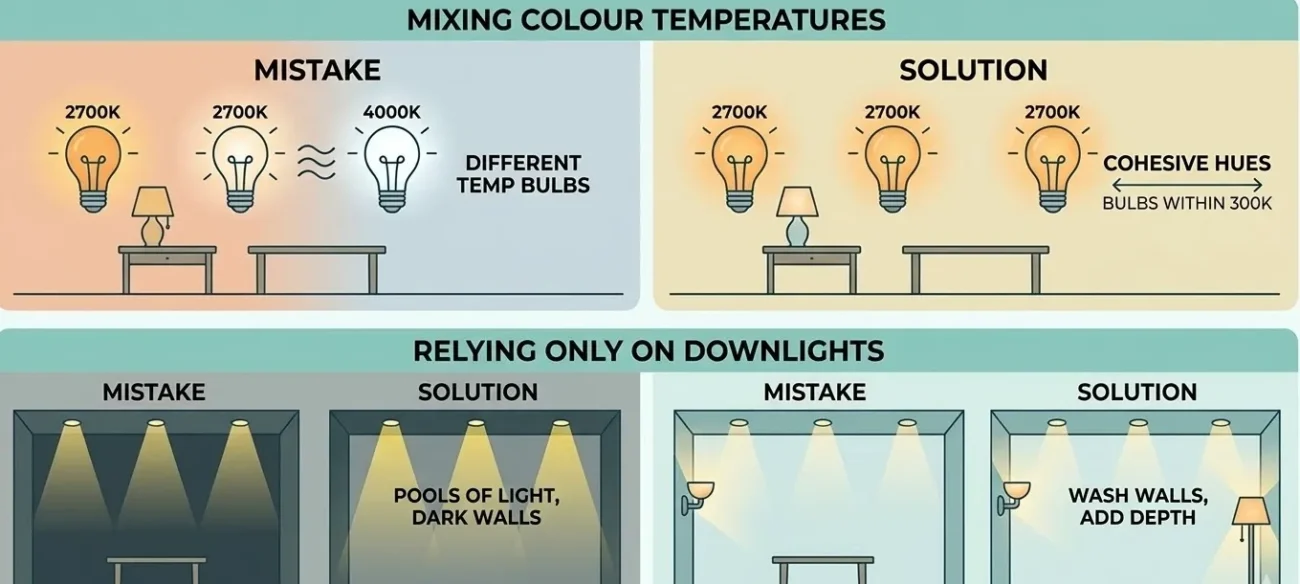
- Mixing colour temperatures in one room. A 2700K table lamp sitting three feet from a 4000K ceiling spot creates a visual tension your brain picks up, even if you can’t name it. Keep bulbs in the same room within about 300K of each other.
- Forgetting the ceiling exists. If zero light reaches upward, the top of the room vanishes into shadow, and everything feels lower and tighter. One uplighter or a wall sconce that throws light toward the ceiling fixes it immediately.
- Relying entirely on recessed spots in living spaces. Downlights make pools on the floor and leave the walls dark. Walls going dark makes a room feel smaller. Add a floor lamp or wall lights, and the room opens up.

Where to Actually Start
Pick whichever room annoys you most. If it only has a ceiling light, add a table lamp or floor lamp; that’s your task layer sorted. If the room feels flat and boxy, a pair of wall lights or an accent light on a shelf changes the whole shape of the space. Swap harsh white bulbs for 2700K or 3000K and see what happens.
Most of this is a £30–£50 fix per room. Moving a lamp. Adding a dimmer. Changing a bulb. Small adjustments, but the kind where someone walks in and says the room feels different without being able to explain what changed. That’s usually the sign you got it right.