

Blog
3 Legit Ways To Earn Income From Crypto Without Getting Rug Pulled – NFA


Look. Before we start.
I am not here to sell you a meme coin. I am not one of those YouTube guys pointing at a fifteen-year-old kid’s Lambo and telling you you can get one too if you just buy this presale token that launches on Tuesday. I have watched enough of that industry to be genuinely tired of it. Ninety percent of what gets marketed as a “crypto side hustle” is either a rug pull waiting to happen, an affiliate scheme dressed up as investment advice, or someone trying to build a downline commission off you buying a course.
That is not what this piece is.
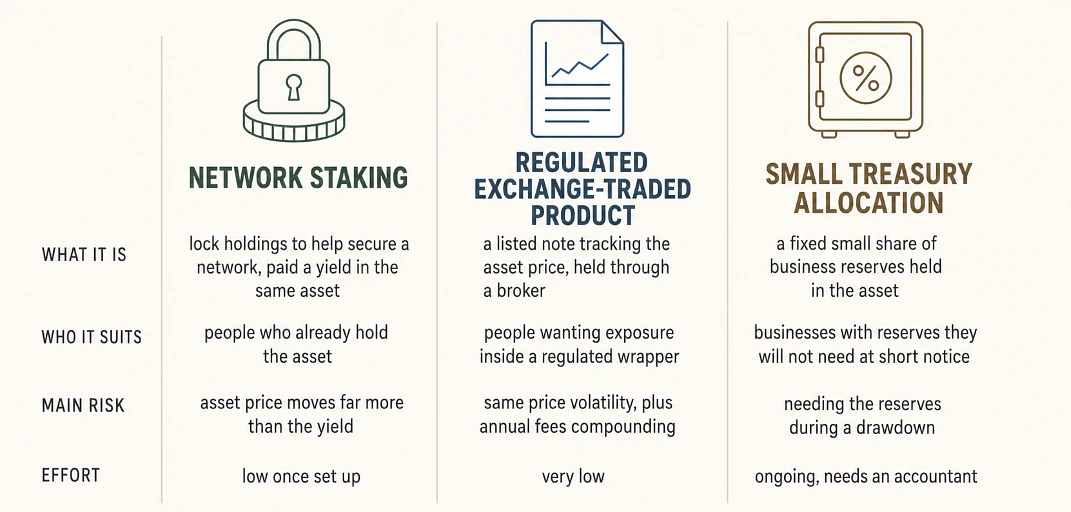
What follows is three legitimate ways to actually earn income from crypto and blockchain. Boring in the good way. Endorsed by real institutions, real regulators, or real people whose reputations do not survive lying to you. Each one is something you can genuinely start on this week if you want to, with realistic yields, honest risks, and no promise you will retire off it.
If that is what you came here for, good. Let’s go.
Idea 1. Ethereum Staking
The first one is the most established and, honestly, the most boring. Which is why it works.
Ethereum switched from proof-of-work to proof-of-stake in September 2022, in the event known as The Merge. Since then, anyone holding Ethereum can stake it, meaning locking it up to help secure the network, and earn a yield in return.
The current yield sits around 3 to 4 percent APR at time of writing. Not enormous. But it is real, it is paid in more Ethereum, and it is genuinely the closest thing the crypto world has to a savings interest rate.
Why this is legit:
- The Ethereum Foundation, Vitalik Buterin’s team, is the entity behind the network itself. Not a random token project. Not a startup that might exist in six months.
- BlackRock, Fidelity, and other regulated institutions run spot Ethereum ETFs approved by the US SEC in July 2024. When BlackRock stakes their own institutional ETH holdings, they are doing the same thing you would be doing.
- Coinbase, Kraken, and Binance all run staking services regulated by their respective jurisdictions.
How you actually do it:
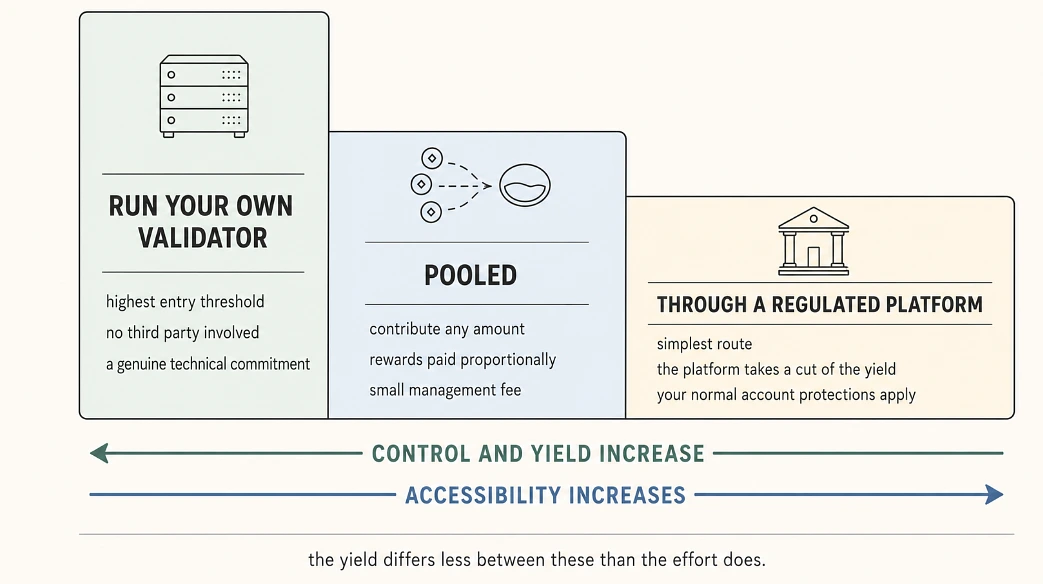
There are three ways, each with a different trade-off.
- Solo staking. You run your own validator node. Requires 32 ETH minimum, which is roughly £75,000 at time of writing. Highest yield, no third party involved, but a serious technical commitment.
- Staking pool. You put in whatever amount you have, the pool combines yours with everyone else’s, you earn proportional rewards. Providers include Rocket Pool and Lido. Lower barrier, small management fee.
- Exchange staking. Coinbase, Kraken, Binance stake on your behalf. Easiest. Yield slightly reduced because the exchange takes a cut. Regulated exchange means your normal consumer protections apply.
The honest risks:
- Slashing. If your validator misbehaves, you lose a portion of your stake. Almost never happens on established platforms but the risk exists.
- Ethereum price volatility. You are still holding ETH. If the price drops 40%, your 4% yield does not save you.
- Regulatory changes. The UK has not yet fully classified staking rewards for tax purposes. HMRC currently treats them as miscellaneous income at the point of receipt. Get an accountant if you are earning meaningful amounts.
Where the crypto piece stops being boring is when the market moves 15% in a week and you want to lock in some of the value you earned. That is where converting into a stablecoin matters, Staking pays you in ETH. If you want the yield to actually feel like income rather than another lottery ticket, converting a chunk of what you earn into a dollar-pegged stablecoin is how sensible holders lock in the gain.
Idea 2. UK Regulated Crypto ETFs And Institutional Products
The second one is the one nobody in the crypto space wants to admit is the sensible pick for most people.
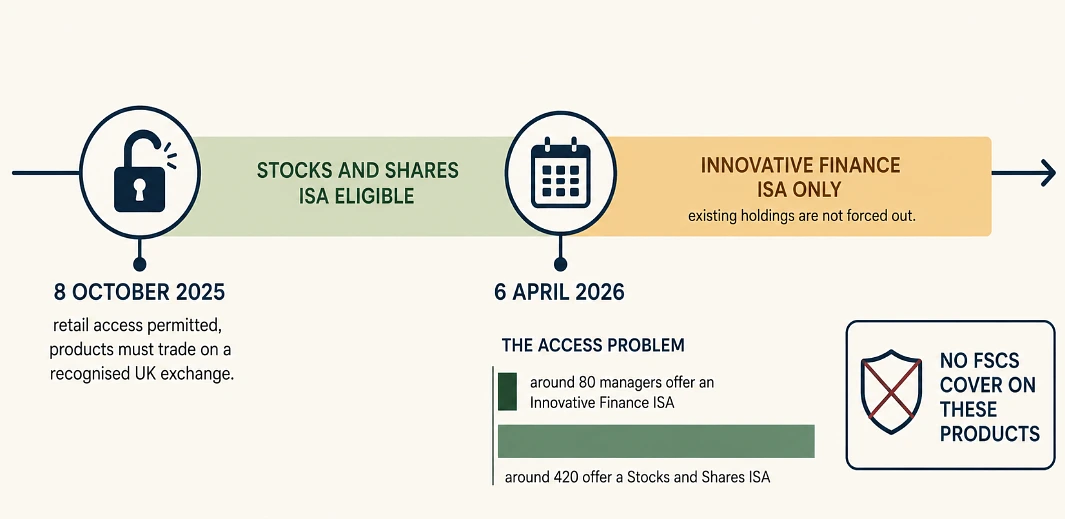
The Financial Conduct Authority approved the first UK-listed crypto Exchange Traded Notes for professional investors on the London Stock Exchange in May 2024. The FCA has been working through the retail access framework since. Currently, UK retail investors can access crypto ETF exposure through several regulated European ETFs listed on the LSE via most UK brokers, including Hargreaves Lansdown, AJ Bell, and Interactive Investor.
This is not a crypto side hustle in the “get rich” sense. It is closer to the crypto equivalent of buying a Vanguard index fund.
Why this is legit:
- FCA regulated. Actual UK regulator involved. Actual UK consumer protections. This is the antithesis of the wild west crypto market people worry about.
- Held in ISAs and SIPPs. Some products can go inside a Stocks and Shares ISA, meaning gains are tax-free up to your annual allowance.
- Institutional custody. Your Bitcoin or Ethereum exposure is held by regulated custodians, not by you on a hardware wallet you might lose.
The Warren Buffett connection worth knowing:
Buffett has famously said he would not touch Bitcoin with a barge pole. He is not wrong to be sceptical about the meme coin end of the market. But what he has repeatedly endorsed, on record, in his Berkshire Hathaway shareholder letters and multiple interviews, is that most retail investors are better off in low-cost index products than picking individual assets. His 2013 shareholder letter recommended putting 90% of an inheritance for his wife into an S&P 500 low-cost index fund and 10% into short-term government bonds.
If you extend the same logic to crypto, the regulated ETF or ETN sitting inside your ISA is the crypto equivalent of the S&P 500 index fund. The boring pick that outperforms most of the clever ones over ten years.
How you actually do it:
- Open or use an existing Stocks and Shares ISA with a UK broker.
- Buy a physically-backed Bitcoin or Ethereum ETP listed on the LSE.
- Hold. Do not check it every day.
The current UK-available options include products from 21Shares, WisdomTree, and Invesco listed on the LSE. Fees range from around 0.25% to 1.5% annually depending on the product.
The honest risks:
- Price volatility. Same as buying the underlying asset. A 30% drawdown in a week is normal.
- Fees compound. A 1% annual fee eats meaningfully into returns over ten years.
- Regulatory changes. The UK retail crypto ETF framework is still evolving. Rules may tighten.
Idea 3. Bitcoin Treasury Strategy For Small Businesses And Self-Employed
The third one is the one that has been endorsed by names you have actually heard of, and it is genuinely how some UK small business owners have been building extra reserves over the past three years.
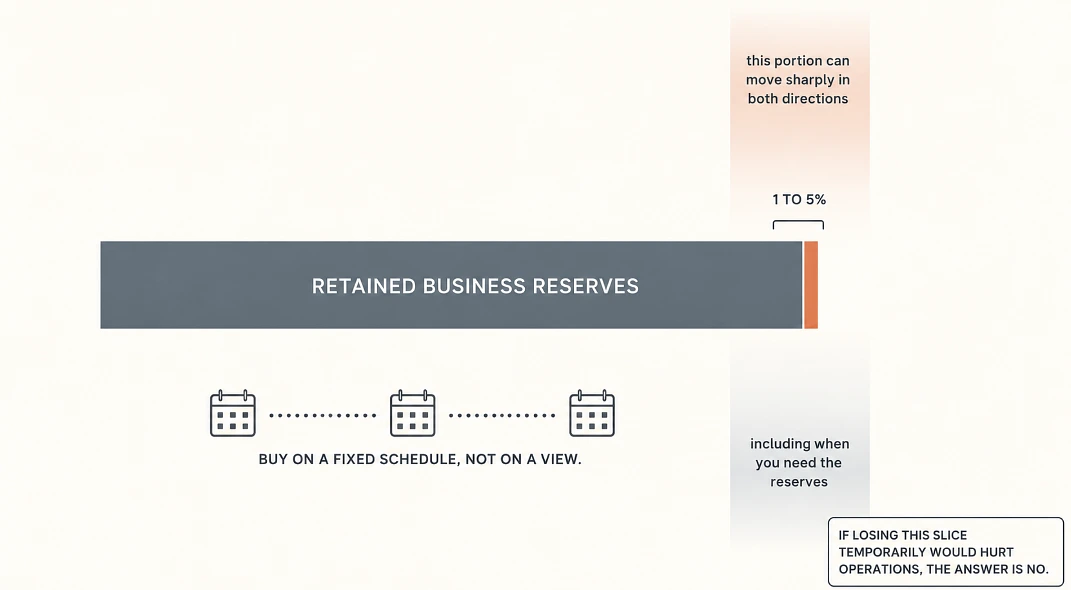
The strategy is straightforward. Instead of holding all business reserves in a UK bank account earning 2 to 4% interest, allocate a small percentage of retained earnings (typically 1 to 5% for cautious operators) into Bitcoin held on a regulated exchange or through a regulated custody service. Over the past decade, this allocation has meaningfully outperformed cash on most rolling five-year windows, though with significantly higher volatility.
Who has publicly endorsed a version of this:
- Michael Saylor. CEO and now Executive Chairman of MicroStrategy (now called Strategy). The company holds around 214,000 Bitcoin as of the most recent public filings, purchased between August 2020 and now. Saylor has done hundreds of podcasts and interviews explaining the treasury strategy in detail. Whatever you think of Saylor personally, his willingness to put his own company’s balance sheet behind the strategy makes it the most transparently documented Bitcoin treasury case in the world.
- Larry Fink. BlackRock CEO. Went from calling Bitcoin an “index of money laundering” in 2017 to describing it as “digital gold” and “a legitimate financial instrument” in his 2024 investor letter. BlackRock now runs the largest Bitcoin ETF in the world. When the CEO of the largest asset manager on Earth publicly changes his position, that is a signal worth noting.
- Fidelity Investments. Allowed Bitcoin exposure inside 401(k) retirement plans for US employees starting in 2022. Runs its own regulated Bitcoin ETF.
How you actually do it as a UK small business:
- Open a business account with a regulated UK crypto exchange. Kraken, Coinbase, and Bitstamp all offer UK business accounts.
- Decide a fixed percentage of monthly retained profit (1 to 5% for the sensible starting point).
- Buy on a dollar-cost-averaging schedule (weekly or monthly) rather than trying to time the market.
- Hold in cold storage or regulated custody, not on the exchange itself.
- Declare properly. HMRC treats business crypto holdings as intangible assets. Get an accountant who has done this before.
The honest risks:
- Volatility can hit at the wrong time. If you need business reserves in a hurry and Bitcoin is down 40%, you are selling at a loss.
- Custody risk. If you self-custody and lose your keys, the money is gone. There is no bank to call.
- Regulatory changes. UK crypto business regulation is still moving. What is fine now may need adjustment in 2027.
- Not for cautious operators. If losing 1 to 5% of your business reserves temporarily would meaningfully hurt your operations, this is not for you. Full stop.
What All Three Have In Common
Look at the three ideas together.
Ethereum staking pays a modest boring yield, on a network run by a real foundation with real institutions backing it. Regulated crypto ETFs give you exposure inside your ISA, with UK consumer protection wrapped around it. A Bitcoin treasury allocation puts a small percentage of business reserves into the same asset the largest asset manager in the world now runs an ETF for.
None of these are quick money. None of them are meme coins. None of them are dependent on some kid on YouTube telling you the next 100x is coming Tuesday.
They are boring, and boring is the point. Crypto income that survives the news cycle is boring by definition. The stuff that is exciting is the stuff that gets you rug pulled.
If you want the honest short version:
- Ethereum staking if you already hold ETH and want a modest yield on it.
- Regulated ETF inside your ISA if you want crypto exposure with UK consumer protection and tax efficiency.
- Bitcoin treasury allocation if you run a small UK business and want to diversify reserves at a small percentage.
Skip everything else that promises more.
And when the volatility hits, which it will, remember why you picked the boring version. The people who lose money in this space are almost always the ones who thought they were being clever. The people who make money quietly, over years, are almost always the ones who picked something legitimate and stopped fiddling with it.
Which is honestly most of what there is to say.