

Blog
The Marketing Video Trap: Why UK SMEs Keep Overspending on Content They Could Make In-House

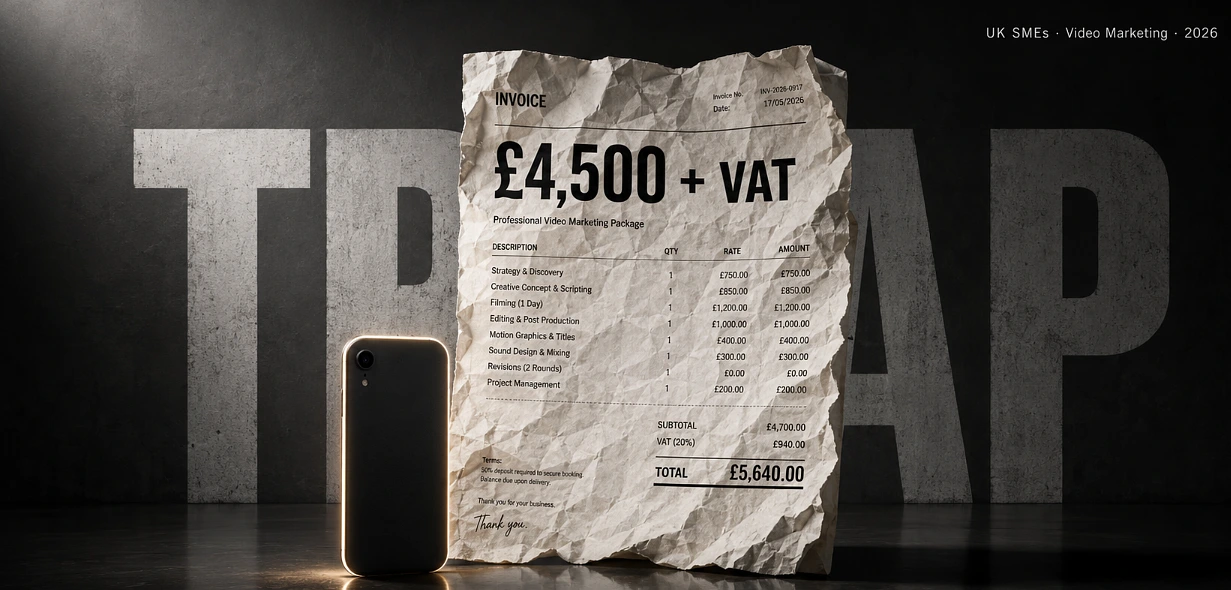
A video quote lands in your inbox. Three days of filming, two rounds of edits, £4,500 plus VAT. You sign off on it because that’s “what video costs.”
But ask any UK small business that has actually filmed content on a phone whether the agency version performed better. Often the answer is no.
This isn’t an argument against professional video everywhere. It’s an argument against the default of outsourcing first and never trying in-house. That default is quietly draining budgets that most small businesses don’t have to spare.
The agency invoice nobody questions
Professional video production in the UK typically costs £1,500 to £10,000 per piece, depending on complexity. For a finished minute of corporate video, the going rate is £1,000 to £3,000.
SMEs running ongoing video campaigns often pay agency retainers of £1,250 to £16,750 a month. That’s not a one-off cost. It’s a recurring line that most small businesses can barely justify.
Even a short 30 second social ad runs £1,500 to £6,000 for something genuinely polished. None of this is unreasonable pricing for the work involved. The problem is most SMEs don’t actually need what agencies are selling them.
Zoom out and the scale gets clearer still. UK ad spend is forecast to top £50.4 billion in 2026, with video taking a growing share. That figure is shaped by big-budget enterprise spend, but SMEs often benchmark themselves against it unfairly.
Why SMEs keep falling for it
Three reasons keep showing up.
First, founders assume polish equals credibility. They picture a national TV advert and assume anything rougher will look amateur.
Second, nobody on the team feels confident enough to pick up a camera. Marketing is already the job nobody has time for, let alone filming and editing on top of it.
Third, agencies are easy to brief. You send a one page document and wait for a finished file. Learning to film in-house feels riskier than simply writing a cheque.
What customers actually want to watch
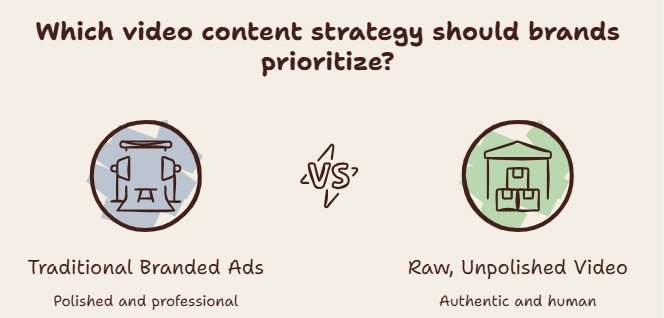
Here’s the part that should change minds. The shift toward raw, unpolished video is well documented. 88% of consumers say authenticity matters when deciding which brands to support.
82% of consumers are more likely to buy from brands using lo-fi content. That same content drives roughly four times the click-through rate of traditional branded ads.
On TikTok and Instagram, 44% of viewers say they prefer casual, creator-led clips over polished brand spots. More than 60% of product discovery now happens on platforms like TikTok, Instagram and YouTube. Audiences there actively favour human content over branded ads.
This means a £4,500 agency film can genuinely underperform a video shot on an iPhone in a stockroom. Audiences have learned to recognise an advert and scroll straight past it. They stop for content that looks like it was made by a person, not a production company.
What in-house video really looks like
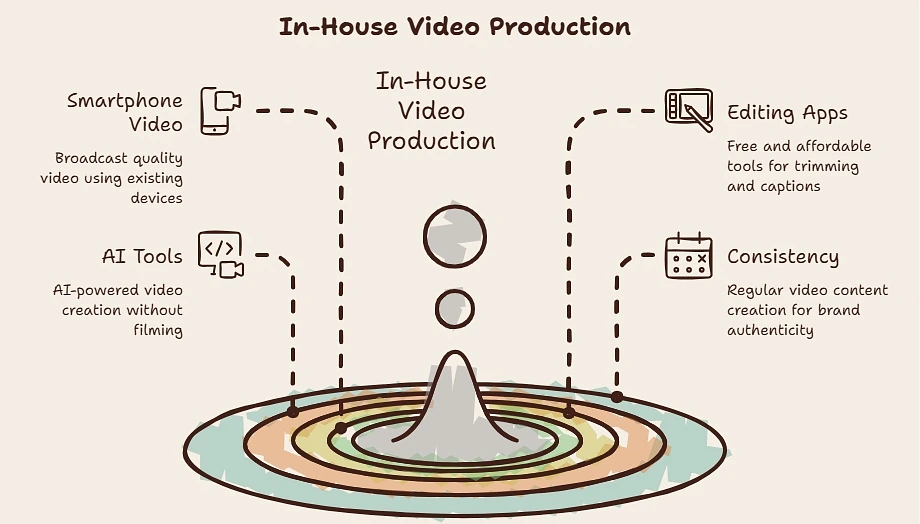
In-house doesn’t mean amateur. It means using the tools already sitting in most people’s pockets, plus a handful of free or cheap apps.
A modern smartphone shoots video that’s broadcast quality for social and web use. Pair it with a £30 clip-on microphone and natural window light, and the technical gap with agency footage mostly disappears.
What’s actually missing in most SME videos isn’t equipment. It’s a clear idea and a short script. A single sentence about the problem the video solves usually beats five minutes of unplanned filming.
For editing, apps like CapCut and Canva offer free tiers covering trimming, captions, music and colour correction. Descript lets non-editors cut video by editing a text transcript, removing most of the learning curve.
AI tools such as Magic Hour AI go further still. They turn a text prompt or product photo into a finished short video, no filming required. Features like AI face swap let one person appear across multiple ad variations without reshooting.
For businesses with no footage at all, that closes the gap entirely.
None of these tools requires a production background to use well.
The skill that actually matters is consistency. A founder filming one short story a week beats one £4,500 agency film within two months. It will also sound more like the brand does in real life, because it is.
Picture a small bakery filming a thirty second clip each Friday of that week’s new loaf. No script, no lighting rig, just a phone propped on a shelf. After a month, that’s four videos covering recipes, customers and behind-the-scenes moments that one agency shoot could never capture.
When an agency is still worth the money
This isn’t a case for cutting agencies out entirely. Brand films, product launches, and anything appearing in paid TV or cinema still benefit from professional crews and equipment.
High-stakes moments, like an investor pitch video or a flagship campaign, carry more risk if they look unfinished. In those cases, the cost of polish is easier to justify against the cost of looking unprepared.
There’s also a hybrid option worth considering. Some agencies now offer light-touch coaching, teaching an in-house team to shoot and edit rather than producing every video themselves. That can cost a fraction of a full retainer while still raising the baseline quality of what staff produce alone.
The mistake isn’t using agencies. It’s using them for every piece of content by default, including the weekly social clips that audiences actively prefer raw.
How to start making your own video
Pick one recurring format first, such as a weekly customer question answered on camera. Keep it under 60 seconds and film it on a phone in landscape or vertical, depending on the platform.
Resist the urge to script every word. Audiences trust a slightly imperfect take more than a stiff, over-rehearsed one. Bullet points work better than a full script for keeping things sounding human.
Review performance after a month, not after one video. Raw content often takes a few attempts to find its footing, the same way any new skill does.
Frequently asked questions
Does this apply to B2B companies too?
Yes, with some adjustment. A founder explaining a complex service in plain language on camera often builds more trust than a glossy explainer video.
Will the in-house video look unprofessional compared to competitors?
Not if it’s well lit and clearly audible. Audiences judge clarity and authenticity over production polish, especially on social platforms.
What’s the minimum kit needed to start?
A smartphone from the last few years, a basic clip-on microphone, and a free editing app. That covers the vast majority of SME use cases.
Should every video be made in-house?
No. Save agency budget for high-stakes brand moments and use in-house production for the regular, ongoing content that builds familiarity.
How much could a typical SME actually save?
Replacing even half of a monthly retainer with in-house content can free up real budget. On a £1,250 to £16,750 a month spend, that adds up fast.
The bottom line
The marketing video trap isn’t that agencies overcharge. It’s that SMEs default to them out of habit, for content that audiences now prefer rougher and more human anyway.
Start with one in-house video this month. Compare how it performs against your last agency piece, and let the data make the case either way.