

Blog
Applying to Six Lenders in a Month Is What Declines You, Not Your Score

Amigo has gone. Handed its lending permissions back to the FCA during 2025, closed the compensation scheme on 28 August, and the lending company went into liquidation, and this was the biggest guarantor lender in Britain not long before any of that. TFS ended up in administration. George Banco stopped writing new business. What survives is a few small names you would struggle to pick out of a lineup.
So when an article tells you to go and find a friend with a clean file who will guarantee it, that article is describing a market which has mostly shut its doors.
There is an old line about bankers, that they will lend you an umbrella while the sun is out and want it back the minute it starts raining, and the reason people have kept repeating it for a century is that it keeps being true. Banks are not built to help you at the moment you actually need helping. They price you when you are steady and they price you again when you are on the floor, and the second price is where the money is. Which is not a reason to give up, it is a reason to stop applying blind.
Six applications in a month will decline you on their own
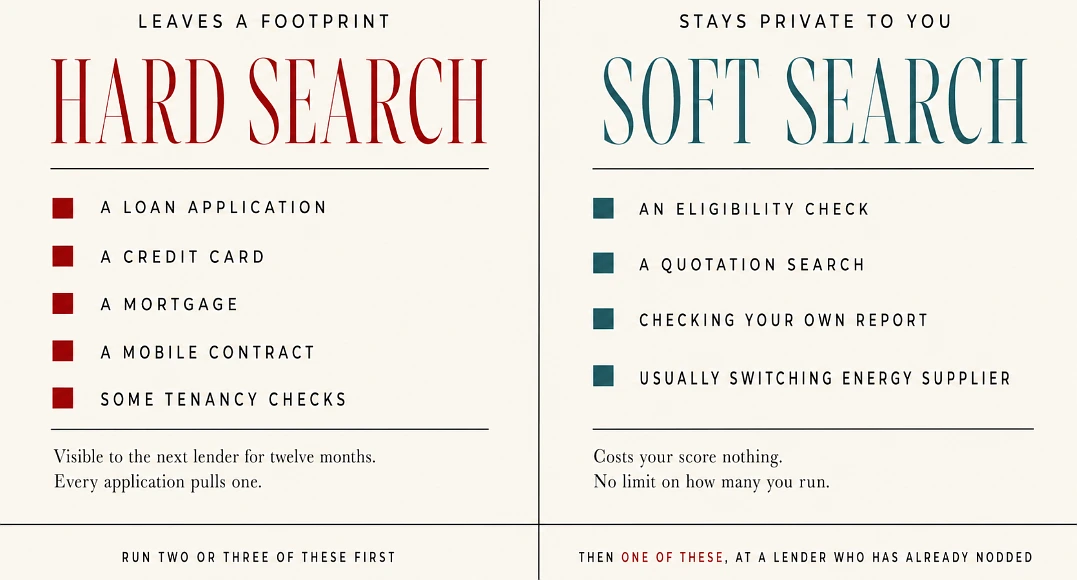
Every formal application pulls a hard search, and that search leaves a footprint the next lender can read. Experian keeps most of them visible for twelve months, and Experian will tell you flatly that too many applications in a short window is one of the standard reasons people get refused, because a run of them looks like somebody knocking on every door in the street.
One search is nothing. Forget it. Five in a fortnight is a story, though, and the sixth lender reads that story before it reads anything else about you, and what it sees is a person five other companies have already said no to.
The applications are doing the damage, not the score sitting underneath them. A loan, a card, a mortgage, a mobile contract, sometimes a tenancy check, all of those pull hard. Switching your gas supplier usually will not, and looking at your own file never does, which is worth saying out loud because plenty of people avoid checking their report in case the checking breaks something.
A soft search will tell you the answer before it costs you anything
A soft search goes by a few names, eligibility check, quotation search, and what it comes down to is a look at your file that stays private to you. You will see it when you pull your report. The next lender will not. It costs your score nothing and there is no limit on how many you run, so going straight to a full application instead is a bit like finding a plumber by booking six of them to turn up on the same morning. Run two or three, see which lenders come back with something resembling a yes rather than a shrug, then apply properly to that one. The specialist end, where bad credit loans get priced for the risk the lender is carrying, will still want a full application eventually, but there is a real difference between one hard search at a lender who has already nodded and six scattered about in hope.
Your three credit files do not say the same thing
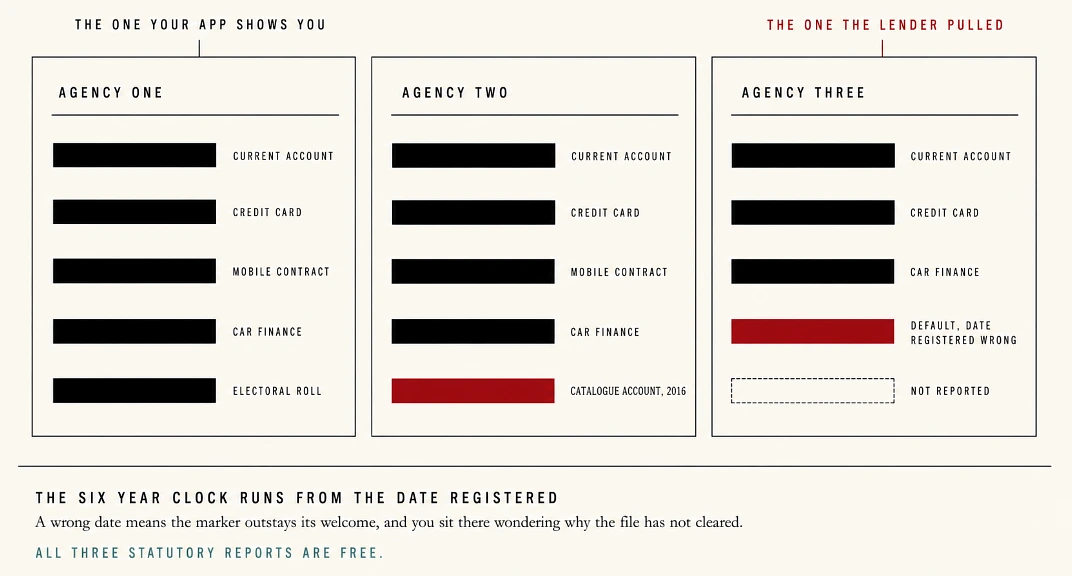
Experian, Equifax and TransUnion each keep their own version of you, and lenders do not all report to all three, so the file your banking app shows you is one of three possible accounts of your history and not necessarily the one that gets read.
That is how people end up baffled. Clean file on the app, declined anyway, because the lender pulled the agency still carrying an old catalogue account everyone had forgotten about.
A wrong default date is the one that quietly costs you years. The six year clock runs from the date the default was registered, so if that date went in wrong the marker outstays its welcome and you will be sat there wondering why the file has not cleared yet.
Statutory reports are free from all three. Read them for the dull stuff, an address you left in 201 9, an account you closed that still shows as open, and get yourself on the electoral roll where you actually live while you are in there.
A credit union cannot legally charge you more than 3% a month
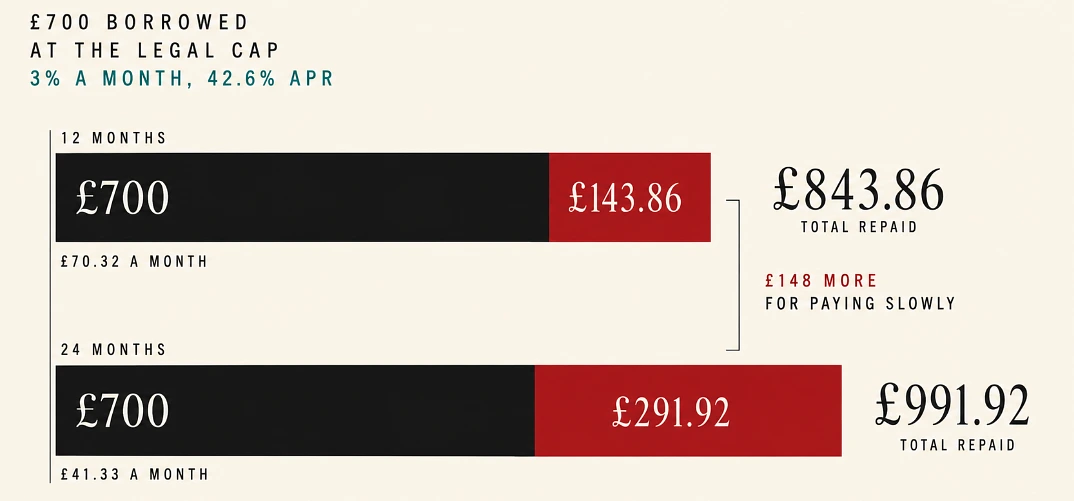
Members own it, the FCA and the PRA regulate it, and Parliament has capped what it may charge you at 3% a month, which is 42.6% APR, across England, Scotland and Wales. Northern Ireland sits lower again at 1 % a month, 1 2.68%. Cap means cap. There is no clever upper tier that appears because your score is poor.
Most of them weigh whether you can afford it now rather than what you were doing three years ago, a good many run no credit check at all, and some will peel a slice off every repayment into savings so you come out the far end with a small pot instead of an empty account.
The catch is joining. You need a common bond, which normally means where you live or work, or your employer, or a trade union, or a housing association, and the whole thing takes days rather than the four minutes an app takes. That delay is the entire reason people skip it and pay double, and the lenders charging double know about the delay better than you do.
Worth seeing what the cap actually costs. Take £700 at the full 3%:
| Term | Monthly | Total repaid | Interest |
| 12 months | £70.32 | £843.86 | £143.86 |
| 24 months | £41.33 | £991.92 | £291.92 |
Forty one pounds a month reads kinder than seventy right up until you spot that you have handed over another £1 48 for the privilege of paying slowly. The monthly figure is the pitch. Total repaid is the price.
Ringing the company you already owe does more than a new loan will
Borrow to cover an arrear and you have added a lender without subtracting a creditor. The debt has changed address, that is all that happened.
Breathing Space is the formal version of that phone call. Government scheme, applied for through an FCA authorised debt adviser rather than by you directly, and the standard one runs up to sixty days with a review dropped in somewhere between day 25 and day 35. Interest and fees frozen on qualifying debts. Most enforcement paused. Creditors not permitted to contact you. One every twelve months.
It is not a write off, and treating it as one is how people waste it. Those sixty days exist so you can sit down with an adviser and build a budget, because the debt is still waiting at the end of them either way. Rent and utilities carry on throughout.
It is free, so you should not be paying anyone to arrange it. StepChange, National Debtline, Citizens Advice, or MoneyHelper on 0800 1 38 7777.
Defaults, since it always comes up. Six years from the date it was registered, and clearing it does not buy you a shorter sentence, it changes the status to satisfied, which lenders do read more kindly. The half of that rule people miss is the good half. Once it drops off, the lender is not allowed to put it back on, even if the money is still owed.
Under five thousand, with a fortnight in hand, the credit union wins and it is not close, because a legal cap will beat any amount of comparing tables. People skip it because it is dull and involves filling a form in, which is a poor reason to pay twice as much for the same money.