

Blog
Britain Has One Tyre Factory Left and 50 Million Old Tyres a Year It Cannot Get Rid Of
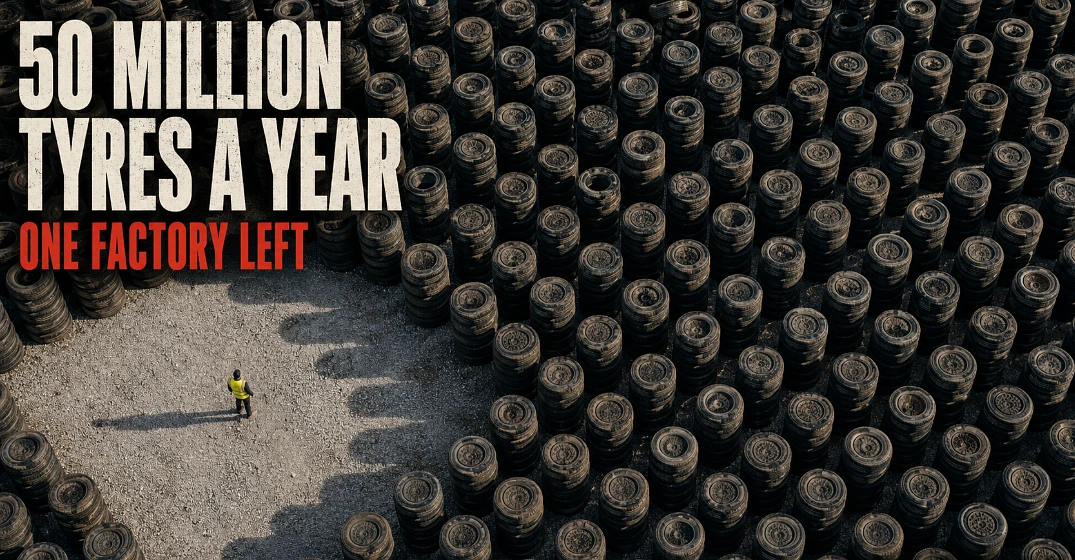
Two facts about British tyres sit side by side and almost never get mentioned in the same breath. The first is that we have more or less stopped making them. The second is that we produce around 50 million worn out ones every year and have no honest idea what to do with them. Put the two together and you get a country that imports nearly every tyre it fits and exports the problem afterwards, which explains a surprising amount about what a new set costs when the fitter hands you the bill.
The Last Factory Standing Is in Carlisle
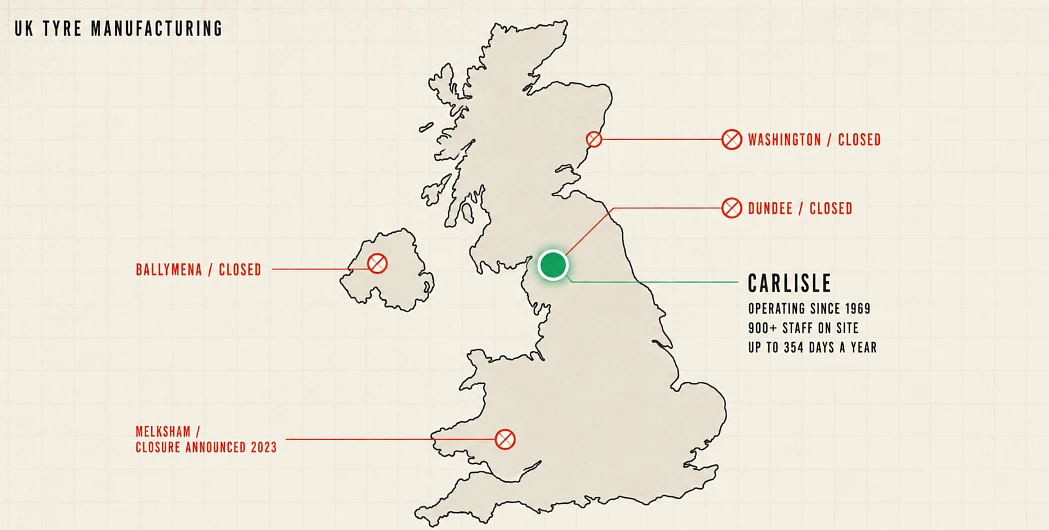
In 1955 Britain had eleven tyre manufacturers. Today it has, in any meaningful sense, one. Goodyear’s Washington plant closed around fifteen years ago, Michelin shut its car tyre factory in Dundee and its truck tyre plant in Ballymena, and Cooper Avon’s operation in Melksham announced its closure in 2023. What survives is Pirelli’s Carlisle plant, making tyres in Cumbria since 1969, running 24 hours a day for up to 354 days a year with more than 900 staff on site, supplying Jaguar, Porsche, BMW, Mercedes and Volvo. The trade press calls it, without much argument from anyone, probably the last large scale tyre factory left in the country. Eleven makers down to one is a football league folding down to a single club that still turns up every Saturday.
And the club is not safe. In October 2025 Pirelli paused production at both its UK sites, Carlisle and Burton on Trent, for six days. The official reason was market conditions. The understood reason was the cyberattack that shut Jaguar Land Rover for five weeks and rippled through every supplier that feeds it, and Burton has since been in consultation about moving its remaining production up to Carlisle. The line between Britain having a tyre industry and not having one is now that thin, and it can be crossed by another company’s IT department.
Where the 50 Million Tyres Actually Go
Now the other half, and this one needed a BBC investigation to drag it into daylight.
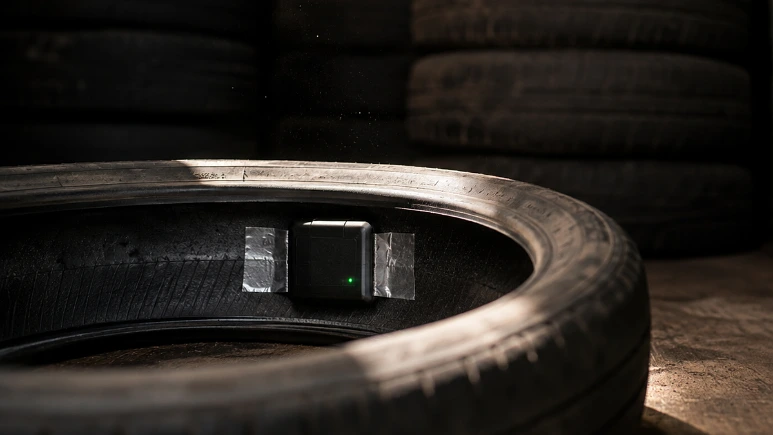
Britain generates roughly 700,000 tonnes of waste tyres a year, and around half of them are exported to India. The paperwork says recycling. What the BBC’s File on 4 team did was hide GPS trackers inside shipments and follow them, and the trackers led to makeshift pyrolysis furnaces where the tyres are cooked at 500 degrees in an oxygen free environment to squeeze out steel, a little oil and carbon black. Around 70% of the used tyres India imports end up in plants like that, roughly half of the country’s 2,000 pyrolysis operations are illegal, and Imperial College scientists told the BBC the workers face cardiovascular disease, respiratory disease and cancers. One of Britain’s biggest tyre recyclers said the line that stuck with me: he could not imagine anyone in the industry who did not know it was happening.
That sentence deserves a second reading. It took hidden trackers in a shipping container for anyone to say out loud what an entire industry admitted it already knew. The government’s response, when asked, was that strict export controls exist along with unlimited fines and possible imprisonment, which sounds firm right up until you notice the containers are still sailing. Britain’s tyre policy is the flat share approach to the washing up, leave the pile, then pay somebody to carry it out of sight, and the official position amounts to a shrug with a customs form attached.
Ireland Fixed the Same Problem With a €2.80 Levy
The part that made me genuinely angry is that the answer sits next door, and it is not complicated.
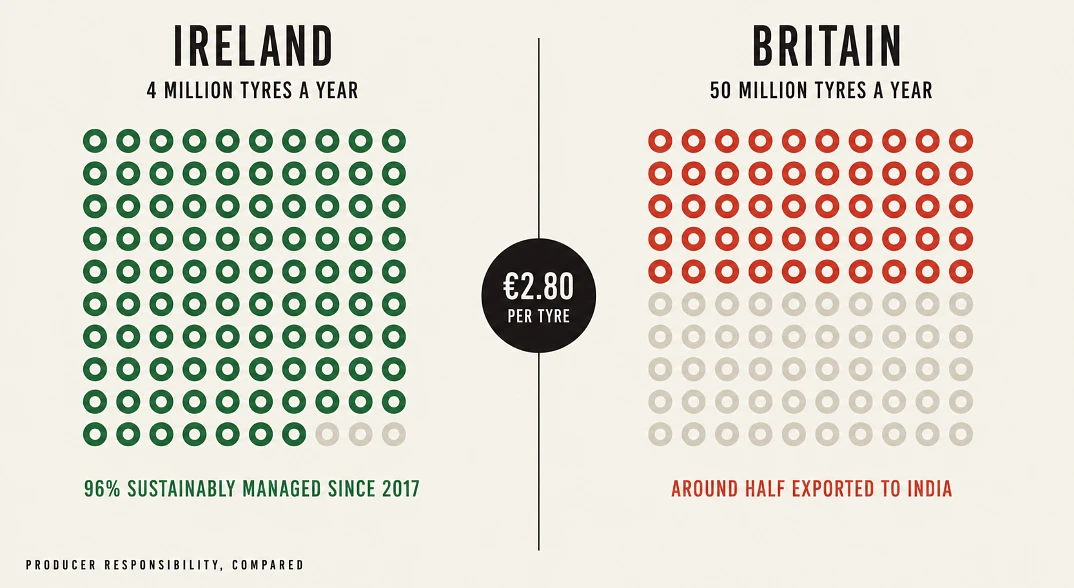
Ireland had the identical mess a decade ago, hundreds of thousands of dumped tyres, an estimated hundred illegal dumps, taxpayers funding the clean up of piles they had already paid a disposal charge on. In October 2017 the Irish government stopped tolerating it. It brought in a producer responsibility scheme, now run by Circol ELT, funded by a visible environmental charge of €2.80 on every car tyre sold, with landfill banned for tyres whole or shredded and every tyre made traceable from sale to end of life. The retailers complained at the time, as retailers do. Then it worked. Over the past five years the scheme has sustainably managed more than 96% of all car, van, 4×4 and motorcycle tyres placed on the Irish market, around four million a year, and from January 2025 it was extended to trucks, buses, agricultural and construction tyres as well. Ireland now even imports used tyres from Britain to process properly, which is a detail I had to read twice. Our neighbour is recycling our waste more responsibly than we are, for a levy that costs less than a coffee, while our own containers head for the furnaces.
So why has Britain not simply copied it?
Genuinely, I do not know, and no one in government has offered a convincing answer either. The model is proven, the cost is trivial, the enforcement is a database rather than a police force, and the Irish results are published annually by their EPA for anyone to read. Whitehall has had the evidence for years now, and so far the appetite to act on it has not followed.
Why This Is Part of the Reason Tyres Cost What They Do
The two halves meet, in the end, at the till, because Britain builds almost nothing, nearly every tyre fitted here is imported, priced in a currency that is not ours and shipped across oceans that have been anything but calm this decade. Even Pirelli’s UK arm, the last domestic maker, reported in its own accounts that its turnover growth came primarily from strong price increases across all its sales channels. And because we ship the disposal problem abroad instead of building a proper system, the true cost of getting rid of a tyre never gets designed into the price honestly. It just arrives later, in a council clean up bill or, as the BBC found, in someone else’s lungs.
Which changes what a sensible driver does. The single most useful response to a tyre economy this badly organised is to buy fewer tyres over a driving lifetime, and that means choosing tyres engineered for lasting value rather than the cheapest set on the rack, checking the EU label for rolling resistance and wet grip, keeping pressures right so a good tyre actually reaches its full mileage, and asking the fitter, plainly, where the old ones go. Four tyres that last forty thousand miles instead of twenty five is a set that never gets shipped anywhere.
- A detail for anyone who wants to check the arithmetic: Ireland’s scheme handles around four million tyres a year at 96% responsible recovery. Britain produces roughly fifty million a year and sends half of them to a country whose own government has banned burning imported tyres. The gap between those two sentences comes down to a decision Ireland made and Britain has not.
The next BBC investigation will find the same containers on the same route unless something changes in Westminster, and the Carlisle plant will keep turning up every Saturday for as long as its customers’ computers stay online. Both halves of this were solvable years ago, and the neighbour next door has already shown the working.