
Blog
How to Create a Travel Magazine Worth Keeping: Turning Trip Photos and Notes into Lasting Memories

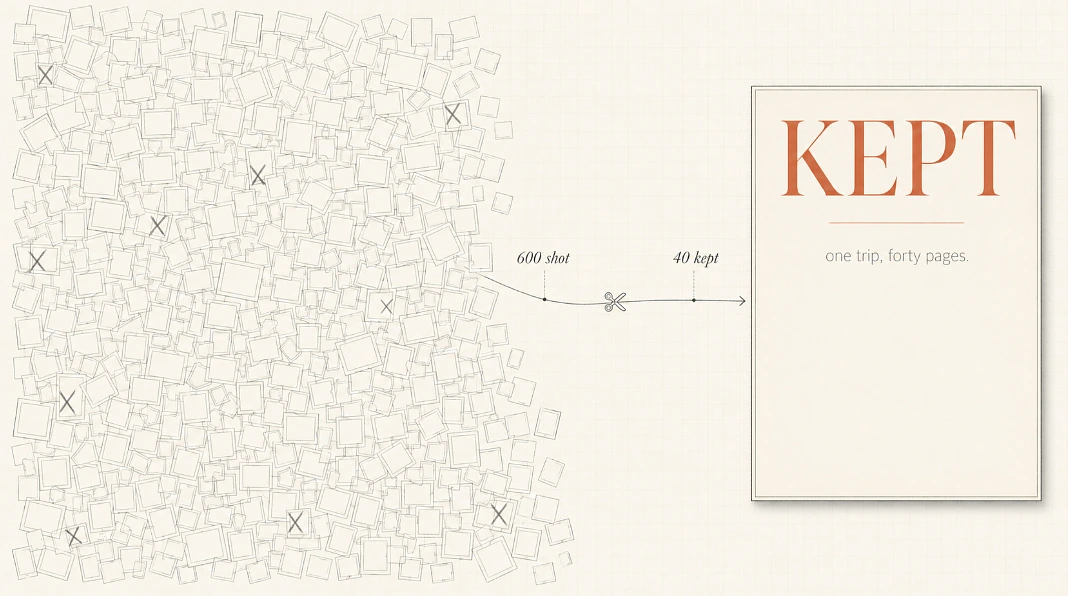
Not every photo deserves to survive. Most of them shouldn’t. Out of maybe six hundred shots from a ten day trip, you’ll keep maybe forty, and treating all six hundred as equally precious is the exact reason the magazine never actually gets made, it just sits half-started in a folder called “trip 2024 FINAL” forever.
A photo album is a hoard. A travel magazine is a decision.
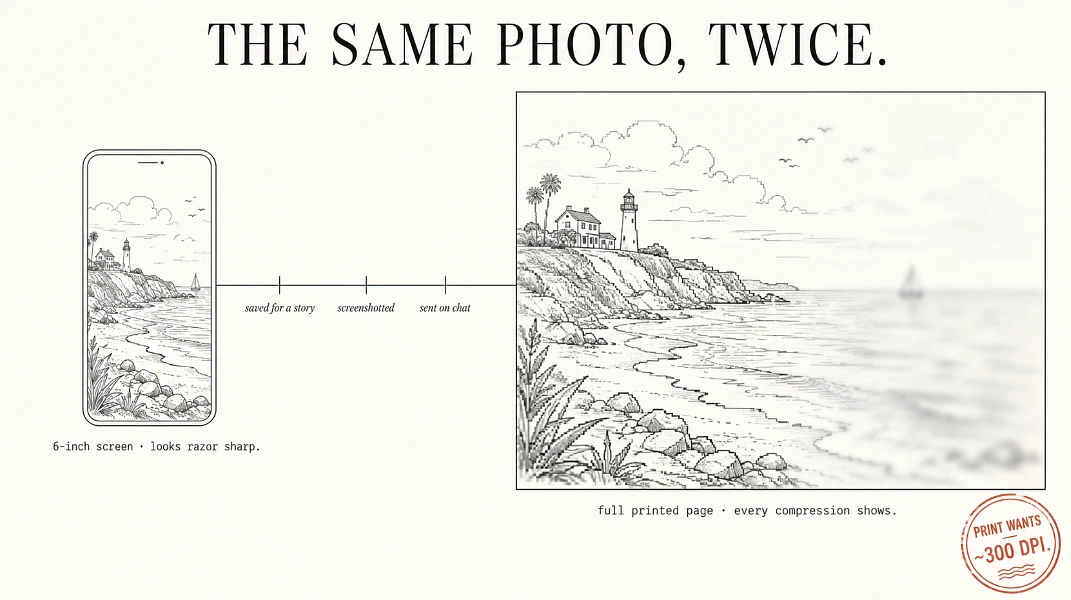
One thing gets skipped when people tell you to “just upload your favourites”. Most phone images have been compressed two or three times since you last looked at them: saved for a story, screenshots of that, sent through WhatsApp. Each one strips detail you don’t notice on a screen but absolutely notice on paper. Print wants something closer to 300 DPI at the size you’re printing. A picture that looks razor sharp on your six inch phone becomes blotchy and blurry when it’s printed across a full page of a magazine, and you only find that out after the file’s uploaded.
Collect It All, Keep Essentially None Of It
Pull everything. The photos, obviously. But also the notes you took at one in the morning on a terrace, the ticket stubs, the screenshot of the map you never looked at, the receipt for the food you can’t remember the name of but definitely remember eating.
You’ll throw away most of this stuff. That’s not failure, that’s the actual job.
Think in scenes, not souvenirs. Landmark photos are duplicates arguing with each other, everyone has the same one from the same angle at the same time of day. The train platform where nothing happened but you were annoyed and tired and it was somehow the realest part of the whole week, that one earns a page. The landmark rarely does.
Give It A Spine Before You Touch Layout
This sort of thing is like getting a bunch of pictures from a WhatsApp group chat halfway through the week: without the context, half the jokes make zero sense and you’re just nodding along.
Was it about food, about slowing down, about family chaos no one planned for. Be truthful about it, not diplomatic for dinner parties. Loosely:
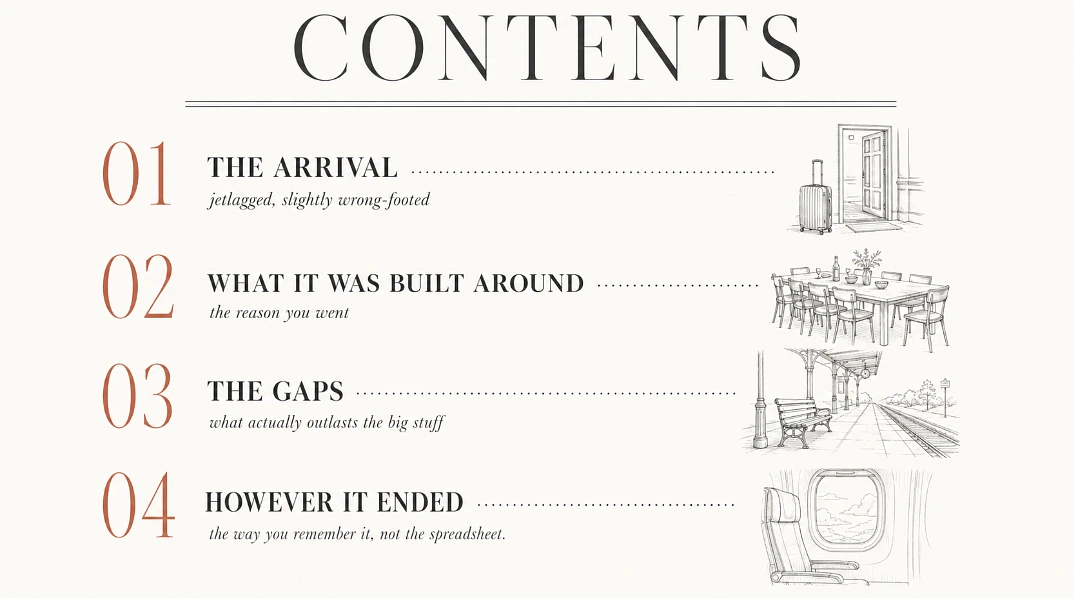
The arrival, jetlagged, slightly wrong-footed, seeing the place for the first time.
Whatever the trip was actually built around.
The stuff that happened in the gaps, which usually outlasts the big stuff in memory.
However it actually ended.
It doesn’t need to be precise. It has to move the way you actually remember it, not the way a spreadsheet would.
Your Notes App Already Writes Better Than You Think
You don’t need travel-writer prose. No one wants it either. Being able to say “We got lost and found the best bakery in the city” is better than three overwritten sentences about cobblestones and golden light every single time.
If you kept anything close to a journal, mine it. The good lines are already sitting there, unpolished, which is exactly why they work.
Not Every Good Photograph Gets A Page
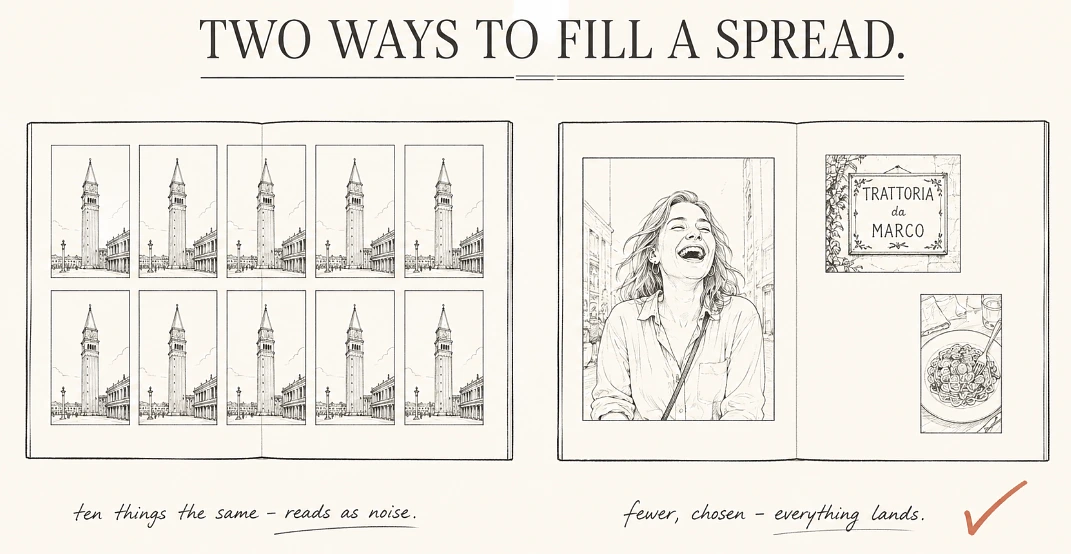
Wide shots tell the story, but the close-ups are the character work, the food, the hand-painted sign no one else photographed, the weird object that made you laugh. It’s almost always better when you find someone in a moment, before they’ve arranged their face for the camera. You hardly ever get that kind of moment with a posed photo.
When you’ve got a whole page of ten things the same, it reads as noise, nothing gets room to actually land because six other things are shouting over it. Fewer, chosen properly, always beats more.
Say What The Photo Can’t, Nothing Else
Don’t caption what’s already visible. That’s just narrating what the reader can already see, which is a strange, slightly patronising thing to do to someone holding a photo in front of their own eyes. Use the words for what the image genuinely can’t carry, how it actually felt, what led up to it, why you kept coming back to this one when you were cutting everything else.
The Actual Skill Is Cutting
The folder with everything still in it, six hundred photos, every note, every stub, is a hoard technically labelled a keepsake. It isn’t one. It’s landfill with a filename.
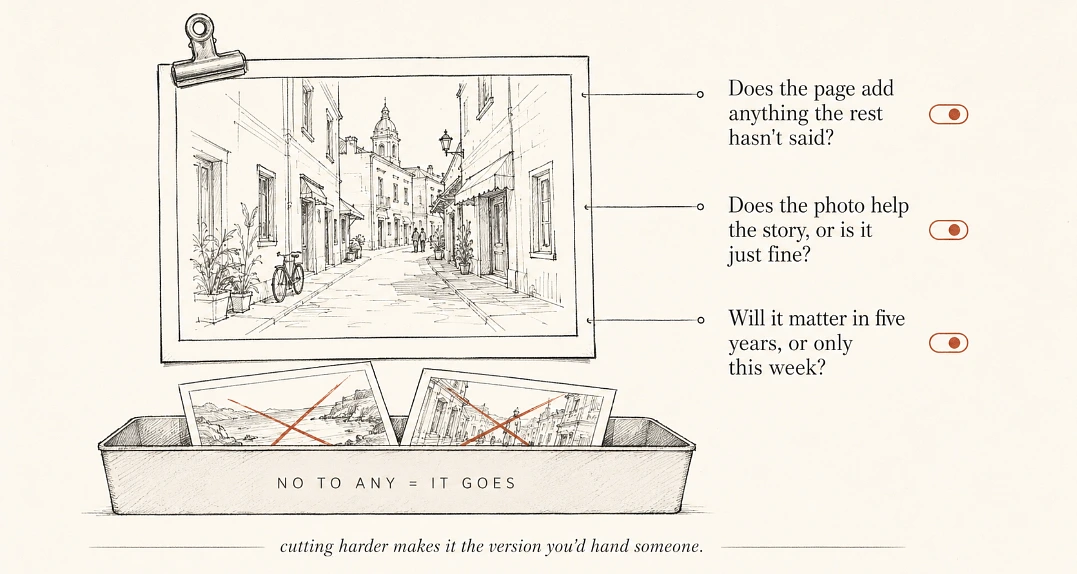
While you’re editing, three questions:
What does this page add that the rest hasn’t already said.
Does this photo really help the story, or is it just fine.
Will this detail matter in five years, or only this week.
No to any of those, it goes. Cutting harder doesn’t make it less personal. It makes it the version you’d actually hand someone instead of the version you’re still meaning to finish.
Just Make It So It Can’t Be Accidentally Deleted
A folder on your phone is only one factory reset away from never having existed. Not a memory, just another burden on borrowed storage. A printed, bound version is you actually choosing to keep something rather than just not getting around to deleting it. The physical build matters here as much as the editing did, paper weight, binding that survives being handed round a table more than once. The travel magazine format exists for a reason: the editorial layouts on archival paper were meant to be picked up ten years from now, not just this Christmas.
Start with one trip. A short one is good. You pull together all of it and keep almost none of it and make the thing you’d actually hand someone rather than the thing still sitting half-finished in a folder named FINAL.