


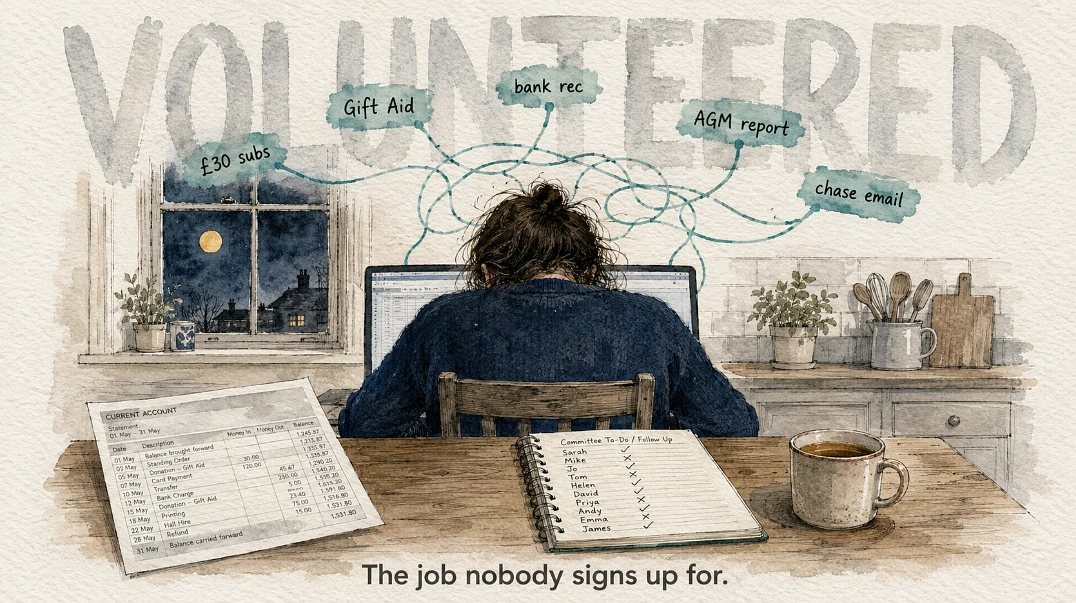
The single thing that frees up the most time is getting rid of double entry: when a member renews online, the payment and the membership list update at the same moment, so you never hand key another name. If you’ve ever been the one who got volunteered to run the subs for a football club, a PTA, a choir or the village hall committee, that one change is the difference between a free Sunday and another night at the kitchen table.
The job nobody volunteers for but someone always ends up doing
Most of the work of running a small club is invisible admin that never gets counted. Chasing people for £30 of subs, matching payments off the bank statement against a list of names, updating a members spreadsheet after every payment, then trying to rebuild it all into something readable for the AGM.
It’s a bigger slice of the country’s unpaid effort than it looks. The Community Life Survey put UK volunteering at over 2 billion hours a year, the equivalent of around 1.25 million full time workers, and a fair wedge of that is someone sitting at a laptop reconciling payments rather than doing the thing the club actually exists for.
Why a few lost hours hurt more than they should
Plenty of these groups are technically small charities, and they run on fumes. In the 2023 charity returns, around 2 in 5 (42.6%) spent more than they took in, and three in five (62%) had income under £100,000. When the budget’s that tight, the treasurer’s time is one of the few things the club has going spare, and burning it on data entry is a quiet drain nobody puts a number on.
What actually changes if you move it online

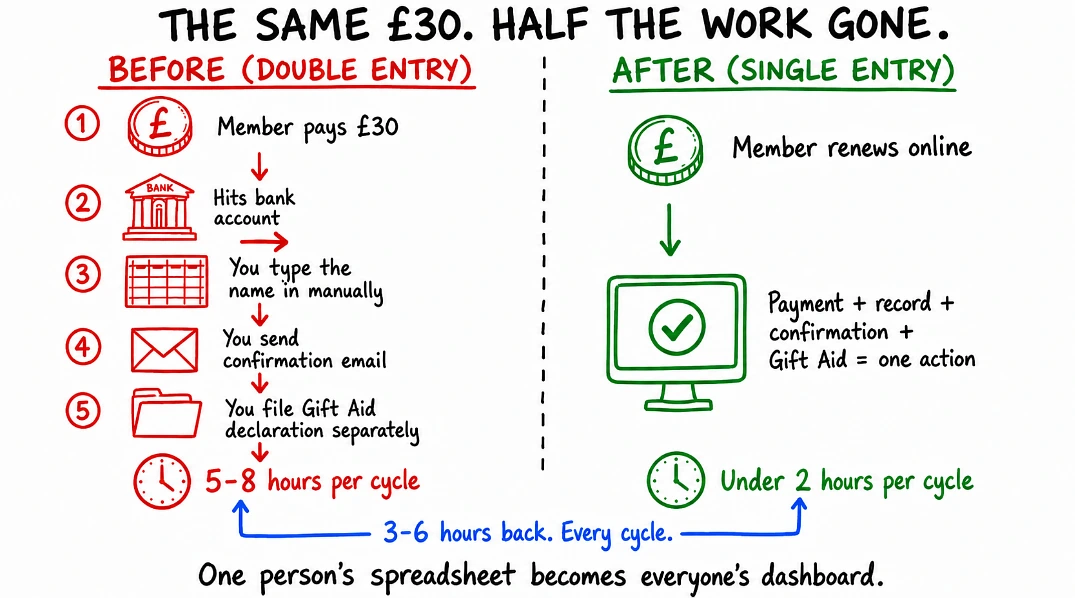
The one mechanism behind every hour saved is the end of double entry. Renew online and the payment and the record update together, so nothing gets typed twice.
From there it spreads:
- The bank rec stops being a monthly slog. Instead of matching the statement to a list line by line, the system shows you who’s paid and flags the ones that bounced.
- Gift Aid gets picked up on its own, instead of you cross checking declarations against payments by hand.
- The chase runs itself. The member who always needs three nudges gets an automatic sequence, say 60 days out, again at 30, a last one at 7, with nothing from you.
The one that quietly matters most: in a lot of clubs, one person holds everything in a spreadsheet only they understand. Put it in a shared system and anyone on the committee can see who paid and when, so the club isn’t one resignation away from losing track of its own members.
Working out whether it’s worth it

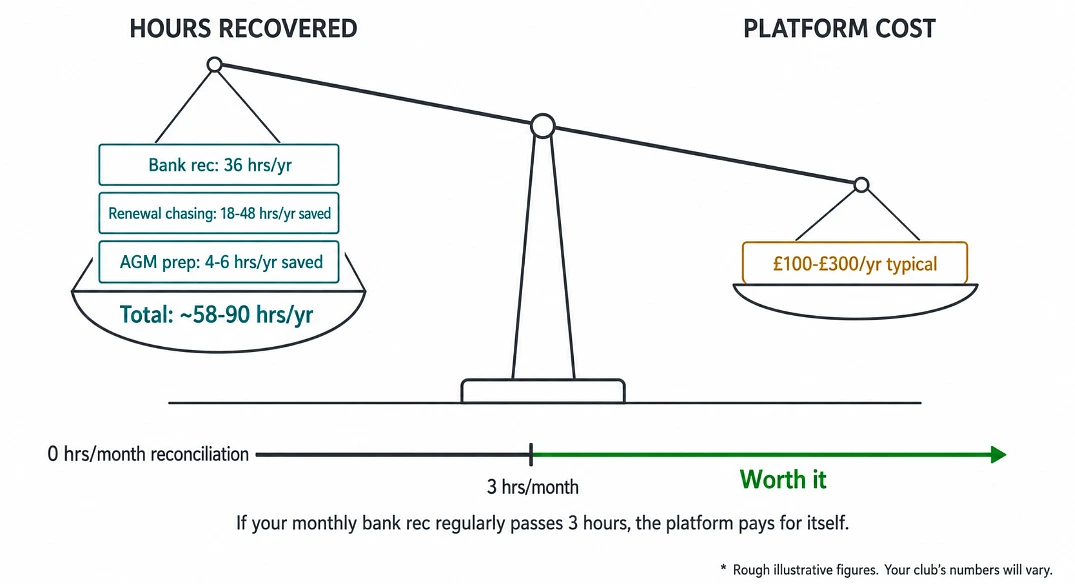
Do the sum: the hours you’d get back each renewal, times what your time is worth, against the yearly cost of the platform. Rough, illustrative figures:
- Monthly bank reconciliation: about 3 hours, so roughly 36 hours a year.
- Renewal chasing and updates: 5 to 8 hours a cycle, down to under 2 once it’s online.
- Cobbling the AGM figures together: a few hours that mostly disappear.
If the hours you claw back are worth more than the subscription, it pays for itself. As a rough guide, it usually does once your monthly reconciliation is regularly creeping past 3 hours.
What to check before you sign up
Look for clear pricing, UK Direct Debit and card payments built in, Gift Aid tracking as standard, and the ability to export all your data. A plain breakdown of nonprofit merchant service options shows where an ordinary card processor quietly costs more than one built for clubs and charities. The export bit matters most down the line: anything that traps your records in a format you can’t take with you is a headache waiting to happen.
Then try before you buy. Run it next to your old spreadsheet for one renewal round, so any snags show up while the familiar system’s still there to fall back on. By the end of that first cycle you’ll know, and you’ll probably have a couple of evenings back to show for it.