


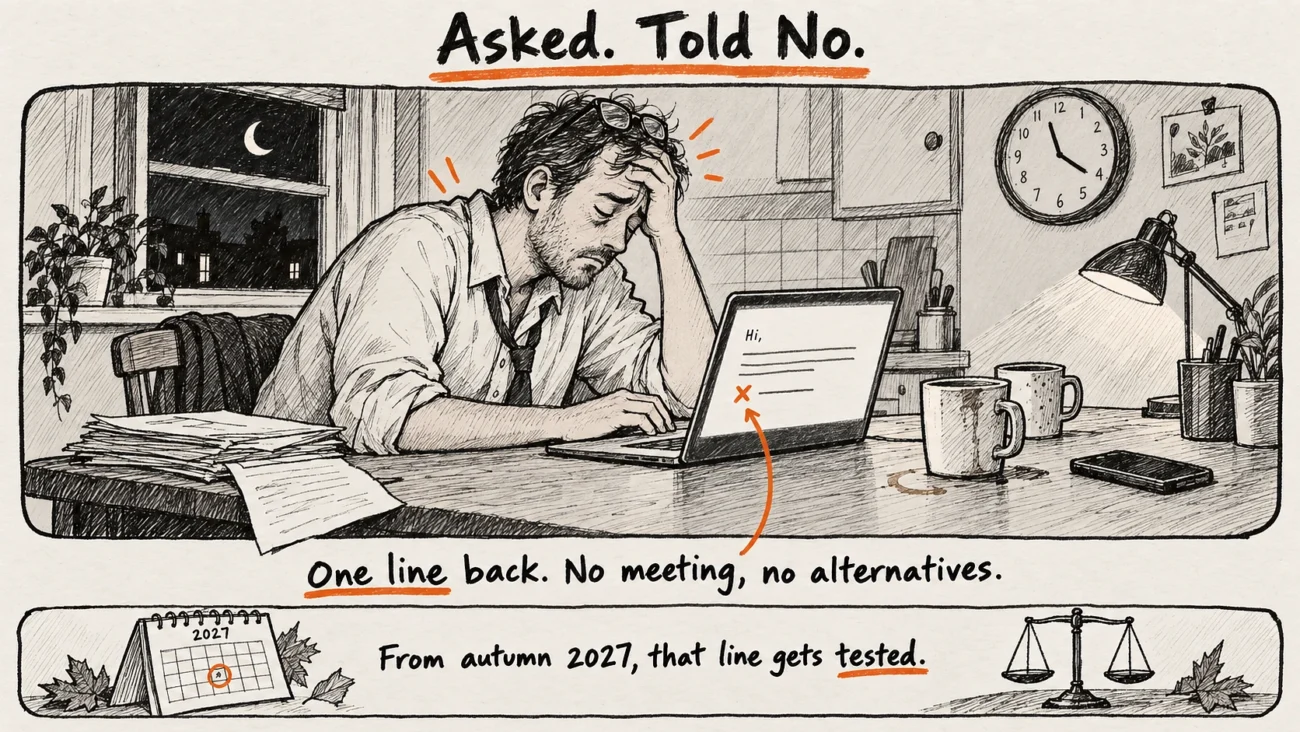
So if you have ever asked to work from home a couple of days a week and been told no with about one line of explanation, that is going to get a lot harder for your employer to do. Not this year, and not next year either, but the date has now been set.
What Was Actually Decided On 15 September

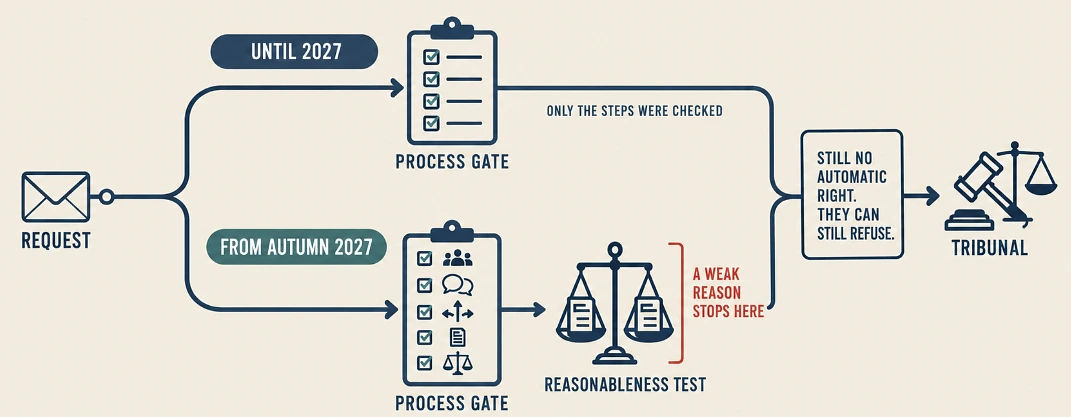
The Department for Business and Trade published its response to the consultation on flexible working on 15 September 2026, and it drew on more than 1,000 responses. The changes come in through secondary legislation in autumn 2027.
Now, here is what employers will have to do before they turn a request down.
- Hold a meeting with you first
- Talk through whether what you asked for is actually workable
- Look at alternatives, so not just yes or no
- Give you the answer in writing
- Pass a new reasonableness test under the Employment Rights Act 2025
And that last one is the part that matters. Employment tribunals will be able to look at whether the decision itself was reasonable, not only whether the employer ticked off the steps. So until now a company could follow the process to the letter and still say no for a weak reason, and that was that. From autumn 2027 the reason itself gets looked at.
One thing to be clear about, though. The Act does not give anyone an automatic right to work flexibly. You still have to ask, and they can still refuse. They just have to be able to defend it.
What The Rules Are Right Now
So in the meantime, it is worth knowing where things actually stand today, because a lot of people think they have fewer rights than they do.
Asking for flexible working has been a day one right since 6 April 2024, and from 6 April 2026 your employer has to answer within two months instead of three. You can make 2 requests a year.
And if an employer gets the process wrong, the penalty is 8 weeks’ pay, capped at £5,600 at the moment. Which is not nothing, but it is also not much of a deterrent for a big company, to be fair.
The 8 Reasons An Employer Can Use

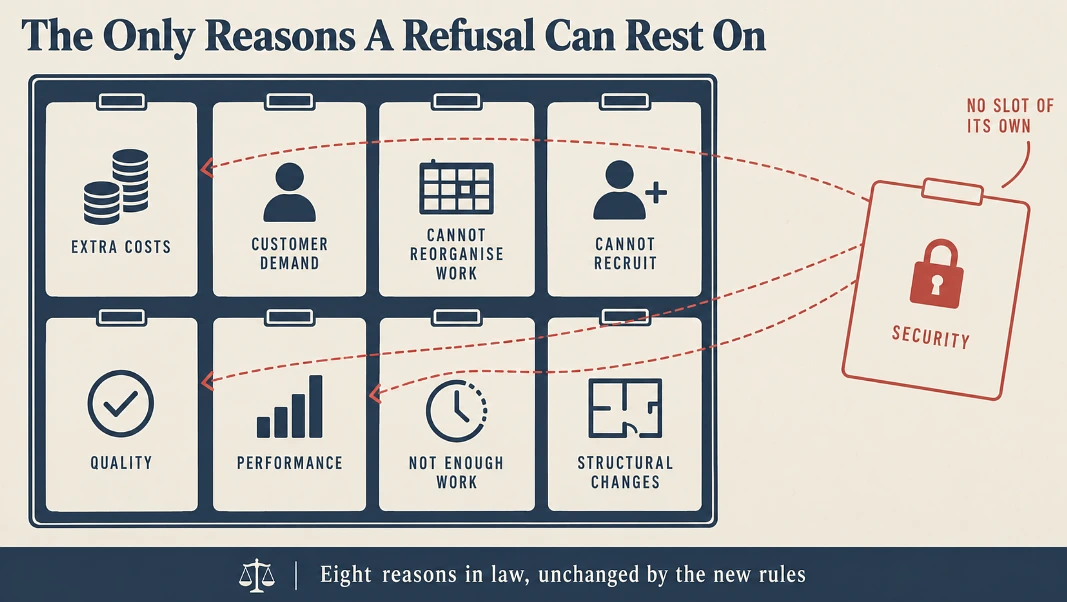
Here is the thing a lot of people do not realise. An employer cannot just say no because they fancy it. Even now, a refusal has to rest on one or more of 8 business reasons set out in law, and those 8 are not changing under the new rules.
- Extra costs that would be a burden on the business
- Harm to the ability to meet customer demand
- Not being able to reorganise the work among the existing staff
- Not being able to recruit more staff
- Harm to quality
- Harm to performance
- Not enough work during the hours you want to work
- Planned structural changes
Now look at that list again. Security is not on it.
So when someone gets told “we cannot let people work from home, it is not secure”, that has to be squeezed under one of the other headings, usually cost, quality or performance. And up to now it has mostly got waved through, because the tribunal was only checking the process. From autumn 2027 somebody can actually ask whether it holds up.
Why “It Is Not Secure” Is The Excuse That Gets Tested
And honestly this is where it gets interesting, because the security worry is not always made up. Company data sitting on home broadband, staff logging in from a laptop the kids also use, people getting scam emails at their kitchen table with no IT person down the corridor to ask. Those are real problems.
But they are problems with a fix, and that is the bit that changes the argument. A lot of businesses are still running networks built for everybody sitting in one building, so remote access gets bolted on and feels risky because it is. Moving to SASE security solutions, where the security follows the person rather than the office, is the sort of change that takes that worry off the table.
So the question a tribunal is going to end up asking is a fairly simple one. Is the work genuinely not safe to do from home, or has the business just not sorted out its setup? Because a refusal built on the second one is going to look a lot less reasonable in 2027 than it did in 2024.
Who This Is Actually Going To Help
The numbers on who works from home already are worth a look. As of June 2026, 39% of Brits work from home at least some of the time, which is around 22.1 million people. That splits into 14% who are home only and 25% who are hybrid.
But it is not spread evenly, and this is the bit that does not get talked about. People with a degree were 10 times more likely to be hybrid workers than people with no qualifications, 42% against 4%. And looking at pay, 45% of people earning £50k or more work hybrid, against 8% of those on under £20,000.
So 45% at the top and 8% at the bottom. That is a big gap, and part of the reason is that a lot of lower paid jobs simply cannot be done from home, which is fine. But some of it is people in jobs that could be done from home being told no, and those are the people a reasonableness test is supposed to help.
The Other Dates Landing Before Then

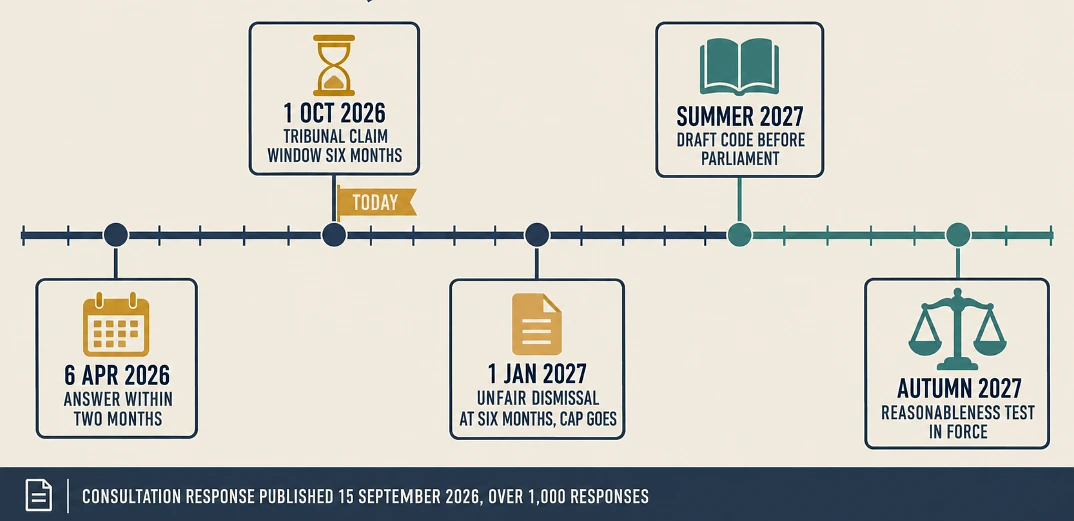
Autumn 2027 is the big one, but a couple of other changes are coming in sooner and they all point the same way.
- Today, 1 October 2026: the time limit for taking a claim to an employment tribunal goes from 3 months to 6 months
- 1 January 2027: the unfair dismissal qualifying period drops to 6 months, and the cap on the compensatory award goes
- Summer 2027: a draft code of practice goes before Parliament, and Acas consults on an updated code, which is where “reasonable” starts getting an actual working definition
So the code in summer 2027 is the one to watch, because until then nobody really knows how high the bar is going to be.