

Blog
Should Your Startup Actually Charter A Jet For The Team Offsite


UK departure tax on private jets went up fifty percent this April. Air Passenger Duty on a short-haul private departure now sits at £142 a head, and it jumps to £1,141 a head on anything long-haul. That’s on top of the charter itself, and it lands at exactly the moment a lot of founders are quietly asking whether flying the whole leadership team into one place still makes sense the old way, connections through three airports, half a day lost each direction, everyone arriving frazzled before the retreat’s even started.
So does it actually add up. Not as a status question, as an arithmetic one.
What A Charter Genuinely Costs Right Now
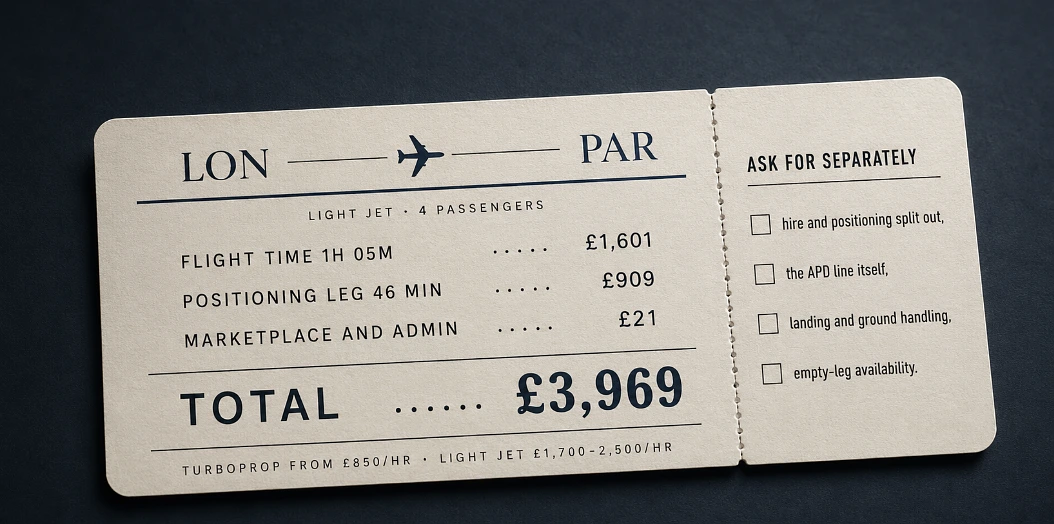
A turboprop, four to nine seats, starts around £850 an hour. That covers most short domestic and near-European hops. A light jet, the usual pick for a founding team of four to six, runs £1,700 to £2,500 an hour.
Here’s a real quote doing the rounds this year, London to Paris on a Citation XLS+, four passengers, broken all the way down:
- Flight time (1h 05m): £1,601
- Positioning leg (46 min): £909
- Marketplace and admin fees: £21
- Total: £3,969 all-in
That’s not a small number sitting next to a commercial fare. It’s also not the number people assume when they picture private aviation as something reserved for a different tax bracket entirely.
Where The Maths Actually Turns
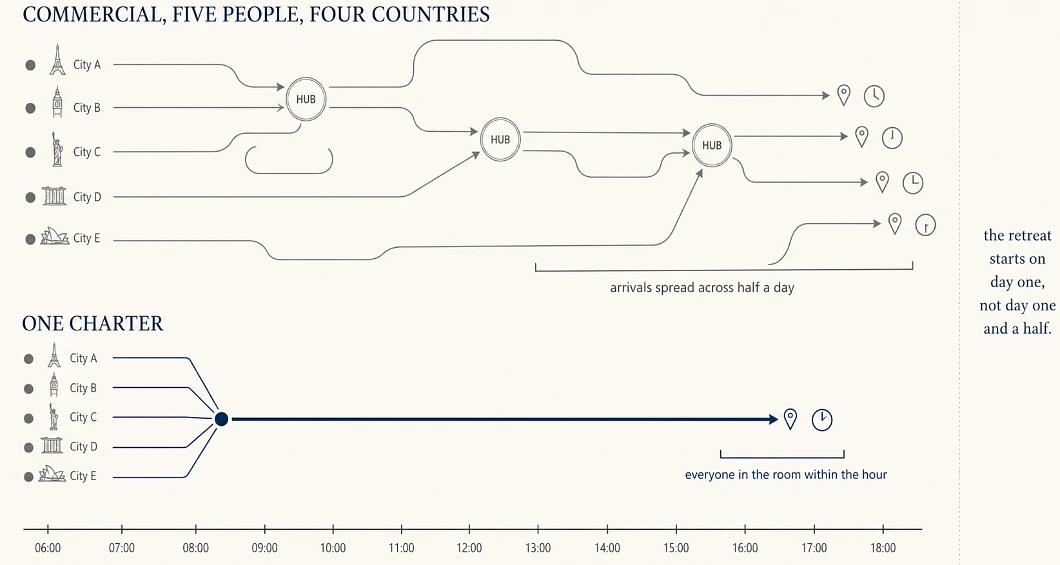
Group of five or more, travelling from more than one country, and the whole picture changes. That’s the bit most of these conversations skip.
Commercial for a distributed team rarely means five direct flights. It usually means five people connecting through three or four different hub airports, arriving at staggered times across half a day, then needing to recover before anyone’s fit for a strategy session.
Add up the actual working hours lost in transit, priced at whatever a founder or senior hire’s day rate genuinely is, and that number competes with the charter fee faster than most people expect:
- One departure time instead of five staggered arrivals across a day.
- Everyone in the room within the hour, not spread across an afternoon of taxis and delayed connections.
- The retreat starts on day one, not day one and a half once everyone’s actually recovered.
Under five people, or a team mostly clustered in one city already, the maths rarely gets there. A single direct commercial flight beats a charter on cost almost every time at that scale, and pretending otherwise is how a jet stops being a logistics decision and starts being a status one.
The Bit That’s Genuinely Changed This Year
Tech has cut well over a hundred thousand jobs industry-wide in the opening months of 2026 alone. That backdrop matters here in a way it wouldn’t have three years ago.
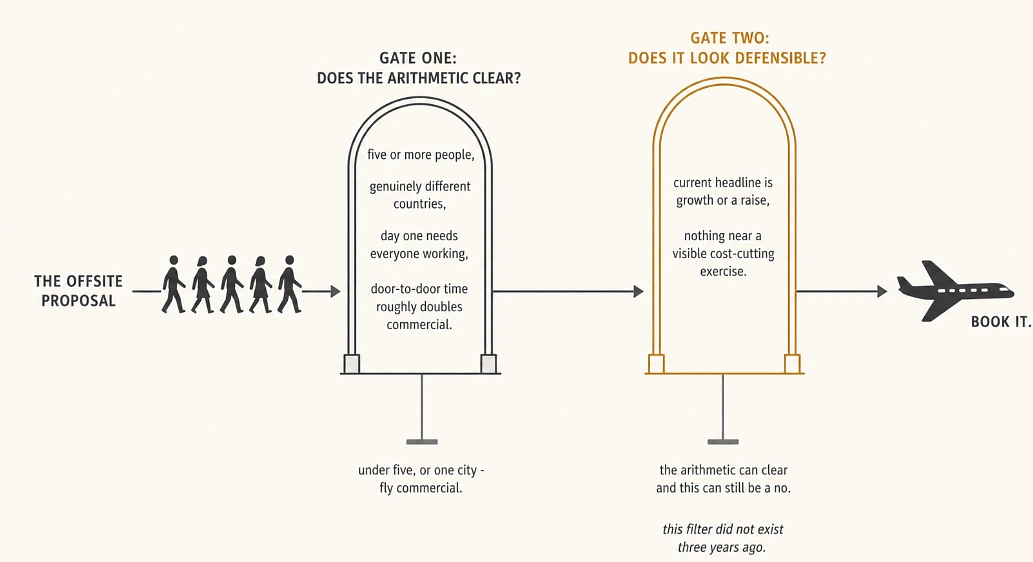
A leadership team boarding a chartered jet for an offsite the same quarter the wider company took a headcount cut is not a story anyone wants written about them, and increasingly it’s the kind of thing that gets photographed and posted regardless of intent. None of that changes the underlying arithmetic above. It does mean the decision needs a second filter layered on top of the cost one, not just does this pay for itself, but does this look defensible to the people not on the flight.
When It’s Worth Actually Booking One
- A leadership or founding team of five or more scattered across genuinely different countries, not just different cities in the same one.
- A retreat where day one actually needs everyone in the room working, not recovering from a connection.
- A route where commercial options are indirect enough that total door-to-door time roughly doubles versus a direct charter.
- A company whose current headline is growth or a raise, not a redundancy round.
When It Isn’t
- A team of four or fewer within a couple of hours of each other by direct commercial flight.
- Timing that lands anywhere near a visible cost-cutting exercise elsewhere in the business.
- A retreat where the schedule has enough slack that arrival time genuinely doesn’t matter.
What To Actually Ask A Broker
If the case does hold up, a broker booking a private jet charter will usually give a fully itemised quote before anything’s confirmed:
- Aircraft hire and positioning fee, broken out separately, not bundled into one headline number.
- The APD line itself, so the tax isn’t a surprise added at the end.
- Landing charges and ground handling, which vary a lot by airport.
- Empty-leg availability, a jet already needing to reposition on your route can come in meaningfully cheaper than a fresh charter booked from scratch.
The rest of the retreat, the venue, the agenda, whether people actually get downtime instead of a relocated workload, matters more to whether the trip achieves anything than how the team got there. But getting everyone in the room without losing a day to connections is a real, calculable piece of that, not a vague nice-to-have, and this year it comes with a tax line attached that makes the sum worth doing properly rather than assuming either way.