



There is a routine that plays out in divorce courts every few years, and in our house we have a name for it: the sudden pauper. A man who spent two decades being photographed beside boats and racehorses arrives in court swearing the money is gone, all of it, lost in some deal that conveniently left no paperwork behind. The wealth did not shrink or dwindle, you understand. It went on its holidays.
Except judges have seen the routine before, and the stories of the people who tried it make far better reading than any legal textbook. Three of the best, all true, all sitting in court records anyone can go and check.
The Lottery Winner Who Sent Her Millions to Her Mum’s House


In December 1996 a Los Angeles woman named Denise Rossi won a share of a $1.3 million lottery pool with her co-workers, and eleven days later, after 25 years of marriage, she filed for divorce. Her husband Thomas Rossi thought the timing was strange, but life is strange, and the divorce went through. What he did not know was that Denise had arranged for all the lottery correspondence to go to her mother’s address, and that the financial disclosure forms she signed under oath listed no winnings anywhere. Those forms are the ones every divorcing spouse signs, and lying on them is fraud, which becomes important shortly.
- Do you know how Thomas finally learned about the money? A lottery buy-out letter posted to the old house in 1999, three years after the divorce, addressed to a woman who no longer lived there. He opened it, read it, and called a lawyer the same week.
When the case, Marriage of Rossi, reached court, the judge found that concealing a marital asset with fraud or malice carries a specific punishment under California law, and it is not splitting the asset once caught. The court awarded Thomas 100% of the winnings. Denise had schemed for the whole jackpot and finished with none of it, plus the legal bills, and the case has been cited at nervous spouses by American divorce lawyers ever since.
The London Fixer Whose Poverty Took 65 Hearings to Disprove


Britain’s grandest version ran through the High Court for most of a decade. Scot Young was a Dundee-born property dealer who made his living as a fixer to the seriously rich, and when his marriage to Michelle Young collapsed in 2006 he told the court he had been ruined by a Russian property deal and was bankrupt, with nothing left to divide. Michelle refused to accept a word of it. She insisted his fortune was resting offshore and ran up £6.5 million in mostly borrowed legal fees hunting for it, and from the witness box she went further than anyone expected, claiming that famous friends including Simon Cowell and the Topshop billionaire Sir Philip Green were helping to conceal his wealth. The judge called these serious allegations against well-known people, and they remained allegations, nothing more, but the headlines they produced ran for years.
Meanwhile the court kept asking Young for his financial paperwork, and he kept not producing it, and that refusal cost him six months in prison for contempt of court. The case needed six and a half years and 65 hearings before Mr Justice Moor could rule in 2013 that the penniless man was actually worth around £40 million, and that Michelle should have £20 million of it. She had claimed for hundreds of millions and called the award disgraceful. The story then took the darkest turn available, because a year later Young fell to his death from a London window, the inquest finding nothing suspicious, and one of the most bitter money fights the English courts have staged ended in a way that satisfied nobody at all.
The Yacht That Would Not Be Caught

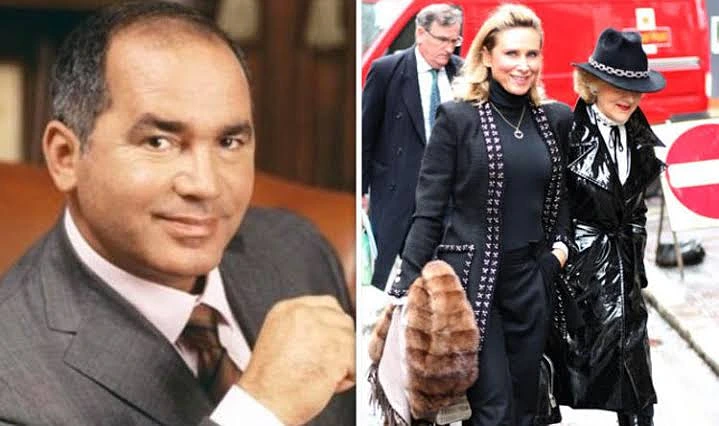
The biggest case of the lot is really the story of one boat. In December 2016 the High Court awarded Tatiana Akhmedova a record £453 million, which was 41.5% of the fortune of her ex-husband, the Russian oil and gas billionaire Farkhad Akhmedov. He responded by dismissing the ruling publicly as “toilet paper”, arguing the pair had already divorced in Russia decades earlier so London had no business dividing anything, and he paid barely £5 million of it, and not voluntarily.
So her lawyers went hunting, funded by the litigation firm Burford Capital in exchange for a slice of whatever they recovered, and the hunt kept landing on Luna, his 115 metre expedition superyacht, previously owned by Roman Abramovich, nine decks, two helipads, ten VIP rooms, a mini submarine and one of the largest swimming pools ever put on a boat. In February 2018 they persuaded the DIFC courts to freeze Luna at Port Rashid in Dubai, where she was sitting in dry dock for repairs. In March 2019 the Dubai Court of Appeal undid all of it, ruling the seizure invalid and the English order unenforceable there, and ordered the yacht released, after which his side turned around and filed an $85 million damages claim against Tatiana and Burford for wrongfully impounding the thing in the first place. A court in the Marshall Islands, where the ship was registered, later ruled on the ownership too, because by that point the divorce was being litigated on three continents over one boat.
- Do you know what her team’s first actual recovery was, out of a £453 million award? The yacht’s helicopter. Seized and sold for about €5 million.
The fight even consumed the couple’s son. Temur Akhmedov was accused by his own mother of moving money for his father, testified that he had personally lost more than $50 million day trading while a student, and in April 2021 a judge described him as a dishonest individual who would do anything to assist his father, ordering him to pay his mother over $100 million in three instalments, two in dollars and one in roubles. Three months later, in July 2021, the whole war finally ended when Akhmedov agreed to pay a settlement of roughly £135 million. After five years of freezing orders, seized helicopters and courtrooms from London to Dubai, she accepted less than a third of what the judge had originally awarded, which tells you what enforcement against a determined billionaire actually costs.
How They Actually Get Caught
Read the three stories together and the pattern is not clever lawyering, it is paper. A letter arriving at an old address. A lifestyle that never matched the sworn poverty, since the court heard Scot Young was eating at London’s best restaurants and driving a Ferrari during his supposed bankruptcy. Yachts sit on ship registries, companies sit on corporate filings, properties sit on deeds, and every one of those records was created the day the asset was acquired, long before anyone thought about hiding it. A
A 2024 study by America’s National Endowment for Financial Education found around four in ten adults admit hiding accounts or assets from a partner, so this is hardly a billionaires-only habit, and the checking instinct scales right down to ordinary life.
The maths of the whole genre is best summarised by Thomas Rossi’s ex-wife, who reached for an extra half and lost the entire thing. Judges can forgive almost anything in a divorce except being lied to on a signed form, and the records that catch the lie were filed years before, by the liars themselves.