

Blog
Why Most Ride-On Cars Don’t Actually Work for a One-Year-Old

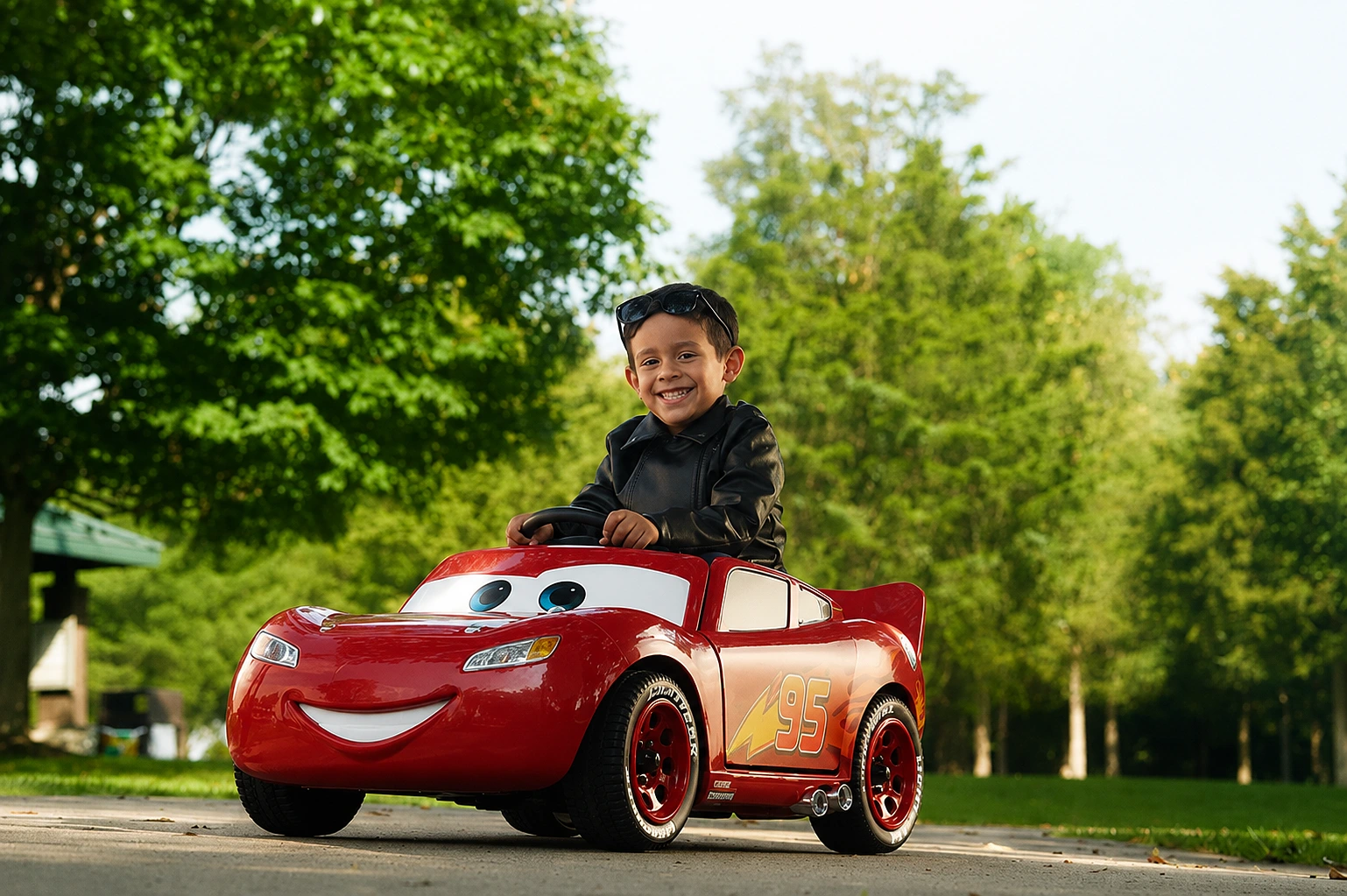
You’re looking for a first birthday gift and you’ve come up with a brilliant idea — an electric ride-on car — but think about it for more than thirty seconds and it falls apart. A one-year-old can’t steer. Most of them can’t reach a foot pedal. They don’t realise that pressing the button makes it move, and even if they did, they don’t have enough spatial awareness to avoid driving straight into the sofa leg.
The reality most of the time with most ride-on cars at this age is that the child sits in the car, gets a bit confused, perhaps presses something it shouldn’t, lurches forward half a metre, is frightened by the movement and cries. Then the parent pushes it around by hand for the next four months until the child is old enough to understand. Which is what most roundup articles don’t talk about, since they’re compiled from product listings and the authors have never seen a 12-month-old use one. This is a typical experience on parent forums, but it rarely features in buying guides.
Fortunately, there are ride-on toys that actually do work at this age. But you need to understand why most of them don’t before the ones that do become meaningful.
What a one-year-old can and can’t actually do with a ride-on
By 12 months, most children are in the transition from pulling up on furniture to taking their first wobbly steps. Fine motor skills are improving but not yet accurate. Gross motor skills are focused on standing and walking, not sitting and steering. Cause-and-effect understanding is simple — when they bang a spoon it makes a sound, but connecting a foot pedal to forward motion is a different kind of cognitive link.
Let’s look at how this translates to various ride-on types:
- Standard steering-wheel-and-pedal cars: the ones that resemble a mini Range Rover or Mercedes. These are not something a one-year-old can physically do. Their legs aren’t long enough to reach the pedal, and their arms don’t have the coordination to turn a steering wheel and accelerate at the same time. Spatial understanding of “left means left” comes later — most children don’t get this until they’re closer to two and a half. These cars are great for a two or three-year-old. For a first birthday, they’re basically a really costly garden ornament for the kid to sit in while you run the parental remote.
- Push-button single-speed cars: such as the Power Wheels toddler range and the Kid Trax quads. These are easier: the kid presses a button on the steering wheel or handlebar and the car starts to crawl forward at one and a half to two miles an hour. Better, because the control is one action rather than two, and the speed isn’t fast enough for anyone to get hurt. The Kid Trax quads in particular sit low, which keeps the centre of gravity down, and their rubber traction strip tyres won’t scratch floors indoors. But even a simple push-button is asking a 12-month-old to learn that press equals move and release equals stop, and some children get it the moment they play while others take months. There’s no way of knowing which one yours will be.
- Joystick-controlled spinners: and this is the category that actually makes sense for a one-year-old, because the joystick removes the steering problem entirely. Rather than “turn the wheel left to go left,” it’s “push the stick and the car spins.” The movement is circular rather than directional, the child doesn’t have to navigate around obstacles, and the spinning motion itself is the entertainment rather than the driving.
Why the Waltzer bumper car is the one that actually works at this age
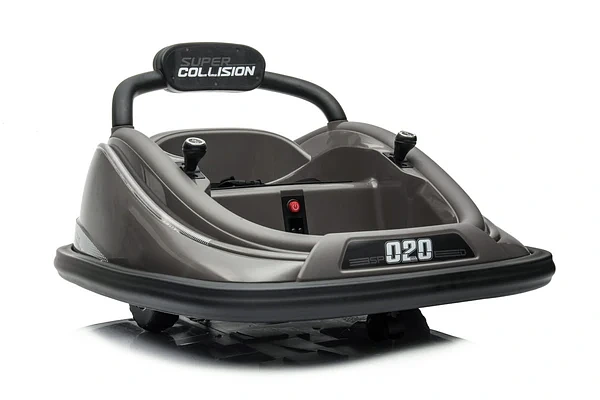
Unlike the traditional ride-on where the child has to pedal forward and back, the Bumper Kids Car from Electric Ride on Cars is built around 360-degree spinning, and that single design decision is what makes it work for a first birthday in a way conventional ride-ons can’t match.
Twin 20-watt motors on a 12V battery, joystick controls a one-year-old’s little hands can handle, and a fully enclosed base so their feet don’t drag on the floor. It’s worth noting that the retailer’s own listing puts the recommended age at two and over, which is in line with most motorised ride-ons, but it’s the parental remote that makes earlier supervised use realistic. You’re not leaving it for the child to drive themselves at 12 months — you’re strapping them in and driving it yourself until their coordination catches up. Most children begin to take over the joystick by about 18 months, and from there they’re self-sufficient fairly quickly.
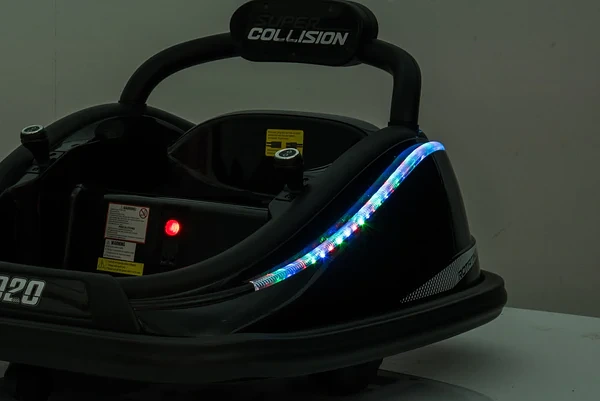
The most important feature at this age is the 2.4G parental remote. You drive, they ride. The child feels the movement, the lights, the music from the built-in MP3 player, the spinning, and you decide where it goes and how fast. For the first three to six months after you buy it, the remote is the product. The car is only the seat.
Two tidbits to know that won’t be mentioned in a regular product roundup:
The enclosed base means safe use on hard floors and carpets, preventing the child’s feet getting caught. That matters more than it sounds, because a lot of ride-ons made for outdoor use have an open base that’s fine on tarmac but becomes a problem in the house as soon as a toddler’s socked feet start to drag.
It comes with a feeding tray attachment. This sounds random until you’ve tried feeding a one-year-old that won’t sit still. The car becomes something like an entertainment highchair — strap them in, put the tray on, feed them on it, and they’re distracted enough by the lights and the spinning to actually eat. Parents who’ve used it talk about it a lot; nobody ever mentions it in the reviews.
The soft bumper shell around the outside won’t leave marks on furniture legs, walls, or the car. If you’re using it indoors — which at twelve months you almost certainly will be — that’s the difference between something that works in the living room and something that chips your skirting boards.
It comes in various colours, including a licensed Spidey version, and some models have a swing function in addition to the spin, which adds an extra movement axis that keeps it interesting for longer.
What about the other options
They’re not bad. They’re just designed for slightly older children — even when the marketing claims otherwise.
The Peg Perego John Deere Mini Tractor is beautifully made, well engineered in Italy, and uses a foot pedal accelerator at around one to one and a half miles an hour depending on the model. A lovely toy for an 18-month-old who can reach the pedal. There’s no parental remote on the standard Mini Tractor, so most twelve-month-olds can’t operate it and you’ll be pushing it by hand across the garden for the first six months anyway.
Power Wheels toddler models — the popular Lightning McQueen versions are often marketed for ages three to seven with more complex controls, but there are simpler toddler-oriented variants with push-button operation that are low to the ground, run at about 2 mph, and have automatic braking. The simpler versions are really robust. But the basic models don’t have a remote, so the child has to operate it themselves. Some one-year-olds get the hang of push-buttons like a pro early on. Others don’t. It’s a gamble at this age.
Kid Trax toddler quads top out at 1.5 mph with push-button handlebar controls, and they’re surprisingly good indoors on their rubber traction strip tyres. If your budget is tight and you mostly want an indoor toy, these are solid. The low saddle seat keeps them stable. No remote, though.
RiiRoo sell their own version of the waltzer-style spinner plus a range of licensed replica cars (Audi, Mercedes, Range Rover) with parental remotes and slow-start technology. The licensed cars look great in pictures. In practice, at twelve months, the child doesn’t mind whether it’s shaped like a Mercedes or a biscuit tin — they care about movement and lights. The waltzer spinner from RiiRoo works on the same principle as the Electric Ride on Cars version. The licensed cars are more suited to a child who can actually steer one, which is nearer to two.
The practical stuff nobody mentions in product roundups
- Charging. These take time to fully charge from flat — eight to twelve hours — and run for about forty-five minutes to an hour depending on usage and surface. If your child wants to ride it every day, you’re charging it every night. Budget that into your routine before buying.
- Storage. Even the smaller bumper cars take up real floor space. Take the measurement before ordering, since a lot of parents buy these and then find they don’t fit anywhere except the middle of the living room.
- Assembly. “Some self-assembly required” on every listing. In reality it takes about twenty to forty minutes with a screwdriver and the instructions, the quality of which varies. Do it the night before the birthday, not on the morning of.
- Surface matters. The bumper car’s enclosed base works on carpet, laminate, tile and short grass. Traditional ride-ons with open bases work best outdoors on tarmac and concrete. If your main use case is the living room, check the base design before you buy.
- Noise. The MP3 player, the LED lights and the motor all make noise. At 7 AM. On a Saturday. While you’re trying to sleep. The volume controls are usually on the car, not the remote. Worth knowing.
At twelve months, the honest advice is to buy something the child can enjoy being in right now, that grows into something they can operate independently over the next year. The waltzer bumper car does that better than anything else at this age, because the parent drives it from day one and the child gradually takes over the joystick as their motor skills develop. Most children will be spinning themselves by 18 months, but of course some are earlier and some later, and that’s true no matter how it’s designed. Always supervise closely at any age, use on flat surfaces, and check the specific model’s weight and age limits on the retailer’s page before ordering, because specs can vary from batch to batch. That transition from passive to active is what gives it genuine longevity, rather than being a toy that sits unused until they’re old enough to work the pedals.