

Blog
Why Some Rooms End Up Becoming the Heart of the Home

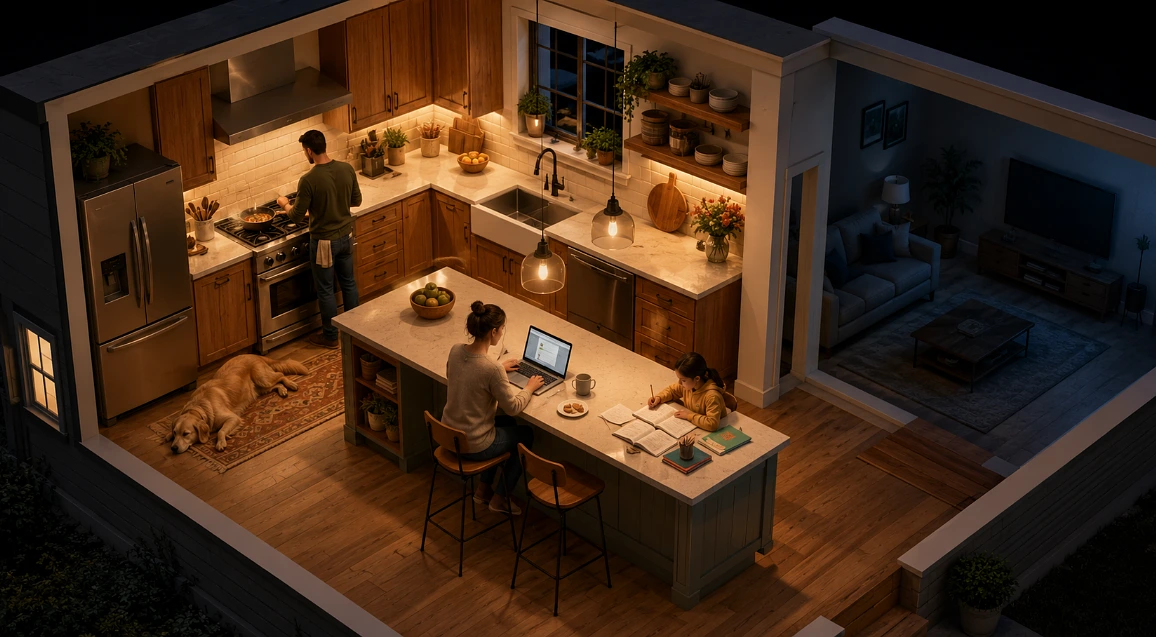
The room people spend the most time in is almost never the one that was designed to be the main room. Living rooms get the big sofa and the nice rug and the carefully chosen paint colour, and then everyone ends up standing in the kitchen for three hours at a party because that is where the food is and the counter gives you something to lean on while you talk.
And the numbers back up what the parties already tell you. A Houzz UK survey of more than 2,800 homeowners found people spend roughly 12% of their lives in the kitchen, somewhere around 2.8 hours a day, cooking, snacking, washing up, and opening the fridge for the tenth time hoping something new has appeared. It’s not really a cooking room anymore. It’s the room, and most of us treat it like one without ever admitting we’ve made that decision.
Why it is almost always the kitchen
Think about what a kitchen offers compared to every other room. Water. Surfaces. Food. Warmth from the hob. A reason to walk in several times a day whether you meant to or not.
A living room asks you to make a decision to go and sit in it. A kitchen just pulls you in, because you need a glass of water or a snack or you’re passing through on the way to somewhere else, and twenty minutes later you’re still at the counter talking about something that has nothing to do with food. That pull is the whole thing. Houzz’s own usage data shows it plainly: people overwhelmingly say cooking is the main reason they’re in there, but they also eat, bake, entertain and socialise in the same space, often without planning to.
Which is why renovating a kitchen tends to change how a whole home feels, not just how the kitchen looks. You’re not upgrading a cooking area. You’re upgrading the room your household actually lives in for most of the day, and the difference between one that works against you and one that works with you shows up in small ways constantly:
- Whether two people can be in there at once without performing a careful dance around each other.
- Whether there’s somewhere to sit and talk to whoever’s cooking without blocking the fridge.
- Whether the lighting lets you see what you’re doing after dark, or makes the whole place feel like an operating theatre.
What makes a room become “the room”
It isn’t size. Big rooms don’t automatically become gathering points. Some of the most-used rooms in homes are fairly small, and some of the largest sit empty most of the day, justifying their square footage to nobody.
The rooms that pull people in tend to share a few practical things, and none of them are about how the room looks.
- They give you several reasons to walk in. A room you enter for one purpose gets visited and left. A room with three or four reasons, food, a spot for the laptop, a window worth looking out of, the corner where the dog likes to sleep, accumulates people, because everyone has their own reason to be there and nobody planned it that way.
- They have decent natural light. People drift toward rooms where daylight comes in and quietly avoid the dim ones. It’s well established that natural light affects mood and alertness, and people gravitate toward it without consciously deciding to.
- They let more than one person use them at once. A room that only works for one person at a time stays a single-use space. The ones that become central are where someone can cook while someone else works at the counter while a kid does homework at the table. That overlap is what makes a room feel alive rather than just occupied.
- And they have something to lean on. Doesn’t have to be a chair. A wide worktop, a deep windowsill, a step between two levels. People need somewhere to land, even briefly, and rooms that offer a casual spot to perch end up hosting longer stays than rooms where you have to commit to sitting down properly.
The return you actually feel is the daily one
There’s a financial case here too, and it’s a strong one. The 2025 Cost vs Value Report, the long-running US remodelling study, puts the minor kitchen remodel at around 113% cost recovery, the highest of any interior project, up sharply from the year before. Even allowing that UK figures differ, the pattern holds across markets, and a Hamptons International survey found half of UK buyers said the kitchen is the single room that would make or break their decision on a property, well ahead of the living room. Do you know 37% of UK home buyers regret their property decision That’s 1 in 3.
But the return people actually feel isn’t the one at resale. It’s the daily one. The frustration of never having enough worktop goes away. The bottleneck where you couldn’t pass each other without someone flattening themselves against the fridge disappears. The single overhead light that blasted the same brightness at 7am and 10pm gets replaced with something that suits how the room is actually used at different times of day.
Small things on their own. Together they change how much time people want to spend in the room. And when the most-used room works better, everything attached to it works better too. Meals happen more often because cooking is less of a chore. People linger at the table after eating because the space is comfortable. Guests end up in the kitchen instead of the living room. Nobody ever says “let’s go and sit in the living room” when the kitchen is warm and bright and there’s still wine on the counter.
The improvements that actually matter
Not the dramatic ones. Better storage, so things have a home and the worktops stay clear. Layout changes, so two people can work without colliding. Enough sockets in the right places, so chargers and appliances don’t need extension leads draped across the counter. Lighting that behaves differently at breakfast than it does at dinner.
None of it photographs well. None of it makes a magazine spread. But it’s what people notice three times a day for the next ten years, which is exactly why it’s worth getting right. A good kitchen specialist, whether that’s a designer or a firm like Springfield Kitchen Remodelling, earns their fee on these unglamorous decisions far more than on the finishes, because getting the layout or the lighting wrong is a mistake you live with at breakfast, lunch and dinner.
Homes change because people change
A kitchen that worked for two people starts failing the moment a baby arrives and suddenly there’s a highchair to fit and bottles to store and things in the cupboard you didn’t know existed six months ago.
A layout that suited a couple who ate out most nights stops making sense the moment they start cooking at home and realise the hob’s on the wrong wall and there’s nowhere to put a chopping board without blocking the sink.
People don’t move every time their needs shift. They adapt. And the rooms that get adapted first are always the ones that matter most, the ones used eight times a day where every flaw is felt constantly and every imperfection is impossible to ignore. The guest bedroom stays exactly as it was for years. The kitchen gets reworked again, because it’s where life actually happens.
That pattern tells you which room is the heart of a home better than any survey can. It’s never the one that looks best in photos. It’s the one people keep coming back to fix.