

Blog
Stop Netting Leaves. Start Testing Chemistry – Easy Pool Care Habits for a Cleaner Summer

Most pool owners spend their summer cleaning the wrong things.
The skimming, the vacuuming, the daily floor sweep. All of it satisfying because you can see the result. Meanwhile the water itself is drifting somewhere it shouldn’t be, and by the third week of July a pool that looked fine on Tuesday is green on Saturday morning.
This catches almost everyone out the first season they own a pool.
The visible work and the important work are not the same work. Skimming leaves doesn’t keep a pool clean. Chemistry does. And chemistry is the part most home owners barely touch.
The Two Halves Of Pool Care
Pool maintenance splits in two.
There’s the physical side, which is just removing material from the water. Leaves, dust, hair, pollen, that fine layer of sediment that builds up on the floor. Repetitive work, mostly mindless, fixable with a skimmer and a brush.
Then there’s the chemistry. Chlorine in range (1 to 3 ppm for a residential pool), pH between 7.0 to 7.8, alkalinity around 80 to 120 ppm, and cyanuric acid somewhere between 30 and 50. These numbers move daily. Sometimes hourly in hot weather.
If the chemistry is right, the physical side is easy. Algae doesn’t grow. The water stays clear even when leaves fall in. Filters do their job.
If the chemistry is wrong, no amount of vacuuming saves you.
You can skim six times a day and still wake up to green water if the chlorine couldn’t hold through a sunny Friday afternoon.
Why Summer Is Where Pools Go Wrong
Sunlight degrades chlorine. UV splits the molecules apart, which is why a pool that tests at 2 ppm at 9am can read zero by 5pm if the stabiliser is too low.
Cyanuric acid extends chlorine’s half-life in sunlight from about 45 minutes to several hours. Almost every summer pool problem traces back to this single fact. People shock the pool again and again without realising the stabiliser is what’s actually missing.
Bather load matters too. Every person who gets in the pool brings sweat, sunscreen, body oils, a few grams of organic material. A pool used once a week by one adult is a different chemical environment than one used every weekend by a family of five and three of the kids’ friends.
The chlorine demand scales with use. Nobody adjusts for it.
Then weather. A week of rain dilutes everything and drags pH down. A heatwave with no rain evaporates water and concentrates the stabiliser, sometimes pushing it past 60 ppm, which is roughly where chlorine starts losing its effectiveness.
None of this gets fixed by netting more leaves.
Where A Robot Actually Earns Its Money
Once the chemistry side is sorted, the physical work is the obvious thing to automate.
A good pool cleaner doing the floor three times a week is functionally identical to you doing it three times a week, except it doesn’t get bored, doesn’t skip a session because you went away for a weekend, and doesn’t decide in mid-August that today is too hot to clean the pool.
The reason this matters more than people realise: settled debris on the floor isn’t just cosmetic. It’s eating your chlorine.
Every leaf decomposing on the bottom for two or three days is consuming sanitiser that should be doing other work. A floor that gets cleaned every other day stays sediment-free, which drops the chlorine demand, which keeps the chemistry steadier, which means less shocking and less correction.
The robot doesn’t replace you. It replaces the boring half of what you’d otherwise be doing. The judgement half is still yours.
Testing the water, reading what the strips or the digital meter tell you, deciding whether the pH needs nudging down half a point or the chlorine needs topping up: that part can’t be outsourced.
What A Sensible Weekly Routine Looks Like
Test water two or three times a week. Always after heavy use or a weather event.
Adjust pH and chlorine in small amounts. Big swings are how pools go out of balance.
Brush the walls and waterline once a week. There’s biofilm there that filters never catch.
Let the robot do the floor on its own schedule.
Skim the surface when it bothers you visually, which is more often than necessary but harmless.
Check the filter pressure weekly and clean or backwash when it’s risen 8 to 10 psi above where it sits clean.
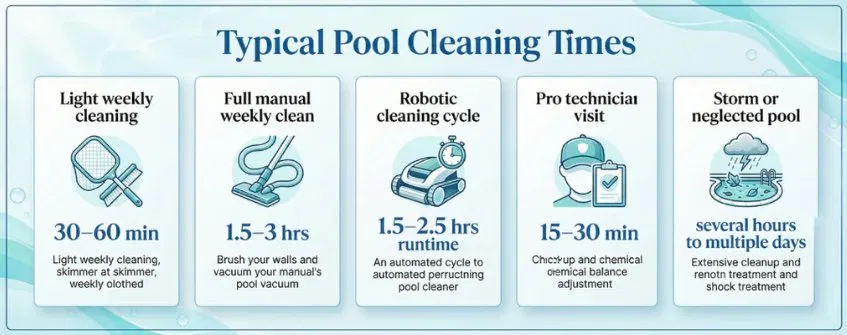
Hands-on time once everything is set up: roughly 20 minutes a week. Sometimes 30 if the weather’s been doing something dramatic.
The Habit That Separates Working Pools From Broken Ones
Test the water more often than feels necessary.
That’s most of it. Everything else follows from knowing what the water is actually doing on a given Tuesday afternoon, and the only way to know that is to test it.
The physical side can be largely automated now. Robots are good. They keep getting better. The chemistry side cannot be automated in any meaningful way for a home pool, because it requires you to look at numbers and make small decisions based on conditions that change every day.
Pools reward small, frequent attention to the things that matter and punish dramatic occasional attention to the things that don’t.
That’s what most pool owners learn the hard way around year three. The ones who figure it out in year one have a much better summer.