
Blog
Online School vs Homeschooling in the UK: What the Numbers Say Before You Choose

More families in the UK than ever before are withdrawing their children from normal education. In England, the number of children enrolled in optional home schooling increased from 111,700 in the previous year to 126,000 in the autumn 2025 census. Additionally, 175,900 children were home-educated at some point during the 2024–2025 school year. The Department for Education’s own breakdown shows that mental health is now the most frequently reported cause for a child’s withdrawal, accounting for 16% of cases where the reason was known. Previously, the reason was lifestyle or a family’s beliefs. It’s important to note that almost three out of ten cases had no explanation recorded, either because the parent failed to submit one or the local authority was unaware of it. As a result, the true situation is likely more complicated than the headline figure indicates.
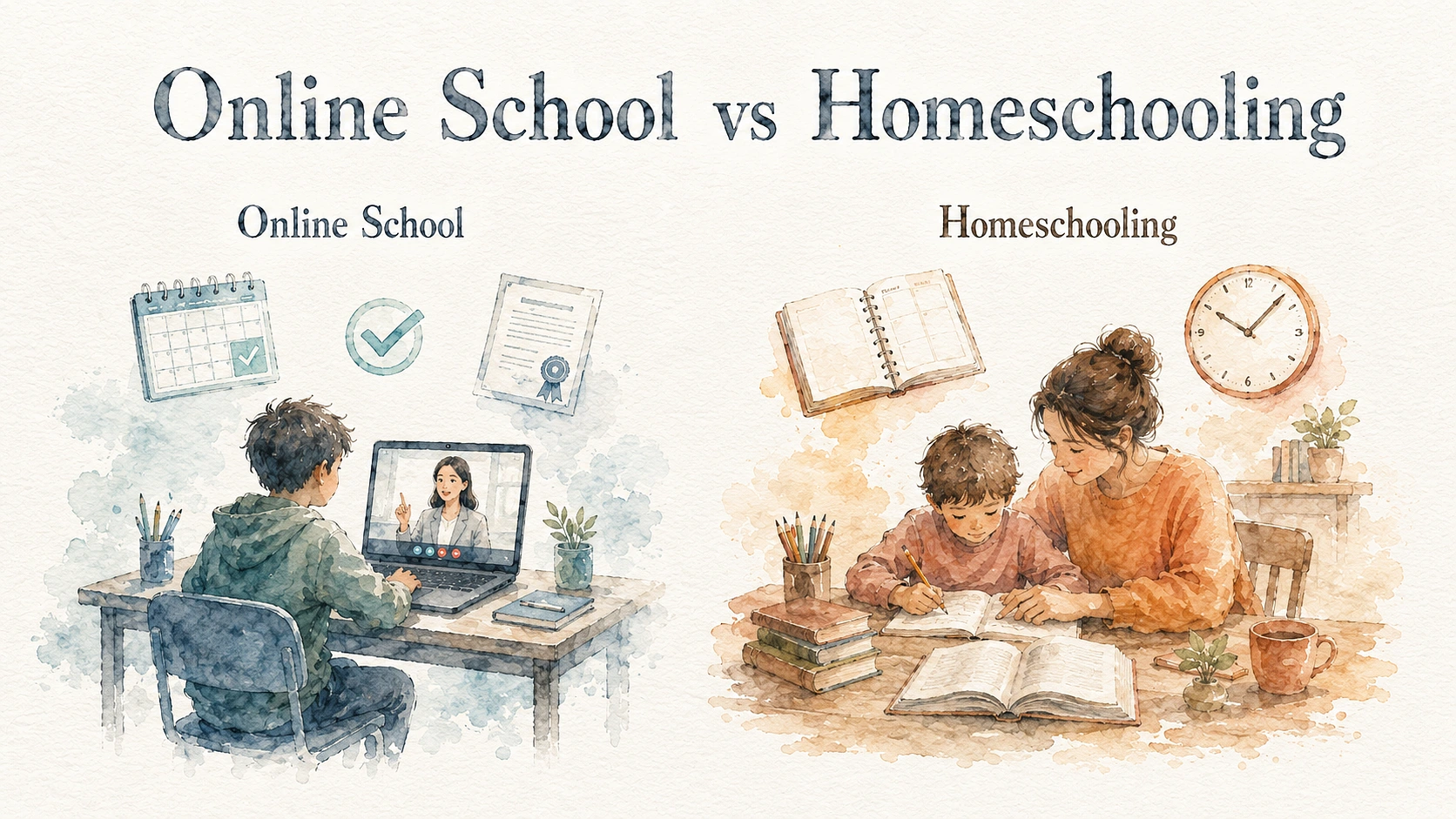
As a result, parents continue to ask the same question. Homeschooling or online education? Despite the fact that they are completely different, people frequently confuse the two. With a schedule, live teachers, and exam preparation, online learning is just like traditional schooling. In contrast, homeschooling gives you complete control over what is taught, when it is taught, and how it is taught. Almost everything that comes after it is altered by only one alteration. However, it’s important to note that many families combine the two, utilizing individual subject courses or structured online platforms inside what is officially a homeschooling environment. You can determine where your family truly falls on the spectrum by knowing the differences between the two in their complete forms, even though it’s not always a clear-cut either-or.
Here’s the quick version before the detail.
| Online school | Homeschooling | |
|---|---|---|
| Who teaches | Qualified teachers, live | You, the parent |
| Timetable | Fixed school day | Whatever you build |
| Pastoral support | Built in | You provide it |
| Exams | Entered for you | You sort it as a private candidate |
| Best for | Routine, teaching done for you | Full control, you can run it yourself |
Who actually does the teaching
This is the bit that decides what your day looks like. An online school runs to a set timetable with live lessons, qualified teachers, registers, the whole thing. Feels like a normal school week, just through a screen. Your kid logs on, the teacher teaches, the work gets marked. You’re not the one running it.
A few schools do this properly, primary right up to Sixth Form. Queen’s Online School is one, it’s part of the Cambridge Online Education Group and is a Pearson Approved Examination Centre, and it teaches the British curriculum live with classes kept deliberately small. So a child gets the same school day whether they’re in Surrey or sat in another country with decent wifi. For families who move around, that’s the whole point.
Homeschooling is the other thing entirely. The schedule is yours. You pick the material, bought curriculum or not. The child goes at whatever pace your family decides. No timetable unless you make one, and nobody checks the work but you.
So it splits like this. Routine, and someone else doing the teaching, that’s online school. Full control, and you’re comfortable running it yourself day to day, that’s homeschool.
How much live teaching you actually get
Contact hours matter, and that’s where problems get caught early. Online schools run live lessons every school day, every subject, so the feedback loop is there and then, and a teacher notices when something starts to slip. Your daughter goes quiet in maths for a week, someone sees it.
Homeschooling has no required hours, nobody watching the timetable. Government guidance on elective home education just says parents have to provide a “suitable” education. No set curriculum. No minimum hours. No checks on contact time. So unless you bring in tutors or pay for an online platform alongside, your child isn’t getting live teacher contact at all. That works perfectly well for some families. It’s a real gap for others.
The honest bit is the feedback. School setup, a slip gets caught in days. At home, if you’re not building your own check-ins deliberately, that gap can sit there for months before anybody notices it.
Class sizes and who’s watching out for your child
This one gets missed until it matters. A good online school keeps classes small, and the better ones assign a wellbeing mentor or safeguarding point in each class. A kid’s behaviour or mood shifts and it gets picked up fast, and you’ve got a named person to talk to rather than a helpline.
Matters more than it used to, given why kids are leaving mainstream school in the first place. Mental health is the most commonly reported reason now. So someone watching out for the child day to day isn’t a nice extra, it’s arguably the main job.
Homeschooling, you are the pastoral support. All of it. No group of other kids unless you set one up, no mentor, no second pair of eyes on your child’s wellbeing. Plenty of families do this really well, some brilliantly. But it sits on you, every bit of it, and you need the time and the headspace to carry it consistently.
The exam problem nobody warns you about
Here is where homeschooling trips families up, and it’s worth slowing down on, because this is the part that costs real money and catches people out.
Through an online school, exams just happen. The school enters your child with a recognised board, they sit their GCSEs or IGCSEs and A-levels, and universities accept them, sorted.
Homeschool and none of it is automatic. Your child sits exams as a “private candidate.” So you have to find an approved exam centre that accepts private candidates, you register them yourself, and you pay the full price, not the discounted rate a school gets.
What does that actually come to right now? Per GCSE or IGCSE, it’s roughly £120 to £380 once the exam board fee and the centre’s own charge are both on there. Sciences and languages tend to be dearer because of the practical and speaking components. DG College London, one of the better-known private candidate centres, currently charges £290 per standard subject and £380 for languages and combined sciences. Five subjects through a centre like that and you’re looking at somewhere between £1,200 and £1,900 depending on what’s being sat.
Then there’s the deadline problem. Miss the standard entry window and late fees are steep:
- Standard entry closes roughly two months before the exam
- Late entry fees at most centres add £60 to £200 per subject on top
- Some centres charge 50% more, some nearly double the standard rate
- Three subjects that would have cost £870 at standard entry can run past £1,400 if you leave it too late
A few things make this messier than it sounds. No centre is assigned to you, you go and find one that takes private candidates, and they are not everywhere. You pay months before the exam itself. Nobody chases the deadlines for you, miss one and that’s potentially a whole year gone.
All of it is doable. Loads of home-educated kids get outstanding grades this way, every year. But it takes early planning and money up front, and that’s the bit that catches out families who jumped into home education mid-year in a rush, which, given the mental health numbers driving recent withdrawals, is a lot of them.
Flexibility, and who each one really suits
Flexibility means different things to different families, so be clear with yourself about what you actually need.
Online school gives you freedom of place on a fixed routine. Lessons run on UK time, you can join from abroad, and some schools offer flexi arrangements alongside a mainstream place. So you keep the school structure but you’re not tied to one building. Good fit if you move countries, travel for work, or you just want the day to have a shape someone else holds.
Homeschooling is the other freedom entirely, control of the clock. No timetable to answer to. You build the whole day around your life, which is why it suits families with unusual routines, a lot of travel, or a child with medical or welfare needs that a fixed timetable just can’t bend around. The trade is that the structure is yours to make and hold. Every single day. Including the days you really don’t feel like it.
The choice comes down to what you can actually carry
Online school fits you if you want the teaching, the pastoral support, the exam pathway, all handled by someone else, and you’d rather not run the logistics yourself. If you’re leaning that way, sitting in on a taster lesson and checking exactly how the exam pathway works before you commit is the sensible next step, because that’s the part that’s hardest to fix later.
Homeschooling fits you if you want full control of the lot, and you’ve genuinely got the time, the money for exam entries, and the patience to manage the teaching and the admin yourself across years rather than weeks.
Both produce kids who get into university. Neither is the “better” one on paper, they just suit different families in different situations. The question isn’t really which one is right, it’s which one you can sustain.