

Blog
Spider Solitaire Has Been On Windows XP For 25 Years, And The Empty Column Is Still The Move Most Players Waste

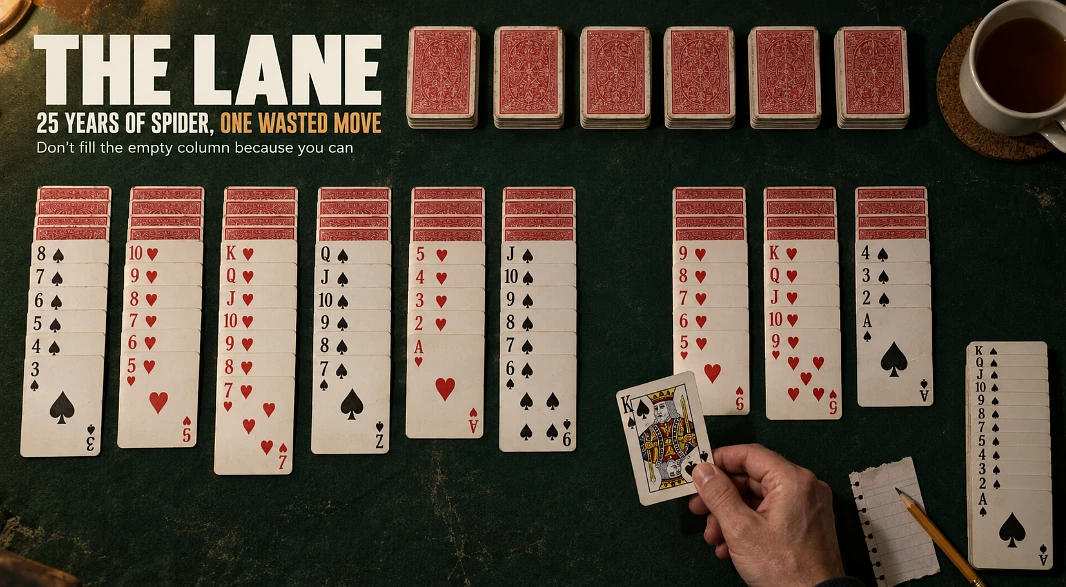
Last week, on 24 October, we put up a piece on why a neat Spider Solitaire column refuses to move, and if you read it you will know the suit rule now, so we are not going over that again. What we did not know when we wrote it was that Windows XP had a birthday coming. Windows XP went into the shops on 25 October 2001, with Spider sitting in the Games folder beside FreeCell, Hearts and Minesweeper, and that makes it twenty five years since most of Britain met the game on an office PC. Which got us thinking about what else people get wrong, because the suit rule is the one that stops you, but the move that loses the game is a quieter one. You get an empty column, and you fill it with the first thing that fits.
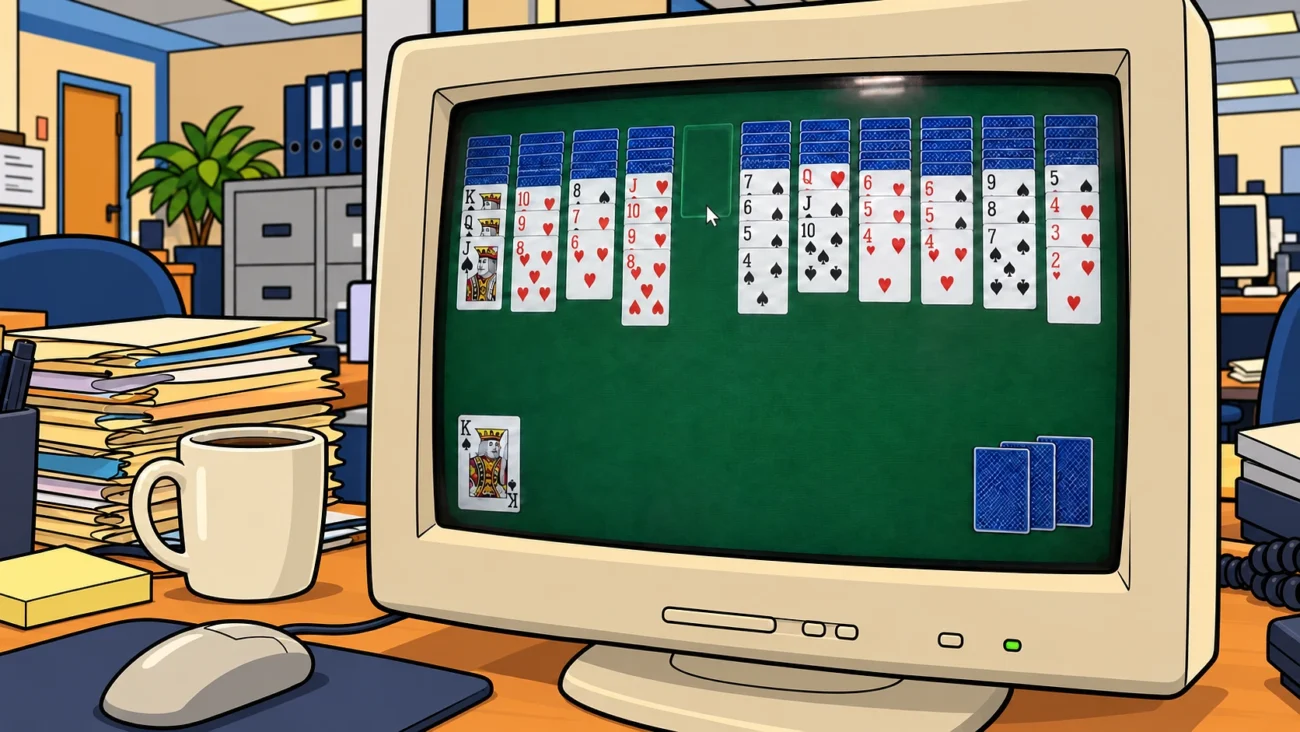
Have a game of two-suit Spider Solitaire open in the other tab as you read, as we did while writing, because an empty column on a real layout makes the point faster than we can.
London Launched Windows XP A Few Hours Before New York Did
Here is a thing we had forgotten until we looked it up. XP’s London launch came first in the day, on the morning of 25 October 2001 at the Royal Festival Hall, with Steve Ballmer doing the honours and telling the room it was “a better Windows than Windows”. Bill Gates did New York the same day, at the Marriott Marquis in Times Square, but with the clocks five hours behind, London had already finished by the time he started. Computing magazine and the Guardian both put the UK advertising spend at £10 million.
The game itself was older than XP by a few years. It came in the Plus! 98 add-on pack in June 1998, went into Windows Me in 2000, and XP took it as standard, so when an office replaced its old machines in 2002 or 2003 the building from top to bottom could get Spider in one go. Those versions also brought in the three levels, one suit for Beginner, two for Intermediate, four for Advanced, and the scoring anyone who played it at a desk can still tell you: you start on 500, lose a point for each move and each undo, gain 100 for each suit you clear, and the ceiling before a single move is taken off is 1,300. No one finishes on 1,300, because clearing 104 cards takes moves.
People Were Failing At This Game Before The War
Microsoft did not come up with Spider, though it did more for it than anyone. The layout we play today is in Morehead and Mott-Smith’s book of patience games from 1949, and a 1945 book by Albert Ostrow had a version with 50 cards. As for the name, the usual story is that eight foundation piles stand for a spider’s eight legs, and no one has found who said it first, so take it as we did.
A British writer had been losing at it long before 1949. Somerset Maugham, in The Gentleman in the Parlour in 1930: “But I knew seventeen varieties of patience. I tried the spider and never by any chance got it out.” Alphonse Moyse wrote in 1950 that its devotees “claim it as the king of all solitaires”, and George Hervey, in his 1977 Card Games for One, wanted to rename it Roosevelt’s Favourite after a magazine piece said the president played it of an evening. Of the three, Maugham is the one we recognise. He could not get it out, and when you look at why, the stock is where the trouble starts.
The Game Will Not Deal While A Column Stands Empty
This is the rule the 24 October piece left out. In Morehead and Mott-Smith, and in the Microsoft version, the ten new cards from the stock go out only when no column is empty. Try it. Leave one space open, click the stock, and nothing happens. So before any deal you have to fill the space, and whatever you put in it is what you are living with for the next ten cards.
The nasty version of this turns up late. Say you have cleared six suits, the layout is down to nine cards across ten columns, and there is one deal left in the stock. You cannot fill the tenth column because there is nothing spare to put there, you cannot deal because a space is open, and there the game sits with cards still to come. Michael Keller of Solitaire Laboratory has written this position up as one that can take a won game off you, which is a hard way to lose. Some programs offer a Relaxed Spider that lets you deal over a space, so look at the rules panel under the game you are playing before you count on it.
An Open Column Counts For More Than Any Run You Have Built
Older patience books had a word of their own for this. Lady Cadogan, in her Illustrated Games of Patience of 1874, writing about a different patience, called an empty column a lane, and her advice reads as if she had been watching over our shoulder: “As the success principally depends on the lanes, it is more prudent, when you have only one, not to refill it until by some fresh combination you can open out another one.” The strategy sites today take a page to say what she said in a line, and Abstract Games puts the sharpest point on it, that a lane is the only place a king can be moved out of the way, because a king goes on nothing else.
What a lane lets you do:
- Park a mixed run, the spade queen on hearts sort from last week, while you sort the suits out underneath it
- Take a king off a column of face-down cards, since a turned card is a card you can plan with
- Use it as a holding bay while you break up and rebuild a run the game would not let you lift in one go
- With two lanes, shuffle two runs past each other, and a second lane opens up far more rearrangements than the first
Count it on your own board if you doubt us. Take a mixed run you have and see how many times the lane has to empty and fill before it is rebuilt in suit, and if you drop the first king that turns up into that lane, all of that is gone. Keep the lane open, take the awkward move that keeps it open, and fill it when the move it buys you makes something better, not because you can.
One Suit Is The Practice Game And Four Suits Is The One Maugham Lost
Nothing changes in the layout between the levels. Ten columns, 54 cards out, 50 in the stock, whichever you pick. What changes is the lift rule, because with one suit each card is a spade and any run in rank order comes away in your hand, with two suits the join problem from last week arrives, and with four suits most columns are several runs stacked on each other.
The odds, from people who have counted them, and they are not all the same kind of count:
Four suits, played well, no peeking …….. about 1 game in 3 (Morehead and Mott-Smith, repeated by Michael Keller)
Two suits ………………………….. “well over 50%, perhaps even 75-80%”, Michael Keller’s informal guess
One suit …………………………… Keller wins about 95 per cent himself, and puts an expert nearer 99
PlaySolitaire’s own players, 2026 .. 60.1 per cent at one suit, 17.6 at two, 20.6 at four
Computer scientists at St Andrews ran the deals through a solver and found four-suit Spider winnable in about 98.5 per cent of them, provided the solver could see every hidden card from the start. One in three is what a person at a desk manages, and Keller’s modern estimate landing near the old one is some comfort, so the gap between the two is the game.
Undo Is Not Cheating, Whatever Anyone Told You At Work
Classic Microsoft Spider let you undo, a point off each time. The people who called it cheating had not read the old books, where a free move was called a grace or a merci and was written into the rules of some patiences. Spider with every card known is a puzzle, so the undo turns a guess into a look, and we will admit we lean on it more than we would at a card table. The games we get out are the ones where the undo showed us the face-down card the planned move would have buried.
Microsoft’s Solitaire Collection, with Spider as one of its five games, had 35 million people playing a month in 2020 and over 100 million hands a day. A good share of them are still trying to get the spider out, as Maugham was in 1930. Keep the lane open, and deal only when the game makes you.