

Blog
The Deciding Factor in an Online Engineering Master’s Isn’t Discipline, It’s Funding


Most coverage of going back for an engineering master’s frames it as a willpower problem: can you find fifteen hours a week alongside a full time job? That’s the wrong question to lead with. What actually determines whether a working engineer can do this, and on what terms, is who pays for it and what strings come attached. Sort that out and the rest is schedulable. Get it wrong and the discipline never gets a chance to matter.
So start with the money, in the order it actually works.
Start with the number the tax code caps, because it shapes everything else
Under US tax law, an employer can give you up to $5,250 a year in education assistance completely tax free. That money is excluded from your gross income and shouldn’t appear in your W-2 wages, which makes it worth noticeably more than the same figure paid as salary.
Why tax free beats a raise of the same size
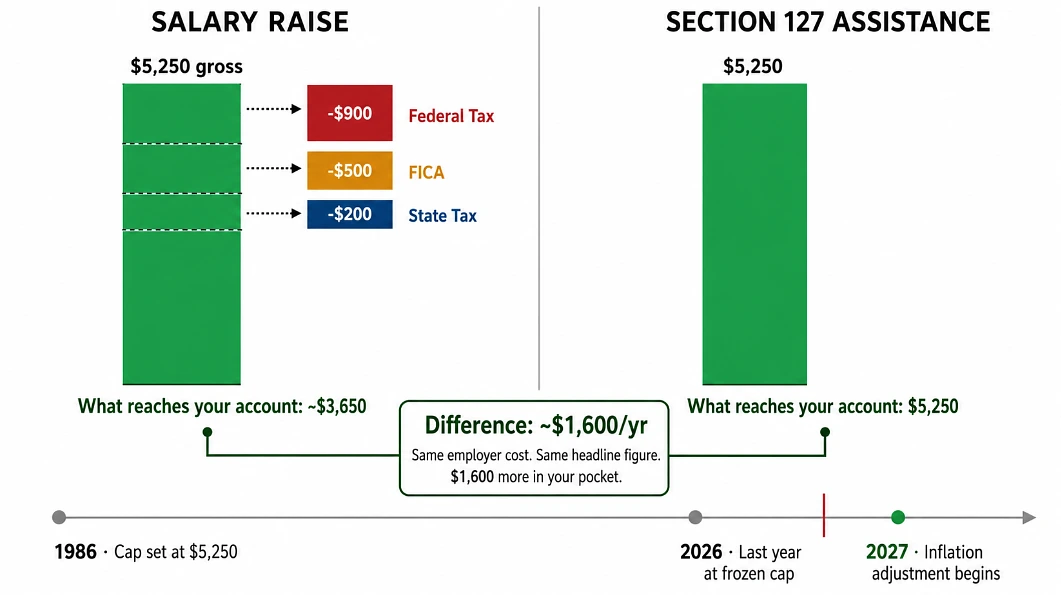
A raise gets taxed before it reaches you. On a $75,000 salary, a $5,250 raise nets roughly $3,650 after federal tax, FICA and state tax, while the same $5,250 in Section 127 assistance arrives whole. Same headline number, very different value.
Why 2026 is the last year of the frozen figure
Here’s the part almost no one writing about this seems to know. The $5,250 cap has been frozen since 1986. Under the One Big Beautiful Bill Act it holds at $5,250 for 2025 and 2026, then adjusts for inflation every year from 2027 onward. So if your employer funds study through the standard route, 2026 is the final year the cap sits at its forty year low before it finally starts climbing.
Aerospace and defence employers blow past that cap on purpose
Some engineering employers fund far beyond $5,250, and the aerospace and defence firms are the clearest example. Boeing’s Learning Together Programme carries no annual limit for eligible STEM degrees and certificates at partner schools, pays the institution directly rather than reimbursing you later, and starts on your hire date. Even outside that no cap STEM lane, the limits are high by US standards, up to $25,000 a year for graduate degrees and $15,000 for bachelor’s.
The reason isn’t generosity, it’s retention. These firms need engineers with advanced credentials and would rather grow them in house than bid for them on the open market. What that means in practice:
- No cap on qualifying STEM master’s at Boeing partner schools, with tuition paid upfront.
- Lockheed Martin and RTX run substantial programmes of their own, though Boeing’s no cap structure is the outlier.
- The benefit often starts immediately, so there’s no waiting period to clear before you enrol.
- For context, about 45% of employers offered tuition assistance in 2023 according to SHRM, yet the benefit stays heavily underused because people never check the portal.
The funding comes with a leash, so read the clawback first
Most employer funded study carries a service commitment, usually one to two years after you finish, with a repayment clause if you leave early. The arrangement is a retention tool as much as a development one. If you’re confident you’re staying put, it’s a non issue. If your next few years are uncertain, the terms of that clawback matter more than the size of the benefit, so read them before you accept a penny.
Only once the money is settled does the programme choice matter
Accreditation matters, but not every badge signals the same thing to employers. ABET accredits engineering at both bachelor’s and master’s level, though master’s accreditation is far less common, and the institutions that pursue it tend to serve sectors where rigour gets scrutinised.
In aerospace, defence and civil consultancy the name on the degree does real work, sometimes as much as the specialism itself. That’s where faculty depth and specialisation range start to count for more than the accreditation line alone, because programmes with faculty embedded in live industry partnerships tend to build coursework around current problems rather than dated textbook scenarios. The test is how quickly you can apply what you’re learning inside the projects you already manage, rather than parking it as theory for some future role.
What the two years actually demand each week
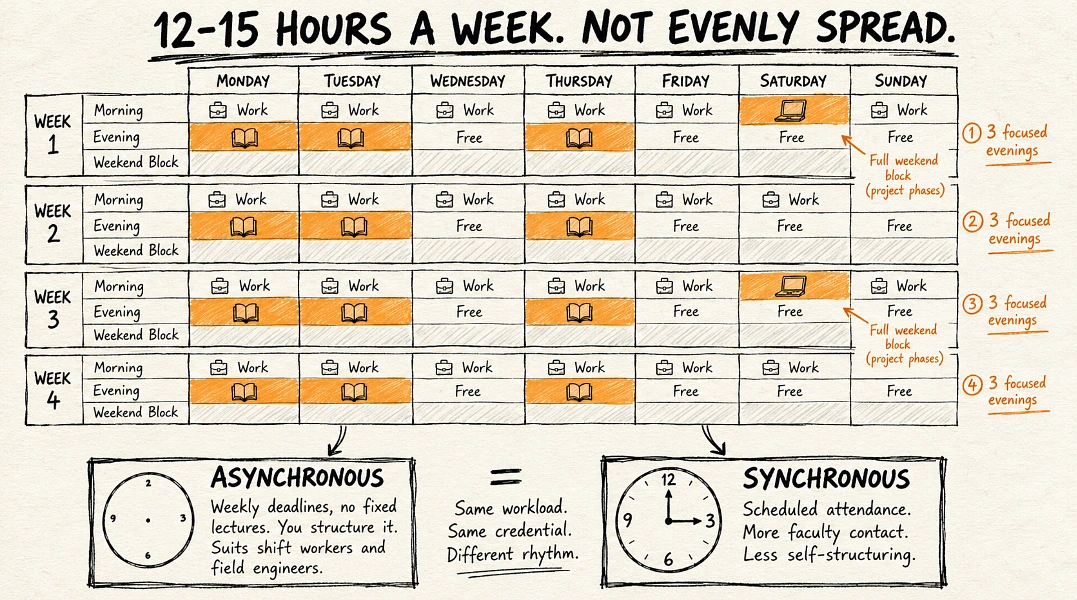
Expect roughly twelve to fifteen hours a week per module, heavier during design project phases and lighter through foundational coursework. It isn’t evenly spread. Some weeks need three focused evenings, others a full weekend block when your cohort is deep in a simulation or group presentation.
The format sets the rhythm. Asynchronous programmes give you weekly deadlines but no fixed lecture times, which suits shift workers and field engineers spread across time zones, at the cost of having to structure your own study without a timetable forcing the issue. Synchronous formats demand scheduled attendance but hand you more direct contact with faculty and peers. It isn’t a shortcut either way, and the credential holds weight precisely because the workload mirrors what residential students carry.
None of this is reason to romanticise going back. It will cost you evenings, collide with deadlines, and eat the occasional weekend you’d earmarked for nothing. But the engineers who finish tend to be the ones who settled the funding and its terms first, then treated the studying as the schedulable part. Work out who pays before you work out when you study, and the whole decision gets a great deal clearer.