

Blog
The Poles Are Going Home, and Britain Has Barely Noticed Its Biggest Migration Story Running in Reverse

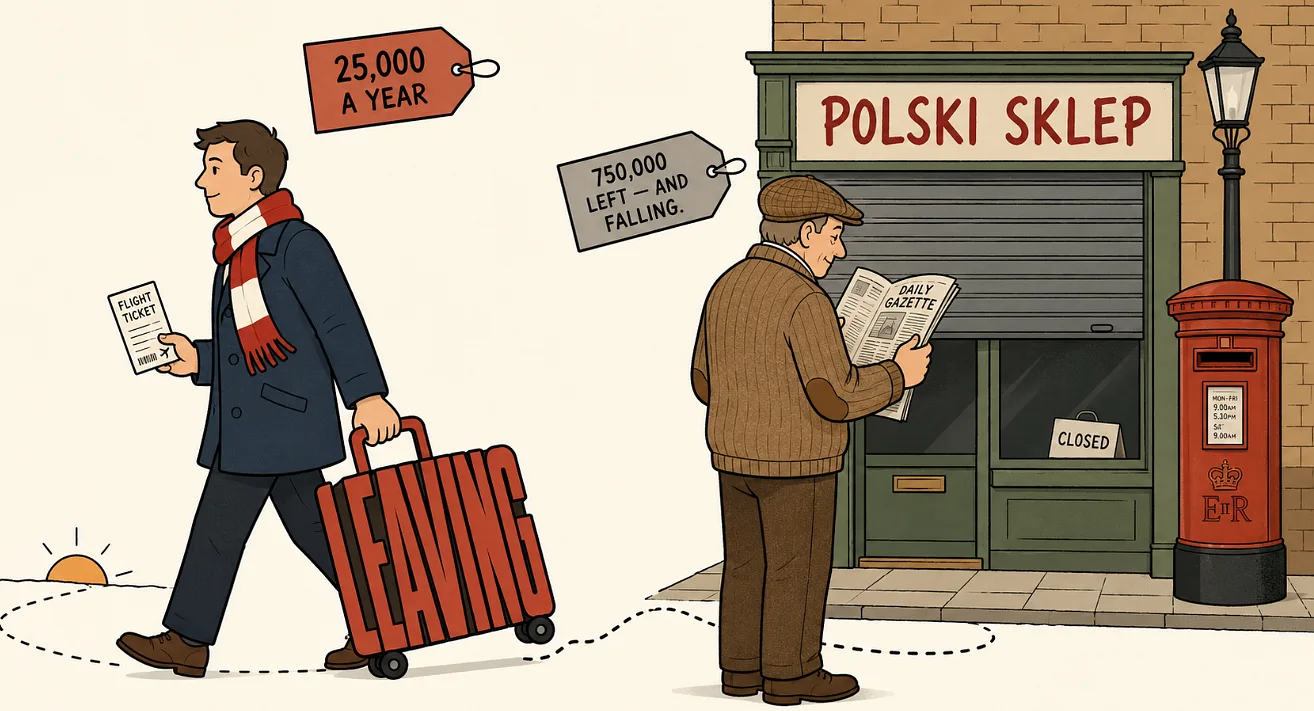
Every British town got its Polski Sklep somewhere in the 2000s, the little shop with the good bread and the unfamiliar sausages, and it arrived so quietly that most of us stopped seeing it within a year. That shop rode in on the biggest single migration wave modern Britain has known, and I am writing about it now because the wave has turned around, and hardly anyone here has clocked it.
And the numbers behind the turnaround are big ones. Poland has been the most common non-British nationality in the UK since 2007, and by 2017 more than a million Polish nationals lived here. The latest estimates put the community at roughly 750,000 and still falling, a decline of about a quarter from the peak according to the ONS record. Around 25,000 Poles have gone home each year for the past five years, and ever since the referendum the number leaving has been larger than the number arriving. Germany has overtaken Britain as the top destination for those who still emigrate at all.
Poland Is Pulling Them Home More Than Britain Is Pushing
The lazy reading is that Brexit chased them out, and Brexit certainly started clocks ticking on decisions people had postponed for years. But I really did wonder why the leaving sped up so much after 2021. So I went digging in the community’s own forums, and the answer coming back again and again was Poland itself, not anything Britain did. See the economics for yourself:
- Poland’s real GDP per capita has grown by nearly 18% since 2019, while Britain’s managed less than 1% over the same stretch.
- The European Commission is forecasting Polish growth of 3.5% for 2026, among the fastest in the EU.
- Unemployment in a city like Gdansk now sits below 3%.
- And in 2024 Poland recorded positive net migration for the first time in its modern story, more people arriving than leaving.
Reading those four lines together, hmm, I get it now, honestly. If my savings stretched further back home, if the cost of living here kept climbing while wages there kept rising, and if my parents were ageing a two hour flight away, I am not sure what would be holding me in a British flat share either. This same maths must have been done on a few hundred thousand kitchen tables since 2016. A former Polish prime minister stood on the Davos stage asking Britain, in so many words, to “give us our people back”, and the country is now getting exactly that.
The researchers who study this migration keep reaching the same finding. Professor Izabela Grabowska, who has tracked the community for years, puts it as leaving for the money and returning for the family, and the ONS interviews back her up, people going home to parents, to retirement, to children they want raised near grandparents, taking their British savings into an economy where those savings now stretch.
What the Returners Have Learned About the Boxes
I spent a while in the return migration forums for this piece and the same advice repeats everywhere, hard won and specific, so it is worth passing on, and it applies to a move in either direction.
The people who do it calmly sort by their first month, not by their old rooms. Work equipment, seasonal clothes for the arrival weather, documents and the chargers, those travel first, while the decorative life follows later in slower parcels. The veterans pack by category rather than stuffing gaps, they strip bulky retail packaging that protects nothing, and they refuse the classic mistake of a final catch all box of unrelated leftovers, because that box is the one that is miserable to declare at customs and worse to unpack. Nearly all of them keep a simple record, box, contents, date sent, tracking number, which matters enormously when belongings leave in stages weeks apart. And the ones moving through temporary accommodation double check the delivery address on every single label, since the flat you land in is rarely the flat you settle in.
The logistics industry has organised itself around exactly this staged pattern. Specialist carriers built for the diaspora, Meest among them, run shipping to Poland as an online process where each parcel is created, tracked and recorded separately, which suits a move that happens in waves rather than in one van. The forum consensus is blunt on the wider point though, whoever you ship with, the record keeping is yours to do, and the movers who treat it as boring paperwork are the ones posting lost box threads a month later.
- One number to hold onto from all of this: twenty five thousand people a year, for five straight years, each of them packing up a British life. That is a mid sized town’s worth of households boxed and shipped east annually, and it explains why the Polski Sklep near you may have quietly closed with no announcement at all.
Whether the stream slows depends on the two economies, and every comparison in this piece currently favours the eastern one. Poland is growing and calling its people home, while Britain watches a community it took for granted thin out year by year, and the plainest evidence of it is physical, taped up boxes labelled in two languages, heading for Gdansk.
The American Poles Show What the British Wave Never Became
I also really wanted to know why Britain’s Polish story is reversing when America’s never does, and the American comparison answers it.
Roughly nine million Americans claim Polish ancestry, and their wave was the old one, steamships and steel towns, Chicago building whole neighbourhoods around it. That diaspora is generations deep, American born, American rooted, and when someone from it relocates to Poland it is usually a retirement dream or a heritage project, one household at a time, often shipping a lifetime of possessions in one carefully planned move. Britain’s wave was completely different in kind. It came by coach and budget airline after 2004, it stayed first generation, its parents and its property and its pension logic all stayed in Poland, and a first generation wave can go home in a way a fourth generation one never will, which turned out to be most of the answer. The American Polish community produces a trickle of transatlantic moves every year. The British one is producing a steady homeward stream, and both of them end up solving the same very practical problem, which is how you move a household’s worth of belongings across borders without losing your mind or your documents.